
Overview:
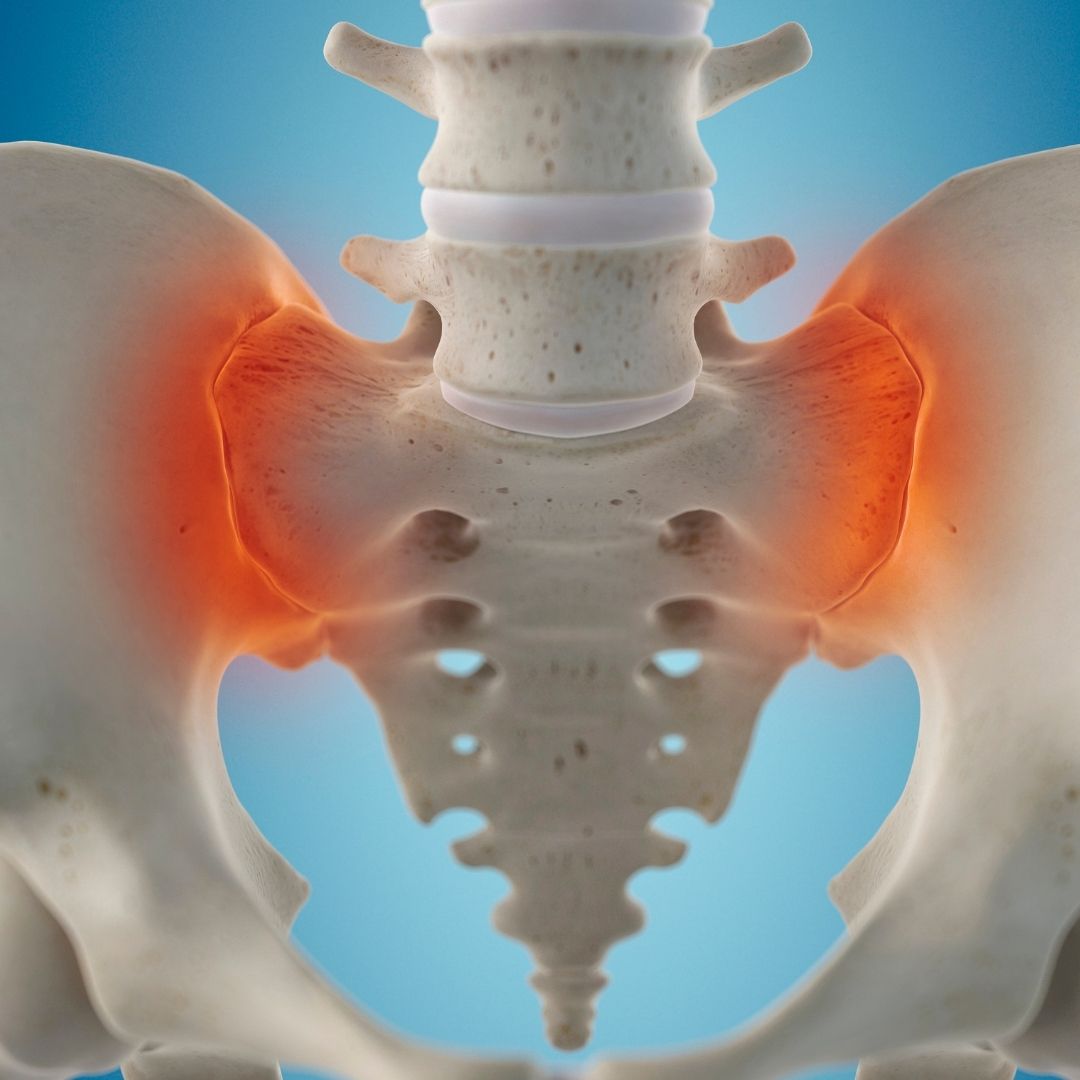
The sacroiliac joints sit either side of the base of your spine, where the sacrum meets the pelvis. They are small, strong joints that move very little, and their job is to transfer load between your upper body and your legs every time you stand, walk or lift. When one of them becomes irritated, the pain usually sits low and to one side, often described as a deep ache just below the belt line.
SI joint pain is commonly mistaken for lower back pain or sciatica, because the symptoms overlap and the area is small. Getting the source right matters, because the treatment for an irritated SI joint is different from the treatment for a disc or a nerve. That is what an assessment is for.
Our chiropractors and remedial massage therapists see this presentation across all seven clinics, in runners and lifters, in office workers, during pregnancy and after birth, and in people who simply cannot recall doing anything to bring it on.
Anatomy:
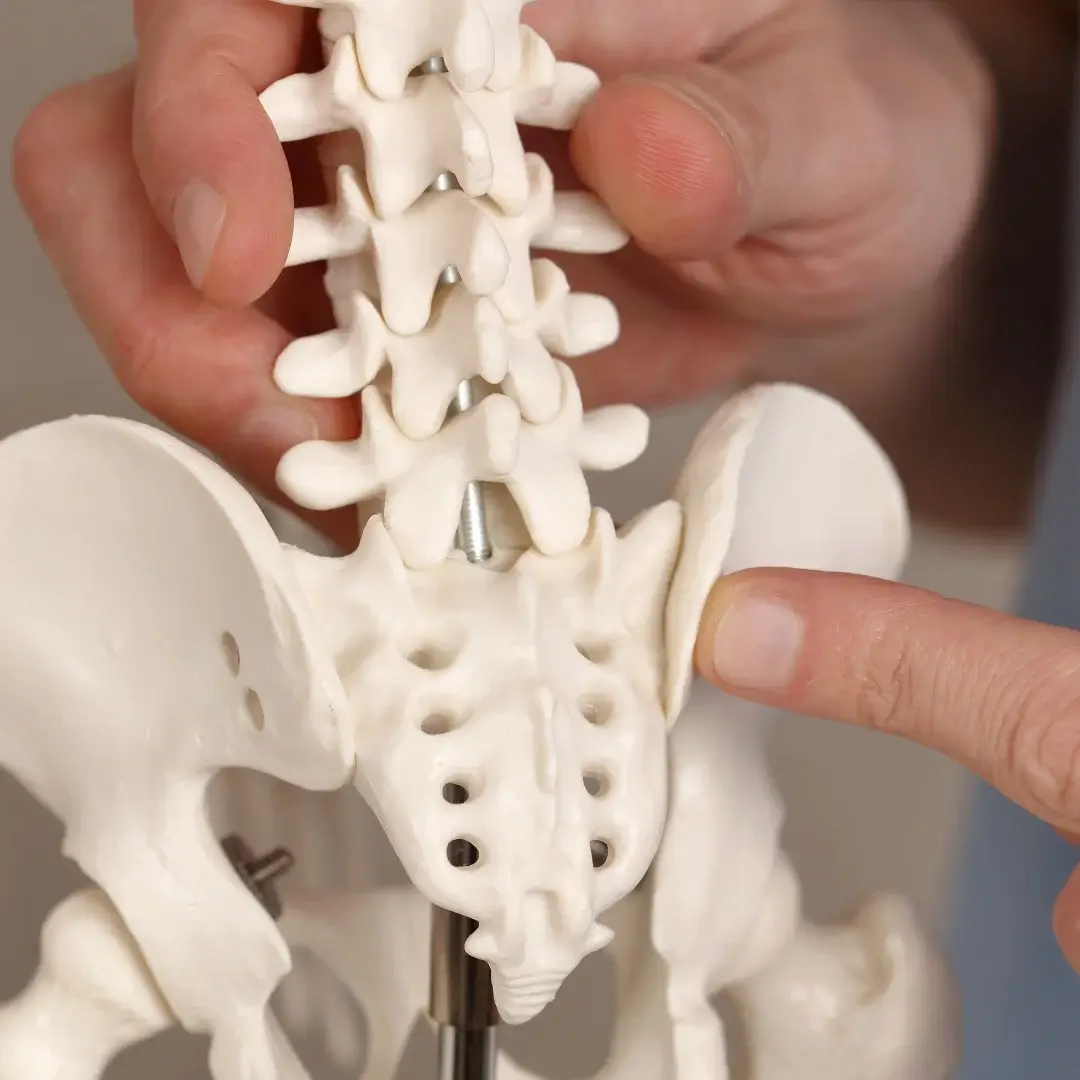
Each sacroiliac joint is a join between the sacrum, the triangular bone at the base of the spine, and the ilium, the large flared bone of the pelvis. The joint surfaces are rough and interlocking rather than smooth, which suits a joint built for stability rather than movement.
Very strong ligaments wrap the joint front and back and limit how far it can travel. Layered over them are the gluteal muscles, the deep hip rotators, the lower back extensors and the latissimus dorsi, all of which cross or attach near the joint. Because so much passes through a small area, tension or weakness elsewhere in the hip and trunk often shows up here first.
Total movement at the joint is measured in a few degrees. That is normal. The goal of treatment is rarely to create more movement, and much more often to restore even load sharing between the two sides.
Causes:
SI joint pain is usually a loading problem rather than an injury. Sustained asymmetry is the common thread: standing on one leg, sitting with a wallet in one pocket, carrying a child on one hip, or running the same camber of road every day. Sudden onset does happen, most often through a fall onto one buttock, a missed step off a kerb, or a heavy lift with a twist.
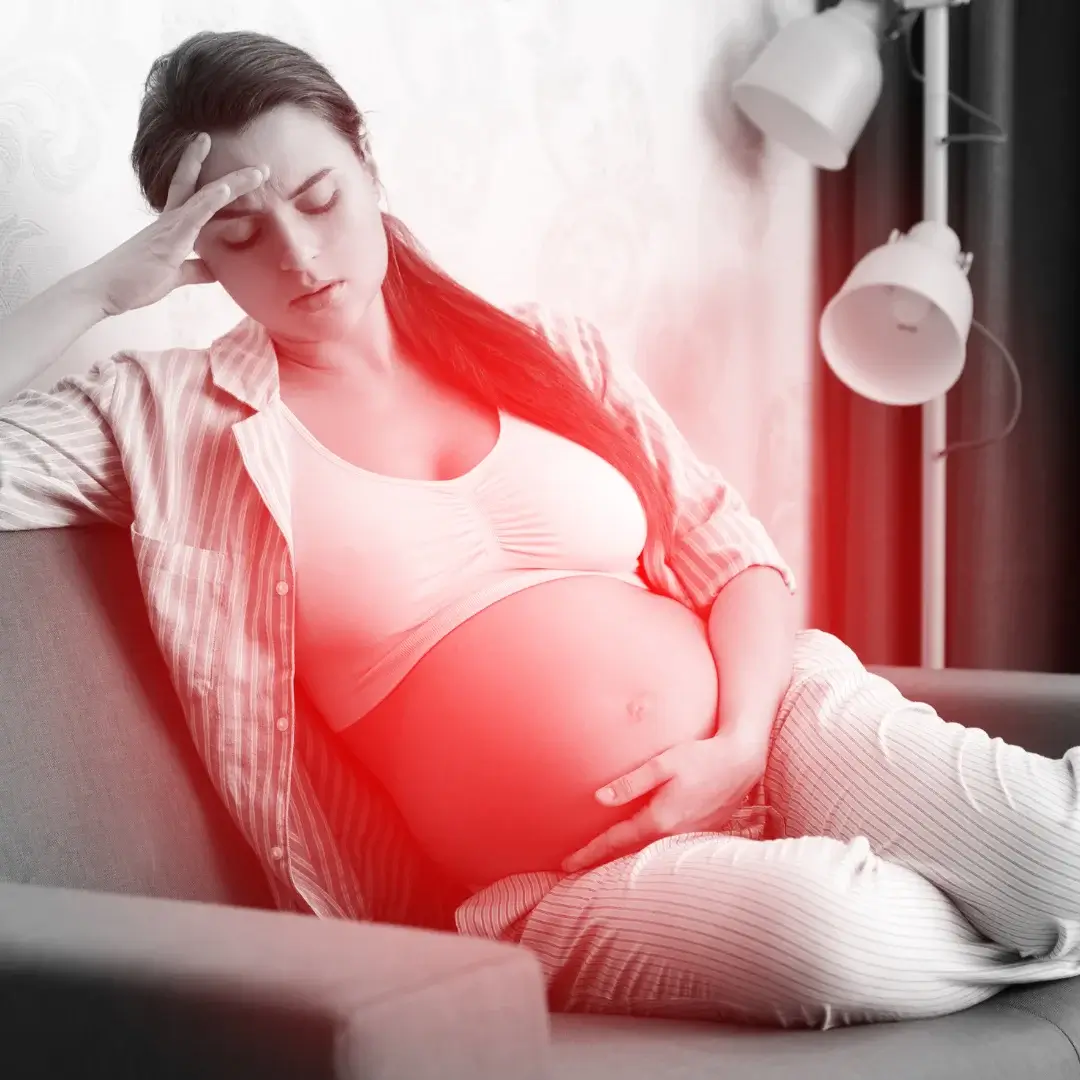
Pregnancy and the postpartum period are a separate and very common pathway. Hormonal changes increase ligament laxity while the load through the pelvis rises, which is a combination the joint is not built for.
Related presentations we see and treat:
SI joint dysfunction. Where the joint is not sharing load evenly with the other side and becomes irritable under sustained standing or single leg activities. Assessment focuses on how the pelvis behaves under load rather than on the joint in isolation.
Pregnancy and postpartum SI joint pain. Ligament laxity and changing load through the pelvis make this one of the more common musculoskeletal complaints in pregnancy. Care is adjusted for each trimester and for the postpartum period.
Contributing factors that show up repeatedly in assessment include weak gluteal muscles, restricted hip movement on one side, a stiff thoracic spine that pushes extra rotation down into the pelvis, and a leg length difference that has never been an issue until load increased.
Symptoms:
The classic pattern is a one sided ache low in the back, close to the dimple above the buttock. Many people can point to it with one finger. It often worsens with standing still, sitting for long periods, rolling over in bed, climbing stairs, or getting in and out of a car.
Pain can refer into the buttock, the groin and the back of the thigh. Referral below the knee is less typical and points the assessment in a different direction.
Some people also report a sense of instability, or a feeling that the pelvis needs to click. Others notice it most on the first few steps after sitting, easing once they get moving.
Diagnosis and Tests:
Diagnosis is clinical. No single test confirms SI joint pain on its own, so we use a cluster of provocation tests together and read them alongside your history and how the area behaves under load.
The assessment also looks upstream and downstream: hip range, gluteal strength, thoracic mobility and how you transfer weight from one leg to the other. That is usually where the reason for the irritation sits.
Imaging is not routinely required and rarely changes the plan. It becomes relevant where there has been significant trauma, where inflammatory conditions are being considered, or where symptoms are not responding as expected.
Treatment:
Treatment has two halves that run together. The first settles the irritated joint so that daily activity becomes tolerable. The second addresses why the joint was carrying uneven load in the first place, which is the part that tends to hold.
Hands on care may include joint mobilisation, soft tissue work through the gluteals and deep hip rotators, and dry needling where indicated. Techniques are chosen for your presentation, and modified during pregnancy.
Advice on positioning matters more here than in many other presentations. Small changes to how you stand, sit, sleep and get in and out of a car often make a noticeable difference within the first week or two.
Rehabilitation:
Gluteal loading is the mainstay. The gluteus medius and maximus control the pelvis in single leg positions, which is exactly when the SI joint is asked to do the most work.
A typical progression starts with side lying and bridging work, moves to split stance and step ups, and finishes with loaded single leg tasks that resemble whatever you want to get back to. Hip mobility and thoracic rotation are often worked alongside it.
Programs are set to your presentation and reviewed as you progress. Consistency over several weeks matters more than intensity in any one session.
What our practitioners recommend:
These are the items our practitioners most often suggest for SI joint pain between appointments. They support your rehabilitation. They do not replace assessment, and what suits you depends on your presentation.
- Swiss ball. Used for pelvic and trunk control work.
- Lumbar support belt. A pelvic or lumbar belt is sometimes used for specific activities during a more irritable period.
- Latex loop bands, pack of 5. Glute loading is a standard part of SI joint management.
As an Amazon Associate I earn from qualifying purchases. We may earn a commission on these links. Our recommendations are based on clinical judgement and are not influenced by commission.
Prevention:
Vary your positions. Long periods of standing still or sitting in one posture are the most common daily aggravators, and simply changing position more often helps.
Keep the gluteals strong and the hips moving, especially if your work or sport is one sided. Build training load gradually rather than in jumps, and be deliberate about recovery when volume increases.
If you have had SI joint pain before, keep a short maintenance routine going once symptoms settle. Stopping entirely is the most common reason it returns.
Outlook/Prognosis:
Most people with SI joint pain improve with conservative care. Many notice a change in the first few weeks, with the strengthening side of the program continuing beyond that.
Pregnancy related SI joint pain often settles substantially after birth, though the postpartum period brings its own loading demands and is worth managing rather than waiting out.
Recurrence is common where the underlying loading pattern is not addressed, which is the reason the rehabilitation side matters as much as the hands on side.
When to seek help sooner:
- Pain following a significant fall or accident.
- Numbness, pins and needles or weakness in the leg, or symptoms below the knee.
- Any change in bladder or bowel control. This needs urgent medical assessment.
- Night pain that wakes you, unexplained weight loss, or fever alongside the pain.
- Morning stiffness lasting more than an hour, or joint pain elsewhere in the body.
- Pain that is not settling after several weeks of sensible self management.
Common questions:
Is my pelvis out of alignment? The joint moves only a few degrees, so it is not slipping in and out of place. What we assess is how evenly the two sides share load, which is a more useful question and a treatable one.
Do I need a scan? Usually not. Imaging is considered where there has been trauma, where an inflammatory cause is being ruled out, or where progress is slower than expected.
Can I keep exercising? Generally yes, with modification. Most people do better continuing to move within a tolerable range than resting completely.
Is it safe during pregnancy? Yes. Techniques and positioning are adjusted for each trimester, and our Bella Vista clinic focuses on women’s and children’s care.
Do I need a referral? No. You can book directly, and HICAPS claiming is available on the spot for eligible health funds.
Book at your nearest clinic
Booking online takes under a minute. No referral needed, and HICAPS on-the-spot claiming is available at every clinic for eligible health funds.
- Book Wahroonga. Chiropractic and remedial massage.
- Book St Leonards. Chiropractic and physiotherapy.
- Book Bella Vista. Women’s and children’s care, remedial massage.
- Book Macquarie Park. Multilingual consultations available.
- Book Sydney CBD. Early and lunchtime appointments.
- Book Brookvale. Inside Sky PT gym.
- Book Willoughby. Satellite location.
Every practitioner is university-qualified and AHPRA-registered. Between them, our team has delivered more than 195,000 treatments.