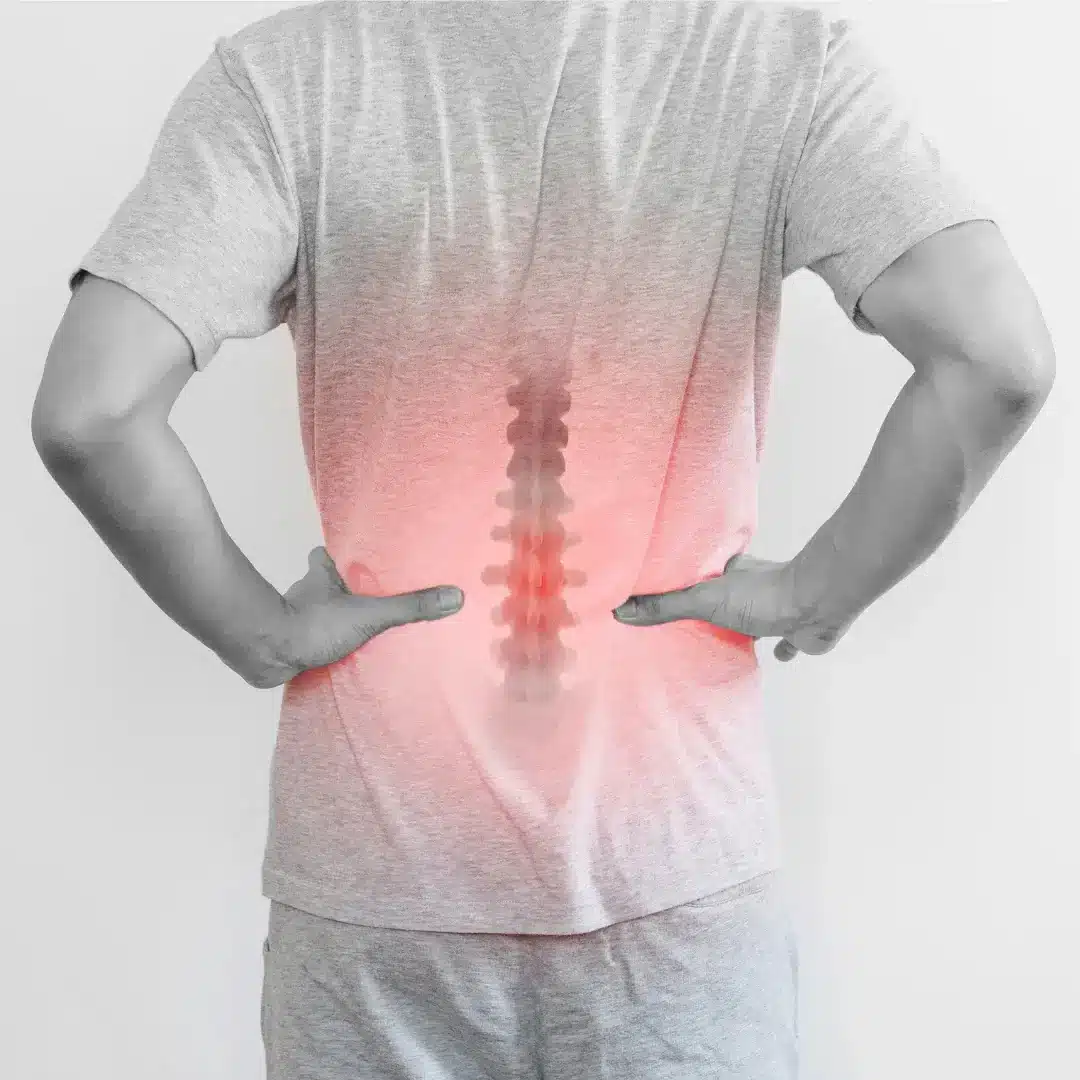

Overview:
The thoracic spine is the middle section of your back, running from the base of the neck to the bottom of the ribcage. Twelve vertebrae sit here, each one joined to a pair of ribs. It is the least mobile part of the spine and the most structurally supported, which is why serious injury here is uncommon and why stiffness is the far more usual complaint.
Most thoracic pain we see is not the result of an accident. It builds gradually in people who spend long hours at a desk, in a car or over a phone, and it is often described as a tight band across the shoulder blades or a sharp catch with a deep breath or a twist.
Because the ribs attach here, thoracic problems can produce symptoms that feel like they belong somewhere else, including around the front of the chest. Chest pain always deserves proper assessment rather than assumption.
Anatomy:
Each thoracic vertebra joins the one above and below through a pair of facet joints, and joins its ribs through two further sets of joints. That gives roughly a hundred small joints between the neck and the lower back, all of which need to move a little for the region to move well.
The facet joints here are angled to favour rotation and limit bending, which is why the thoracic spine is where most of your trunk twisting happens. Above it, the neck is built for mobility. Below it, the lumbar spine is built for load. When the middle section stiffens, those neighbours tend to take up the slack.
The muscles of the upper back, the rotator cuff and the muscles that control the shoulder blade all attach across this region, which is why thoracic stiffness and shoulder complaints so often turn up together.
Causes:
Sustained posture is the dominant cause. Long periods in a flexed position load the joints and muscles of the middle back in a way they are not designed to hold, and the region gradually loses extension and rotation.
Sudden onset does occur, usually through an awkward twist, a heavy lift, a cough or sneeze at an unfortunate moment, or sleeping in an unusual position. These tend to involve a rib joint rather than the spine itself.
Related presentations we see and treat:
Mid back pain. The general presentation of ache and tightness between the shoulder blades, most often linked to desk work and sustained sitting. Treatment usually pairs hands on mobility work with a change to the daily set up.
Rib joint pain. A sharper, more localised pain where a rib meets the spine, often noticed with a deep breath, a cough or a twist. It settles well with treatment but is uncomfortable enough that people usually seek help quickly.
Rib out. The common name for the same rib joint irritation, describing the feeling rather than what is actually happening. Nothing has moved out of place, and the assessment looks at the joint and the muscles around it.
Contributing factors include a workstation that is too low or too far away, carrying a single strap bag on the same shoulder every day, a training program heavy in pressing and light in pulling, and reduced shoulder movement that forces the middle back to compensate.
Symptoms:
Most people describe an ache or tightness between or just below the shoulder blades, worse late in the day and worse after long sitting. Others describe a sharp, catching pain in one spot that arrives with a particular movement or a deep breath.
Symptoms can wrap around the ribcage following the line of a rib, and occasionally reach the front of the chest. Stiffness on waking is common, as is a strong urge to stretch or have the area clicked.
Reduced ability to turn, difficulty taking a full breath because of pain, and discomfort reaching overhead are all frequently reported.
Diagnosis and Tests:
Assessment is clinical. We look at how each segment moves, where the movement is restricted, and which specific joint reproduces your symptoms when tested.
Because this region sits between two more mobile areas, the assessment also examines the neck, the shoulders and the lower back. Thoracic stiffness commonly presents as a neck or shoulder complaint, and treating only the painful area misses the reason.
Imaging is not routinely needed. It is considered after significant trauma, where there are risk factors for reduced bone density, or where the presentation does not fit a mechanical pattern. Chest symptoms are always screened before treatment begins.
Treatment:
Restoring movement is the priority. Hands on care may include joint mobilisation, manipulation where appropriate, soft tissue work through the upper back and around the shoulder blade, and dry needling where indicated.
Rib joint presentations often respond quickly, which is a relief for people who arrive unable to take a full breath comfortably. The middle back as a whole usually needs a longer run of work because the stiffness has built over months or years.
The daily set up is treated as part of the plan, not an afterthought. Where desk work is the driver, changing the desk is more useful than treating around it.
Rehabilitation:
Extension and rotation are the two movements most often lost, and both are trainable at home. Foam roller extension work over the middle back is the most commonly prescribed exercise in this region.
Alongside that, we load the muscles that control the shoulder blade, since a middle back that cannot hold a position under load will keep drifting back to the posture that caused the problem.
Short and frequent works better than long and occasional here. A few minutes several times a day, particularly through a working day, tends to hold better than one longer session.
What our practitioners recommend:
These are the items our practitioners most often suggest for thoracic spine pain between appointments. They support your rehabilitation. They do not replace assessment, and what suits you depends on your presentation.
- Foam roller. Used for thoracic extension mobility work, which is the most commonly prescribed home exercise for this region.
- Posture support brace. A short term postural cue used alongside the strengthening work.
- Ergonomic office chair. Desk set up is the daily driver for most thoracic presentations in office based patients.
- Ergonomic backpack. A pack that loads both shoulders evenly rather than one.
As an Amazon Associate I earn from qualifying purchases. We may earn a commission on these links. Our recommendations are based on clinical judgement and are not influenced by commission.
Prevention:
Move often. No sitting position is good for hours at a time, so the useful habit is changing position regularly rather than finding one perfect posture.
Set the desk up so the screen is at eye height and the keyboard is close enough that you are not reaching. Carry bags on both shoulders. Balance pressing work with pulling work in the gym.
Keep a short mobility routine going once symptoms settle, especially if your work is seated. This region stiffens again quickly when the routine stops.
Outlook/Prognosis:
The outlook is good. Rib joint irritation often settles within a couple of weeks, and general thoracic stiffness usually improves steadily over several weeks of combined treatment and home work.
Recurrence is common where the daily set up does not change, which is why that part of the plan carries as much weight as the treatment itself.
Where symptoms do not follow a mechanical pattern, or do not respond as expected, we reassess and refer for further investigation rather than continuing to treat.
When to seek help sooner:
- Chest pain, shortness of breath, sweating or pain into the jaw or left arm. Call 000. These symptoms need emergency assessment, not a clinic appointment.
- Pain following a significant fall, accident or direct blow to the back.
- Numbness, pins and needles or weakness in the legs, or unsteadiness walking.
- Any change in bladder or bowel control. This needs urgent medical assessment.
- Night pain that wakes you, unexplained weight loss, or fever.
- A history of osteoporosis, cancer or long term steroid use alongside new back pain.
Common questions:
Is my rib actually out? No. The name describes the sensation rather than the anatomy. The joint where the rib meets the spine has become irritated and stiff, which is treatable and generally settles well.
Why does it hurt to breathe? The ribs move with every breath, so an irritated rib joint is loaded around a hundred times a minute. That is also why it tends to feel worse than the injury actually is.
Should I keep stretching it? Gentle movement usually helps. Repeatedly forcing the area to click tends to feel good briefly and change little, so we would rather build the movement properly.
Is my posture the cause? Sustained positions matter more than any one posture. The practical fix is moving more often and setting the desk up so the position is easier to hold.
Do I need a referral? No. You can book directly, and HICAPS claiming is available on the spot for eligible health funds.
Book at your nearest clinic
Booking online takes under a minute. No referral needed, and HICAPS on-the-spot claiming is available at every clinic for eligible health funds.
- Book Wahroonga. Chiropractic and remedial massage.
- Book St Leonards. Chiropractic and physiotherapy.
- Book Bella Vista. Women’s and children’s care, remedial massage.
- Book Macquarie Park. Multilingual consultations available.
- Book Sydney CBD. Early and lunchtime appointments.
- Book Brookvale. Inside Sky PT gym.
- Book Willoughby. Satellite location.
Every practitioner is university-qualified and AHPRA-registered. Between them, our team has delivered more than 195,000 treatments.