
Overview:
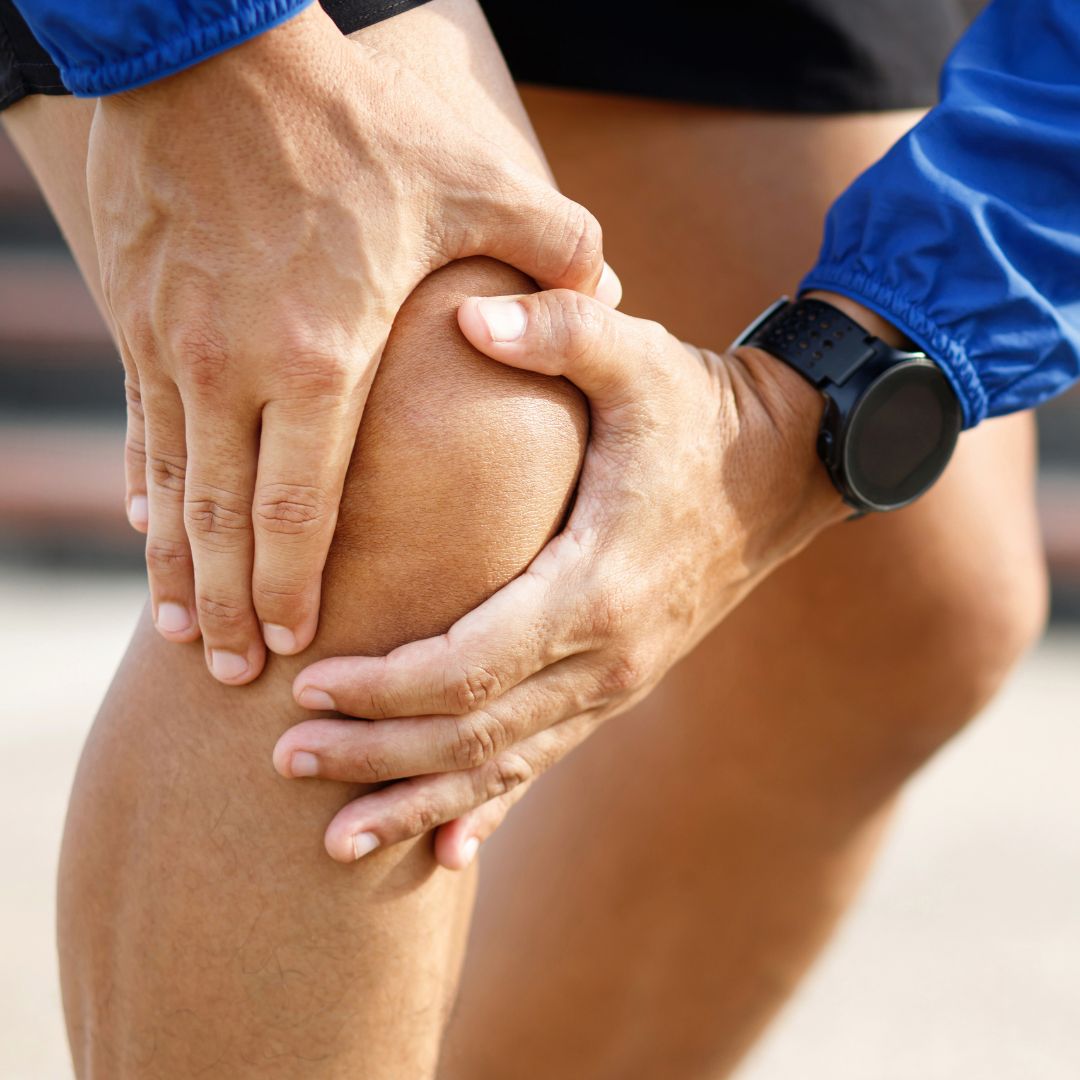
A meniscus tear is damage to one of the two crescent-shaped pieces of cartilage sitting between your thigh bone and shin bone. The menisci spread load across the knee, absorb force and add to joint stability.
Tears happen two ways. A traumatic tear usually comes from the knee twisting while the foot stays planted, common in sport. A degenerative tear develops as the tissue changes with age, and can happen with a movement as ordinary as getting out of a low chair.
Not every meniscus tear needs surgery. Many people manage symptoms well with activity modification, progressive strengthening and rehabilitation. If you have been told you have a tear on a scan and assumed an operation was inevitable, that is worth a conversation. This page sits under our wider knee pain information.
Anatomy:
Each knee has two menisci. The medial meniscus sits on the inner side, the lateral meniscus on the outer side. They sit between the femur and tibia and spread force across the joint, improve stability, absorb load, help the knee move smoothly and protect the articular cartilage underneath.
The outer part of the meniscus has a better blood supply than the inner part. That matters, because tears closer to the outer edge have more potential to heal than tears in the areas with limited blood supply. It is one of the things that shapes whether repair is an option.
Causes:
- Sudden twisting or pivoting: the classic traumatic mechanism, particularly with the foot planted.
- Rapid changes of direction: football, rugby, basketball, netball, soccer and skiing all involve them.
- Deep squatting under load: loaded knee flexion at end range.
- An awkward landing: or a contact injury through the knee.
- Forceful rotation with the foot planted: the knee turns and the meniscus takes the shear.
- Age-related tissue change: the meniscus becomes less resilient over time, so a relatively minor movement can cause a degenerative tear.
- Existing knee osteoarthritis: degenerative tears frequently occur alongside it, and often show on MRI in people with no knee pain at all.
Symptoms:
What you feel depends on where the tear is, what type it is and how severe:
- Pain along the joint line: inner or outer, and usually tender to press.
- Swelling and stiffness: often coming on over hours rather than immediately.
- Pain twisting or pivoting: and turning on a planted foot.
- Pain in a deep squat: or difficulty getting into one at all.
- Difficulty fully bending or straightening: the last few degrees feel blocked.
- Clicking, catching or popping: through certain movements.
- A sense the knee may give way: and reduced confidence loading it.
Locking is worth being precise about. A knee that feels stiff, painful or catches briefly is not the same as a truly mechanically locked knee, where it physically cannot straighten because tissue is blocking the movement. A genuinely locked knee needs prompt medical assessment.
Diagnosis:
Diagnosis starts with a detailed history and a physical examination.
- How the injury happened: the mechanism tells you a lot before anyone touches the knee.
- Location of the pain and any swelling: joint line tenderness is a key finding.
- Knee range of motion: particularly whether full extension is available.
- Knee strength: quadriceps in particular, which shuts down quickly after a knee injury.
- Ligament stability: because traumatic meniscus tears often come with company.
- Loading tests: squatting, weight-bearing and rotational movements where appropriate.
- Walking and sporting function: what the knee can currently do.
Traumatic tears often come with other injuries, particularly ACL tears, MCL injuries, articular cartilage injuries and bone injuries. That is why a proper assessment matters after significant twisting or sporting trauma.
Do you need an MRI? Not always. MRI shows the menisci, ligaments and cartilage in detail, but degenerative meniscal changes are common on scans as people get older and are often present without causing symptoms. Imaging is more appropriate after significant trauma, where the diagnosis is uncertain, where there is persistent swelling, where the knee is genuinely locking, where symptoms are not improving as expected, where surgery is being considered, or where another significant injury is suspected. Treatment follows your symptoms and function, not the scan alone.
Treatment:
What is right depends on whether the tear is traumatic or degenerative, where it is and what pattern it takes, how bad the symptoms are, whether there is locking, what else is injured, your age and activity level, and what your sport or job asks of the knee. Many tears can be managed without surgery initially.
- Early management: reducing the activities that clearly aggravate it, managing swelling, restoring comfortable movement and getting normal walking back. Complete immobilisation is generally unnecessary for uncomplicated injuries unless specifically advised.
- Quadriceps strengthening: the centrepiece. Quads shut down fast after a knee injury and rebuilding them changes how the knee feels.
- Hamstring, calf, hip and gluteal strengthening: so the load is shared across the whole limb rather than concentrated at the knee.
- Knee mobility work: restoring full bend and full straightening.
- Balance and proprioception training: single-leg control, which is what gives you confidence back.
- Squatting and stepping progressions: reintroducing deep flexion, twisting and change of direction as strength returns.
- Manual therapy: for relevant knee stiffness or surrounding muscular restriction, alongside the strengthening rather than instead of it.
Pain-relieving or anti-inflammatory medication may be appropriate during painful periods and is worth discussing with your doctor or pharmacist. Surgical assessment may be considered where there is persistent mechanical locking, a displaced tear restricting movement, a repairable traumatic tear, significant associated injuries, or persistent symptoms despite an appropriate period of rehabilitation. Where it is possible and appropriate, a surgeon may repair the meniscus rather than remove the damaged section, because preserving meniscal tissue matters for long-term knee health. A partial meniscectomy removes the damaged portion and may be considered where the tear cannot be repaired and keeps producing symptoms. For most degenerative tears, exercise-based treatment is generally considered before arthroscopic surgery.
Rehabilitation:
How long does it take? A mild or uncomplicated tear managed conservatively often shows meaningful improvement in about six to twelve weeks. Getting back to demanding running or sport commonly takes two to four months or longer, depending on strength, symptoms and any associated injuries. After meniscus repair surgery, rehabilitation commonly takes three to six months, and returning to higher-level pivoting sport can take longer again because the repaired tissue needs time to heal. Recovery after a partial meniscectomy is generally faster than after repair, though return to sport still depends on rebuilding strength, movement and function.
Rather than the calendar, return to activity is judged on pain and swelling, knee range of motion, quadriceps strength, single-leg control, running tolerance, jumping and landing, and sport-specific movement.
Getting back to running and sport. The progression runs through walking and everyday movement, progressive lower limb strengthening, single-leg exercises, running, acceleration and deceleration, jumping and landing, changes of direction, sport-specific drills, then a gradual return to training and competition. Going back simply because the knee has stopped hurting, without restoring strength and capacity, is the most common route to ongoing symptoms.
Three exercises for a meniscus tear
These three were put together by our practitioners as a starting point. They are general exercises, not a personalised program.
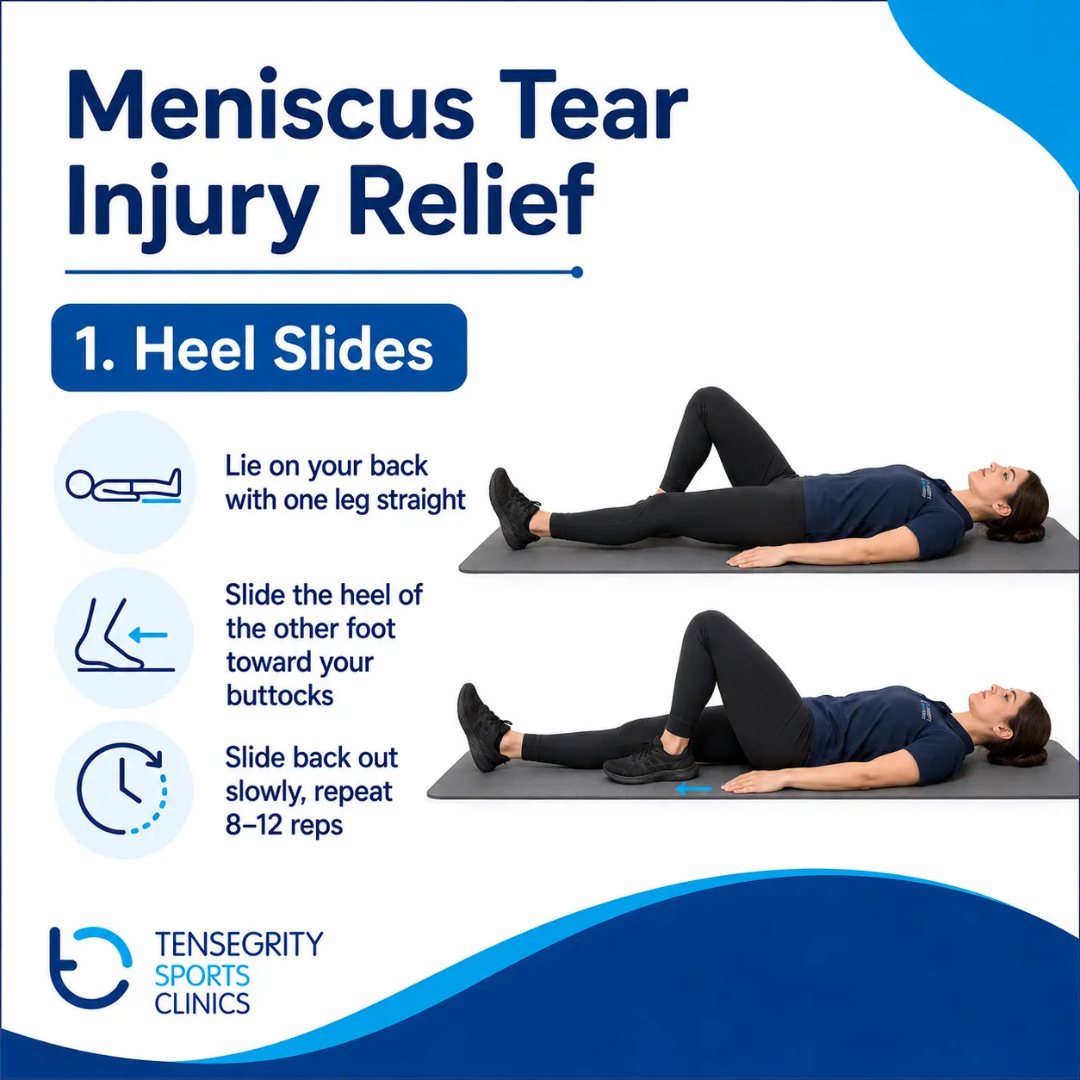
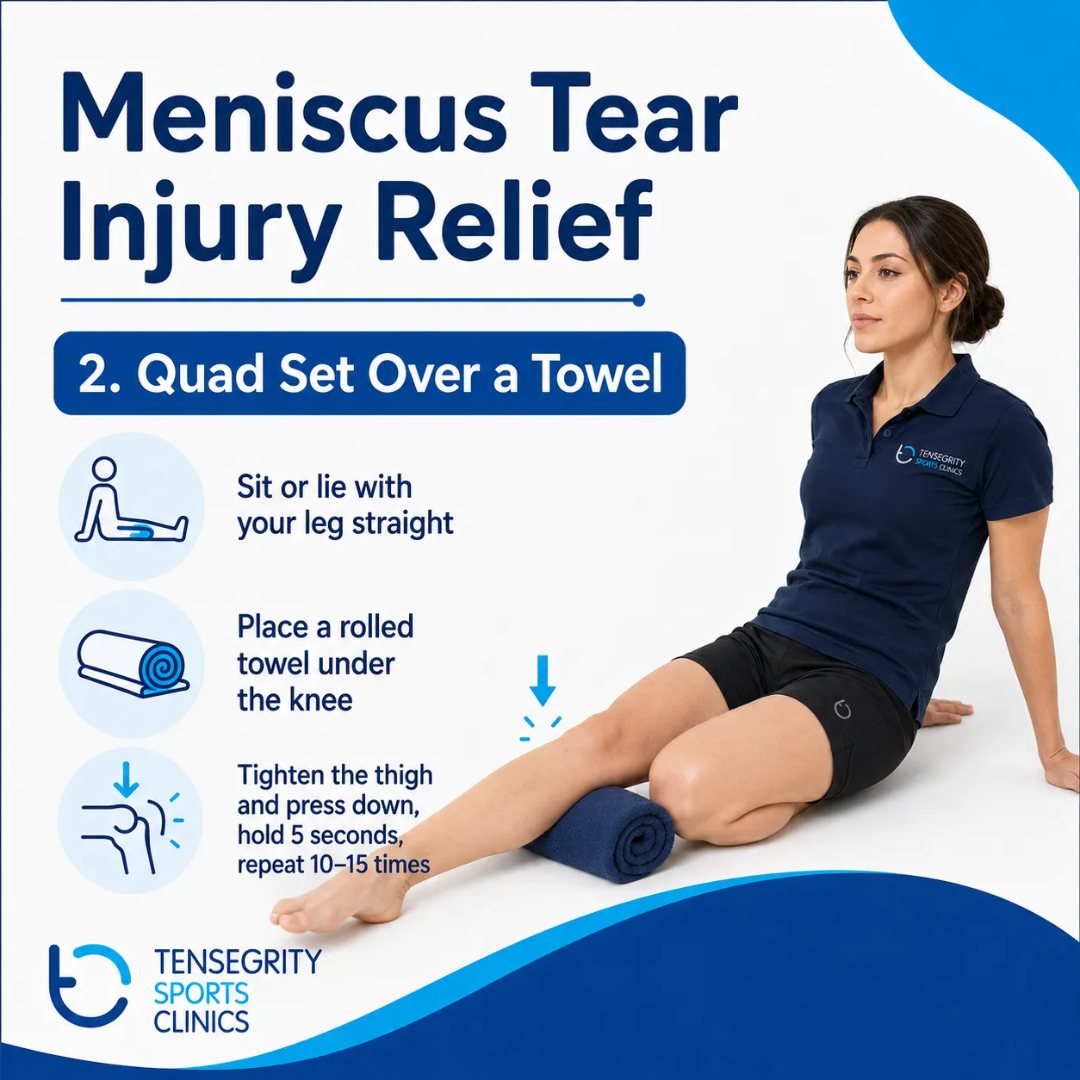
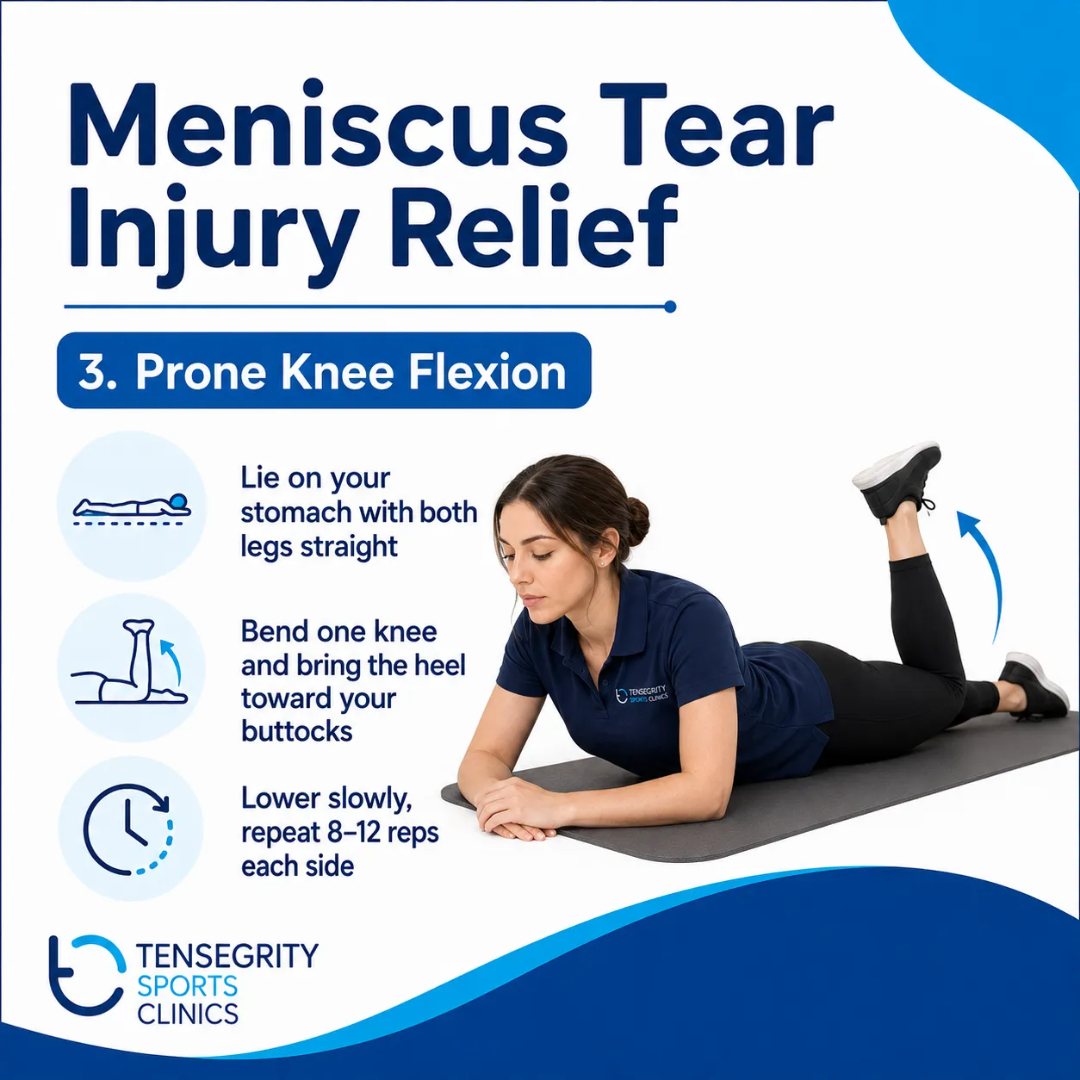
If the knee is locking, giving way or not settling, book an assessment before pushing the loading further.
Prevention:
Not every meniscus tear is preventable, particularly those from significant sporting trauma or age-related tissue change. These help:
- Maintain quadriceps and hamstring strength: the knee’s primary protection.
- Maintain hip and calf strength: so force is distributed across the limb.
- Include balance and single-leg training: control matters as much as raw strength.
- Increase training loads gradually: particularly returning after a break.
- Work on landing and change-of-direction mechanics: in pivoting sports especially.
- Finish rehabilitation after a previous knee injury: before returning to sport.
- Prepare progressively for pivoting and cutting sports: rather than starting the season cold.
Outlook:
Having a meniscus tear does not automatically mean surgery or ongoing knee problems. Many people return successfully to exercise, running and sport after conservative rehabilitation. The outlook depends on the type and location of the tear, whether other structures are injured, whether there is osteoarthritis, and what you need the knee to do. For degenerative tears in particular, treatment focuses on the overall health, strength and function of the knee rather than trying to fix an MRI finding.
A tear does not mean you need to stop exercising. For most people, temporarily modifying the aggravating activities while progressively strengthening the knee lets both symptoms and function improve. The aim is not to protect the meniscus indefinitely. It is enough strength, mobility and confidence for the knee to handle everyday life, exercise and, where it applies, a return to sport.
Get assessed if you have: significant swelling after a knee injury, difficulty bearing weight, persistent joint line pain, repeated giving way, an inability to fully straighten the knee, significant pain after a twisting injury, symptoms that are getting worse, or knee pain not improving with appropriate activity modification and rehabilitation.
A locked knee after an acute injury should be assessed promptly, particularly where the knee physically cannot be fully straightened.