
Overview:
Osteitis pubis is pain and irritation around the pubic symphysis, the joint at the front of the pelvis where the left and right pubic bones meet. It is a recognised cause of persistent groin and pelvic pain, particularly in athletes doing a lot of running, kicking, twisting and rapid changes of direction.
Soccer, AFL, rugby and other field sports see most of it, though it happens outside sport too. Symptoms usually build gradually and are often only noticeable after training at first. As it becomes more irritable the pain starts affecting running, kicking, changing direction, walking and everyday movement.
The term has historically been used broadly for any pubic-region pain. Modern assessment considers pubic-related groin pain alongside other possible sources including adductor, inguinal, iliopsoas and hip-related conditions, because several structures sit very close together. This page sits under our wider hip pain information.
Anatomy:
The pubic symphysis sits at the front of the pelvis, connecting the left and right pubic bones through a fibrocartilaginous joint. Several important muscles and tendons attach close by, including the adductor muscles, rectus abdominis and the other abdominal muscles and connective tissue.
That makes the pubic region a hub for transferring force between the trunk and the legs. During running, kicking and changing direction, substantial force passes through this small area, which is why it becomes symptomatic in athletes rather than in people who sit still.
Causes:
This is about repeated loading around the pubic symphysis rather than one isolated injury:
- High-volume running: and repeated sprinting.
- Frequent kicking: soccer and AFL in particular.
- Rapid changes of direction: cutting and twisting under load.
- A sudden increase in training volume: or a jump in competition load.
- Reduced hip or adductor capacity: less strength means more strain through the joint.
- Previous groin injury: a strong predictor of recurring pubic-related pain.
- A rapid return to sport: after time away, without rebuilding capacity first.
- Inadequate recovery: between demanding sessions.
It can also follow pregnancy and childbirth, pelvic surgery or significant pelvic trauma. In athletes it frequently sits alongside other causes of groin pain rather than existing on its own.
Symptoms:
- Pain around the pubic bone: central rather than off to one side, with tenderness directly over the symphysis.
- Central groin pain: and lower abdominal or pelvic discomfort.
- Pain running and sprinting: often worse at higher speeds.
- Pain kicking or changing direction: and during lunges.
- Pain squeezing the legs together: the classic adductor squeeze finding.
- Pain during sit-ups: because the abdominals attach right there.
- Pain getting out of bed or rolling over: a good marker of how irritable it has become.
In more irritable cases symptoms also show up walking, on stairs, standing on one leg and getting in and out of a car.
Diagnosis:
Assessment works through the region carefully, because several conditions produce very similar pain.
- Exact location of the pain: and tenderness over the pubic symphysis.
- Adductor strength and squeeze testing: a key part of the examination.
- Hip strength and range of motion: tested in all directions.
- Abdominal muscle testing: because the trunk attaches into the same area.
- Loading tests: squatting, lunging, running and sprinting.
- Change of direction and kicking: where relevant to your sport.
- Screening the alternatives: adductor-related, inguinal-related, iliopsoas-related and hip-related groin pain, plus lumbar and pelvic conditions.
Osteitis pubis or adductor-related groin pain? They produce very similar symptoms and often occur together. Adductor-related pain gives tenderness over the adductor muscles or tendons and pain squeezing the legs together. Pubic-related pain gives local tenderness directly over the pubic symphysis and the adjacent bone.
Osteitis pubis or a sports hernia? Also overlapping. Osteitis pubis is more central, around the symphysis. Athletic pubalgia involves the lower abdominal wall, the inguinal region and the pubic region. An athlete can have features of both, which is why persistent groin pain needs a broad assessment rather than one label based on where it hurts.
Osteitis pubis or symphysis pubis dysfunction? These get confused. Osteitis pubis is usually associated with sporting or repetitive loading. Symphysis pubis dysfunction sits within pregnancy-related pelvic girdle pain, during pregnancy or postpartum. Symptoms overlap, the context and management do not.
Do you need imaging? Not always. Where symptoms persist or the diagnosis is uncertain, X-ray may show changes around the symphysis in more established cases, and MRI gives information about bone marrow changes, the symphysis itself, the adductor attachments and other soft tissue. Imaging abnormalities also show up in athletes with no significant symptoms, so a diagnosis is not made on an MRI alone.
Treatment:
Most cases are managed conservatively. The aim is restoring your ability to tolerate the forces passing through the pelvis, not just settling the pain.
- Load management: during the irritable stage, temporarily reducing sprinting, long-distance running, high-volume kicking, sharp changes of direction, full match participation and heavy adductor work. Complete long-term rest is not the objective. Rest alone reduces symptoms without preparing you for the loads that caused them.
- Adductor strengthening: adductor squeezes, isometric adduction, resisted hip adduction, lateral lunges and Copenhagen adduction variations, progressively loaded as strength improves.
- Hip and lower limb strengthening: glutes, quadriceps, hamstrings, hip flexors and calves, so overall capacity improves rather than only the painful area getting attention.
- Trunk strengthening: controlled abdominal work, anti-rotation exercises, loaded carries and rotational strengthening. The trunk is half of how force transfers through the pelvis.
- Progressive return to running: comfortable walking, easy jogging, continuous running, more volume, faster running, acceleration and deceleration, high-speed running, then sprinting. Speed matters here. Slow jogging does not expose the groin to the same forces as near-maximal running, so a field-sport athlete who only jogs is not ready.
- Return to change of direction: lateral movement, side-stepping, planned changes of direction, cutting, reactive agility, then sport-specific movement.
- Return to kicking: short controlled kicks, low intensity, more volume, longer distance, more power, kicking while moving, then full-intensity sport-specific kicking.
Manual therapy may give temporary relief from associated muscular discomfort or stiffness, but passive treatment alone will not restore the capacity needed for high-level sport, so it sits alongside the strengthening and load management. Most cases are treated without surgery. Surgery is uncommon and considered only in selected persistent cases where symptoms remain significantly disabling, conservative management has been unsuccessful, the diagnosis is carefully established and the athlete still cannot return to what they need to do. Persistent symptoms should first be reassessed to make sure another cause of groin pain has not been missed.
Rehabilitation:
How long does it take? Recovery varies a lot. Milder or relatively recent presentations often improve over about six to twelve weeks. More established cases commonly need three to six months of progressive rehabilitation. Long-standing cases can need six months or longer, particularly for athletes returning to high-level field sport.
It depends on how long symptoms have been present, how irritable it is, adductor and hip strength, your sporting demands, running and sprinting volume, kicking requirements, previous groin injuries, and how consistent you are.
Before returning to unrestricted sport, you should have appropriate adductor strength, hip strength, trunk capacity, running tolerance, high-speed running ability, sprinting capacity, acceleration and deceleration, change of direction, kicking tolerance, sport-specific fitness and confidence. Walking without pain does not mean the pelvis is ready for full-speed field sport.
Three exercises for osteitis pubis
These three were put together by our practitioners as a starting point. They are general exercises, not a personalised program.
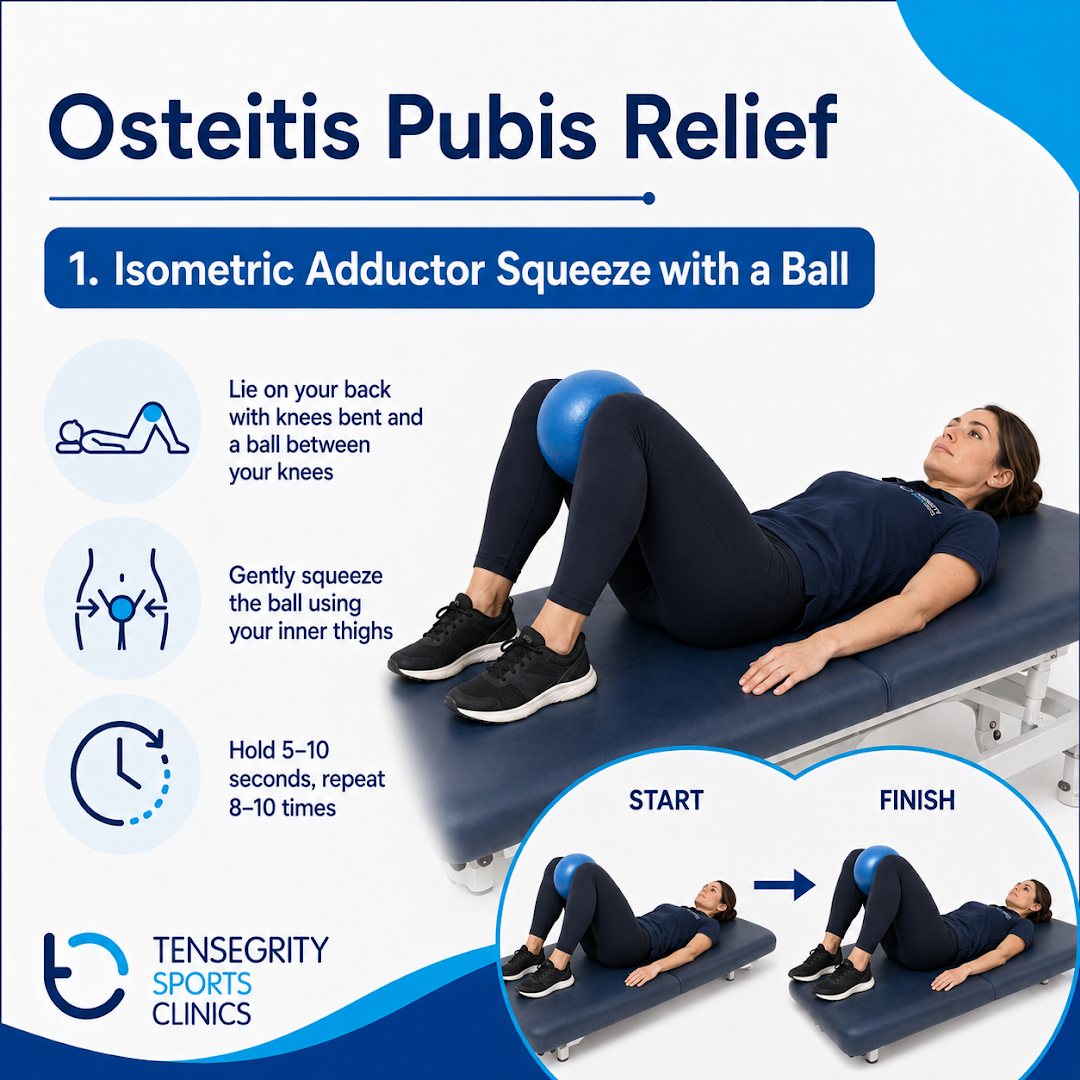
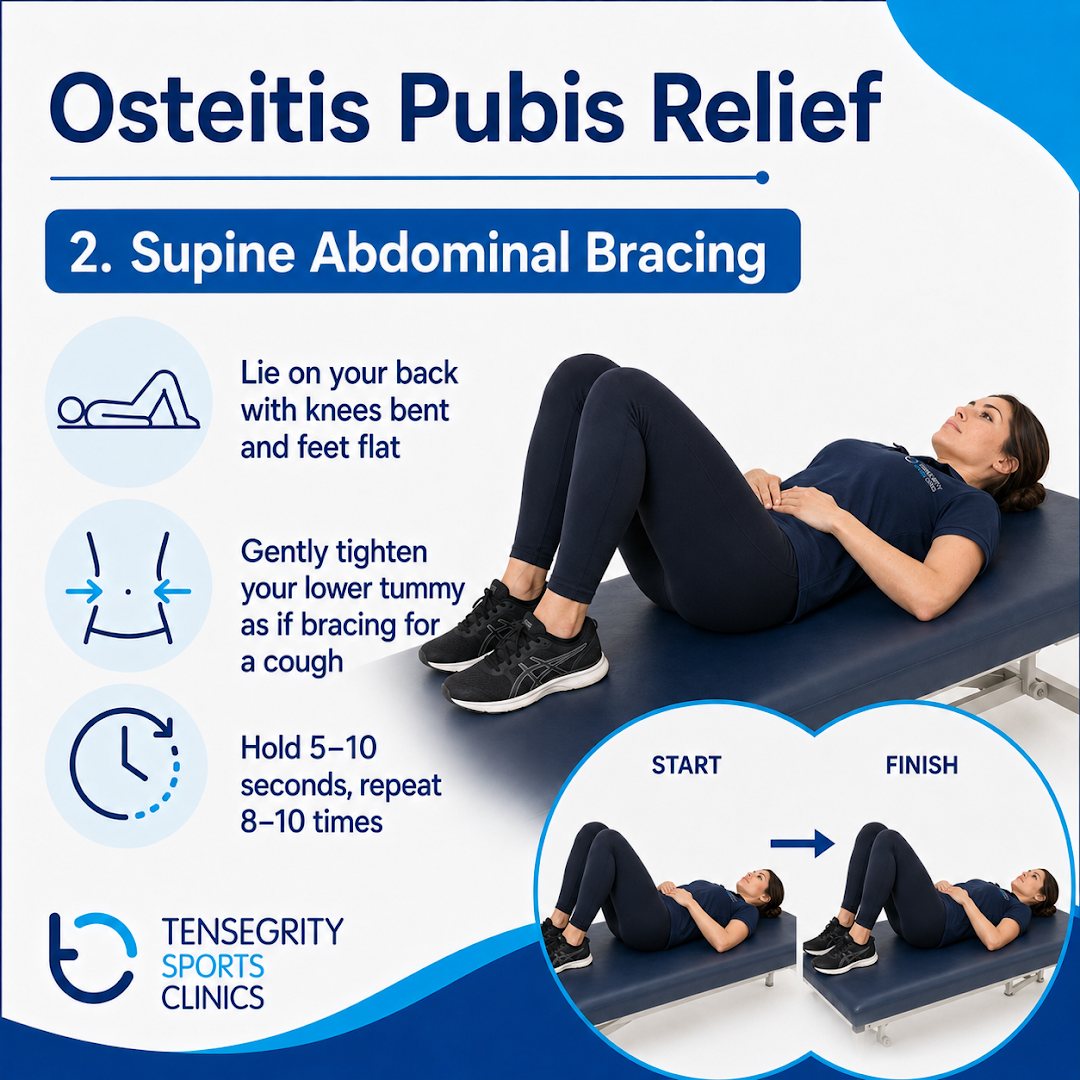
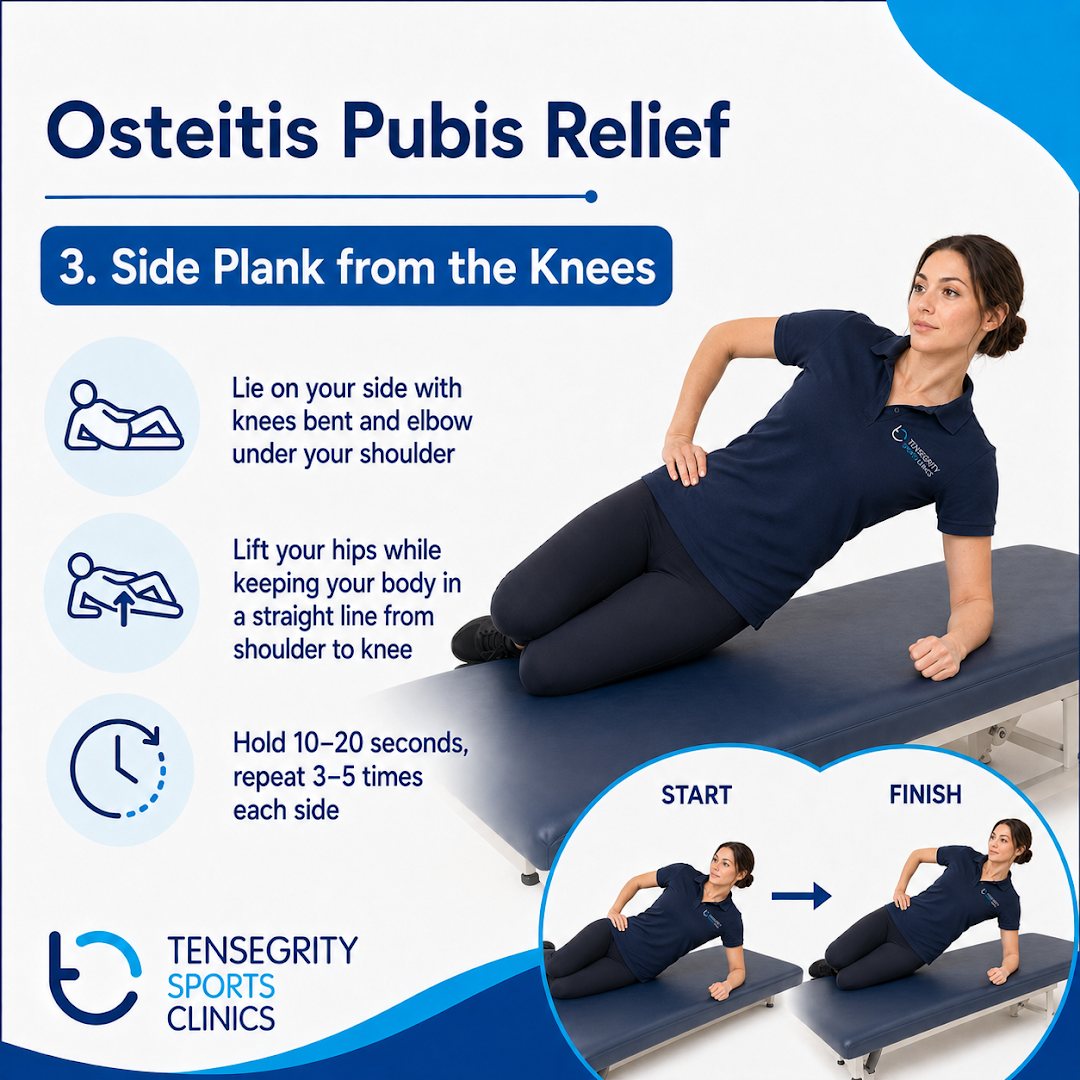
These are the starting point, not the endpoint. Rehabilitation has to progress through running speed, cutting and kicking before sport, so book an assessment to get the progression right.
Prevention:
- Maintain adductor strength: the most direct protection for this region.
- Maintain hip and lower limb strength: so force is shared rather than concentrated.
- Include trunk strengthening: the other half of force transfer through the pelvis.
- Keep regular exposure to high-speed running: rather than only jogging in the off-season.
- Increase running volume progressively: and progress kicking loads gradually.
- Prepare progressively for change-of-direction demands: before competition starts.
- Avoid sudden spikes in training volume: and finish rehabilitation after previous groin injuries.
Outlook:
The outlook is generally favourable, though persistent cases can take time. Symptoms often improve with reduced sporting load, and then return as soon as full training resumes if enough strength and capacity have not been rebuilt in between. That pattern is the frustrating part of this condition and the reason rest alone does not fix it.
It does not mean sport has to be permanently avoided. The aim is to progressively rebuild the capacity of the adductors, hips, trunk and lower body, then gradually expose you to the running, sprinting, cutting and kicking your sport actually demands.
Get assessed if: groin or pubic pain persists, symptoms are getting worse, pain repeatedly returns during sport, walking becomes significantly painful, symptoms began after significant trauma, you develop substantial weakness, or things are not improving despite appropriate rehabilitation.
Severe pelvic or groin pain developing without an obvious sporting explanation, or pain alongside an unexplained fever or feeling generally unwell, should be medically assessed. Not all pain in this region is musculoskeletal.