

Overview:
A hip labral tear is an injury to the labrum, the ring of fibrocartilage surrounding the socket of the hip joint. The labrum deepens the socket, spreads load and contributes to the stability of the joint.
Tears can follow a sporting injury or trauma, but they also develop gradually from repetitive loading or from the structural shape of the hip. Symptoms usually include deep groin or hip pain, clicking or catching, stiffness, and discomfort with twisting, pivoting, squatting or sitting for long periods.
Labral abnormalities also show up on scans in people with no hip pain at all. A labral tear on an MRI does not automatically mean surgery. That is the single most useful thing to know if you have just been handed a report. This page sits under our wider hip pain information.
Anatomy:
The hip is a ball and socket joint. The femoral head is the rounded upper end of the thigh bone, the acetabulum is the socket in the pelvis, articular cartilage covers the joint surfaces, and the labrum is a ring of fibrocartilage around the edge of the socket. A joint capsule and ligaments support the whole thing.
The labrum deepens the socket, improves stability, distributes force across the hip, maintains a seal around the joint and helps it move smoothly. The hip takes considerable force during walking, running, jumping, squatting and sport, and the labrum sits right where that force concentrates.
Causes:
- Hip impingement: FAI is commonly associated with labral injury. Variations in the shape of the femoral head, neck or socket increase contact between the bones during certain movements, which loads the labrum repeatedly.
- Pivoting and twisting sport: football, soccer, hockey, dance, gymnastics and martial arts all involve repeated cutting, deep hip flexion, kicking and direction change.
- Trauma: a significant fall, collision or sporting injury can damage the labrum directly.
- Hip dysplasia: a shallower socket changes how force is distributed and places extra demand on the labrum.
- Repetitive hip loading: repeated deep squatting, twisting or high-volume sport in susceptible individuals.
- Degenerative change: labral changes become increasingly common with age and can occur alongside hip osteoarthritis.
Symptoms:
Symptoms vary considerably between people:
- Deep pain in the groin: or at the front of the hip, sometimes around the side.
- Clicking or catching in the joint: and occasionally a locking sensation.
- A sharp catching feeling deep in the hip: particularly with rotational movements.
- Pain in a deep squat: and during lunges.
- Pain twisting or pivoting: and when running or kicking.
- Discomfort getting in or out of a car: and after sitting for a long stretch.
- Hip stiffness and reduced movement: with difficulty getting back to sport.
Clicking or popping in the hip without pain is relatively common and does not by itself indicate a problematic labral tear.
Diagnosis:
Assessment starts with a detailed history and physical examination, using provocation tests alongside everything else. No single physical test definitively diagnoses every labral tear, so findings are weighed together.
- Location and behaviour of the pain: and how deep in the joint it feels.
- Hip range of motion: particularly flexion and rotation.
- Hip strength: tested across all directions.
- Loading tests: squatting and single-leg movements.
- Hip rotation under load: which often reproduces the catching.
- Walking, running and sporting movements: where relevant.
- Recent training changes and previous hip injuries: and how they were managed.
Labral tear or hip flexor pain? Front-of-hip and groin pain comes from several structures. Hip flexor or iliopsoas problems can look very similar. A labral injury is more likely to give deep joint pain, pain with twisting or pivoting, catching, and pain in deep hip flexion. Symptoms alone cannot always tell you which structure is responsible, which is what the assessment is for.
Do you need an MRI? Imaging may be appropriate where a clinically significant labral injury is suspected. X-ray assesses joint structure, femoral and acetabular shape, signs of osteoarthritis and features associated with FAI or dysplasia. MRI gives information on the labrum, cartilage, tendons and surrounding soft tissue. An MR arthrogram is sometimes recommended for additional detail about the labrum. Because labral abnormalities occur in people without hip pain, a tear on imaging is interpreted alongside your symptoms and examination, never on its own.
Treatment:
What is appropriate depends on how severe the symptoms are, what caused the tear, what else is going on in the hip, your sporting and occupational demands, your age and how you respond to rehabilitation. Many people start with a period of non-surgical management.
- Activity modification: temporarily modifying deep squatting, repeated pivoting, high-volume running, kicking, deep lunges and prolonged sitting in aggravating positions. Not permanent avoidance. The aim is less irritation while strength and capacity improve.
- Progressive hip strengthening: glutes, hip flexors, extensors, adductors, abductors, quadriceps, hamstrings and trunk, matched to what you need to return to.
- Functional rehabilitation: building tolerance to squatting, lunging, single-leg loading, running, jumping, landing, pivoting and changing direction.
- Hip mobility where it is clinically relevant: repeatedly forcing the hip into painful end-range positions is generally unnecessary. The aim is the movement your activities require while respecting your hip anatomy.
- Manual therapy: can reduce associated muscular discomfort or improve movement temporarily. It cannot repair the labrum or restore the capacity needed for sport, so it sits alongside the exercise.
- Sport-specific progression: athletes need rehabilitation that eventually reproduces the speed and complexity of their sport, not just pain-free walking.
- Review and progression: reassessed against function rather than repeated unchanged.
Pain-relieving or anti-inflammatory medication may be appropriate and is worth discussing with your GP or pharmacist. Not every hip labral tear requires surgery. Many people achieve meaningful improvements in pain and function through rehabilitation and activity management. Surgical assessment may be considered where symptoms remain significantly limiting despite appropriate rehabilitation, where there are persistent mechanical symptoms affecting function, where associated FAI or another structural condition is clinically significant, where you cannot return to required sport or activity, or where symptoms substantially affect quality of life. That decision should not be based on MRI findings alone. Where surgery is appropriate, hip arthroscopy through small incisions may involve labral repair, treating damaged cartilage or addressing clinically relevant FAI-related bone shape. Preserving and repairing the labrum is considered where possible.
Rehabilitation:
How long does it take? With non-surgical rehabilitation, meaningful improvement often comes within about six to twelve weeks, and more substantial gains in strength and function over three to six months or longer, particularly for athletes. After hip arthroscopy, rehabilitation generally runs over several months, and return to unrestricted sport commonly takes around four to six months or longer depending on the procedure, associated pathology, strength, sport and individual healing. High-level athletes in demanding pivoting or kicking sports usually need longer again.
Getting back to running and sport is based on physical capacity rather than time. The progression runs through comfortable walking, progressive hip strengthening, single-leg strengthening, running, faster running, jumping and landing, acceleration and deceleration, pivoting and changes of direction, sport-specific drills, then full training and competition.
Before an unrestricted return you should have appropriate strength, movement, confidence and tolerance to sport-specific loads.
Three exercises for a hip labral tear
These three were put together by our practitioners as a starting point. They are general exercises, not a personalised program.
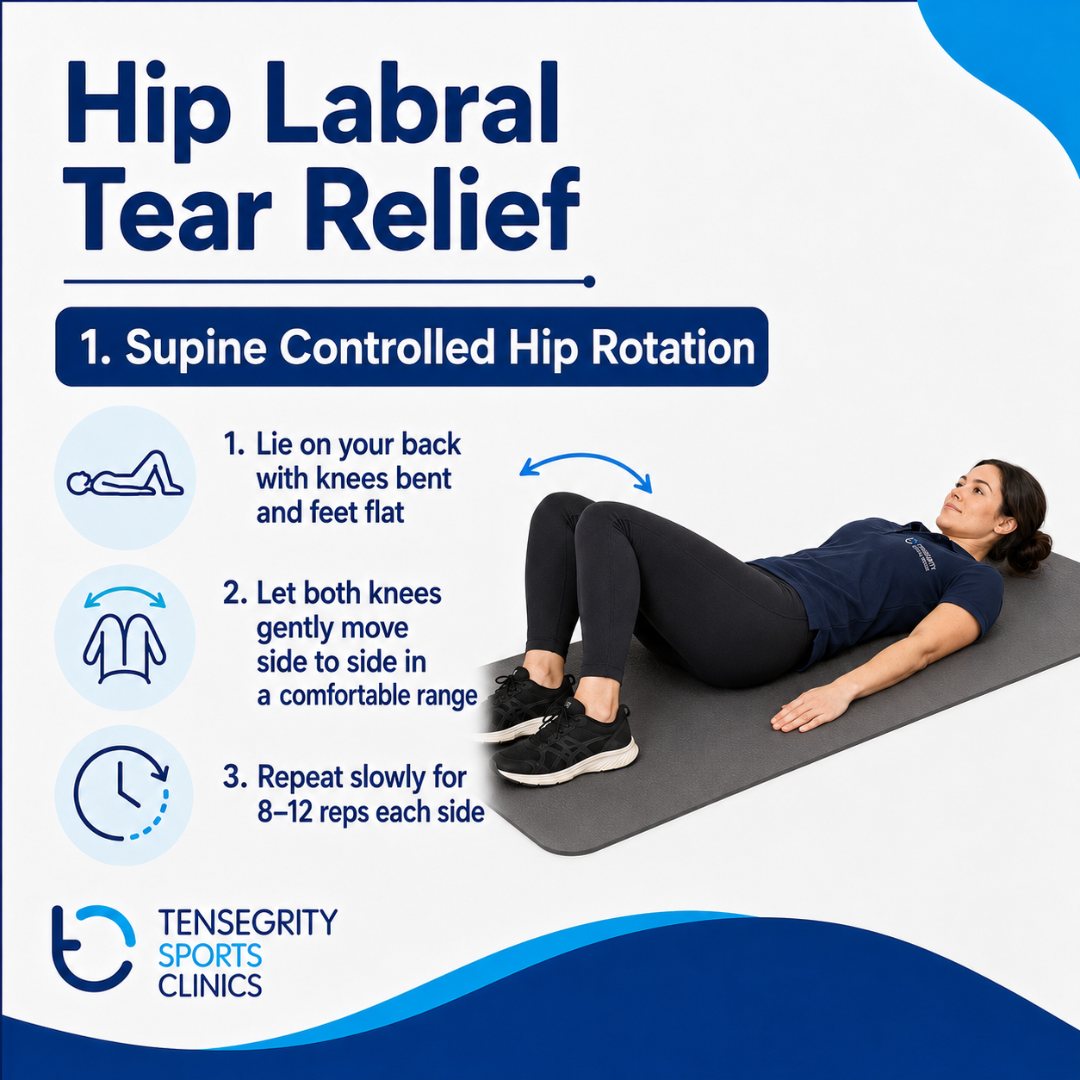
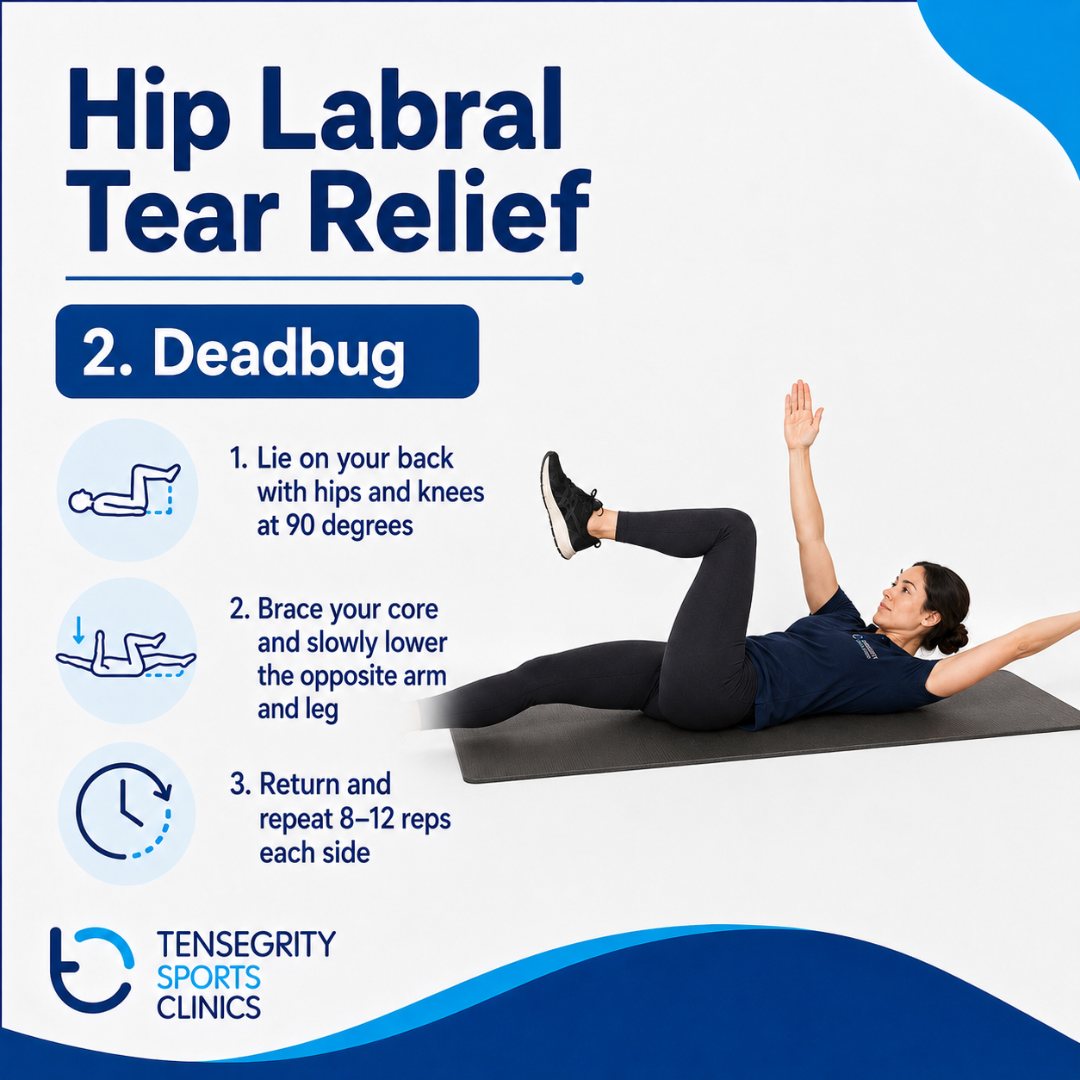
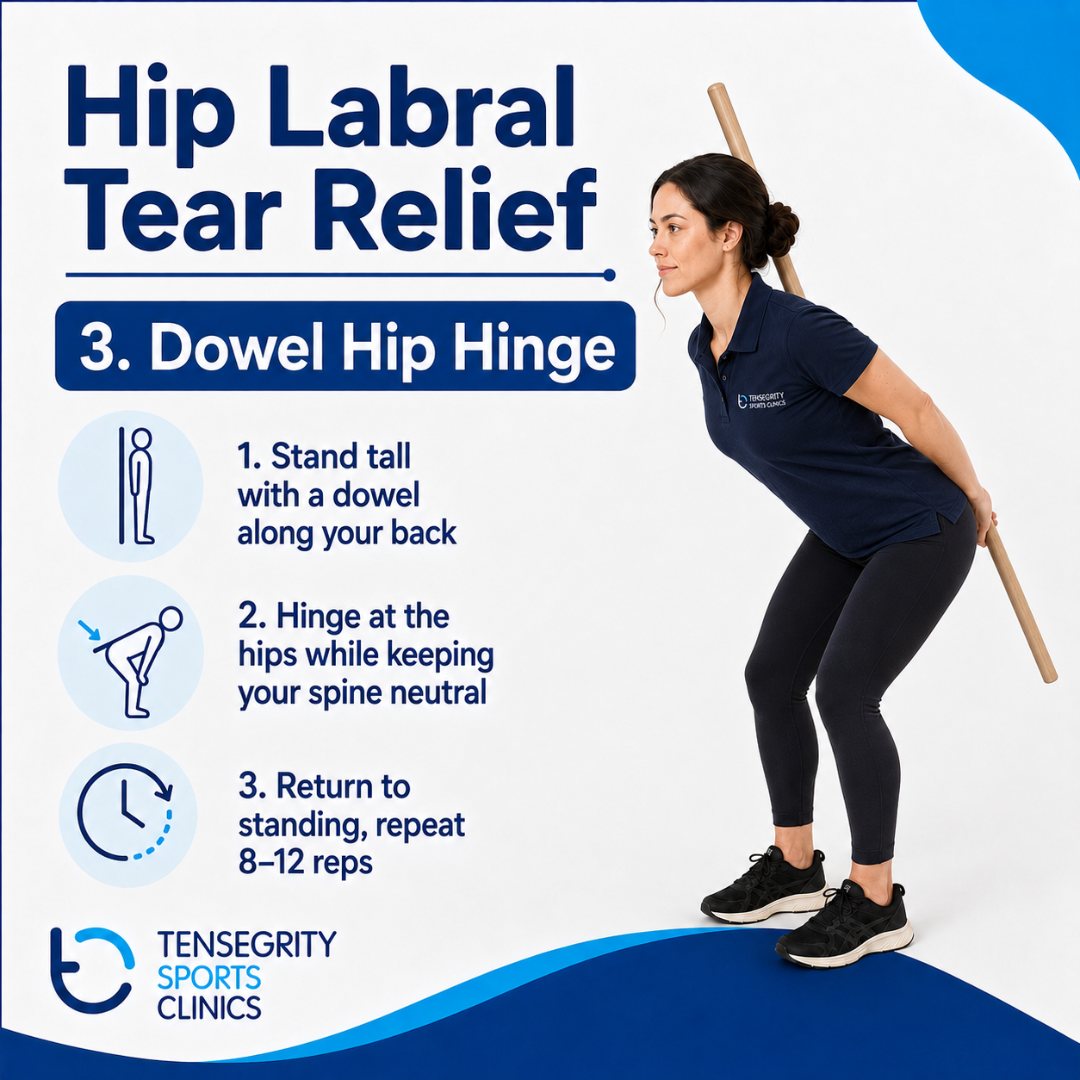
Forcing the hip into painful end-range positions is generally unnecessary. If the hip is catching, locking or not settling, book an assessment before pushing further.
Prevention:
Not every labral tear is preventable, particularly where individual hip anatomy or significant trauma is involved. These help maintain hip function:
- Maintain hip and lower limb strength: the most useful thing within your control.
- Progress running loads gradually: and increase sporting intensity in steps.
- Maintain appropriate hip mobility: without forcing painful end range.
- Allow adequate recovery: between demanding sessions.
- Avoid sudden large increases in training: the most common trigger.
- Finish rehabilitation after previous hip injuries: before returning to full load.
- Address persistent groin or hip pain early: rather than training through it for a season.
Outlook:
A labral tear on imaging does not automatically mean the hip is permanently damaged or that surgery is needed. Many people have labral changes without any symptoms. For people who do have symptoms, the outlook depends on the associated hip anatomy, cartilage health, physical demands and how the hip responds to rehabilitation. Many improve significantly with conservative treatment, and selected people with persistent symptoms benefit from surgical assessment.
A diagnosis does not mean you need to stop exercising or permanently give up squatting, running or sport. How much a labral tear matters depends on the person, not the scan. Treatment focuses on progressively improving hip strength, movement and load tolerance so you can get back to what matters, without letting an imaging finding define what your hip is capable of.
Get assessed if: groin or hip pain persists or is getting worse, pain significantly limits walking or exercise, the hip repeatedly catches or locks, symptoms began after significant trauma, hip movement becomes substantially restricted, or symptoms are stopping you returning to normal work or sport.
Sudden severe hip pain after significant trauma, particularly with an inability to bear weight, needs prompt medical assessment.