
Overview:
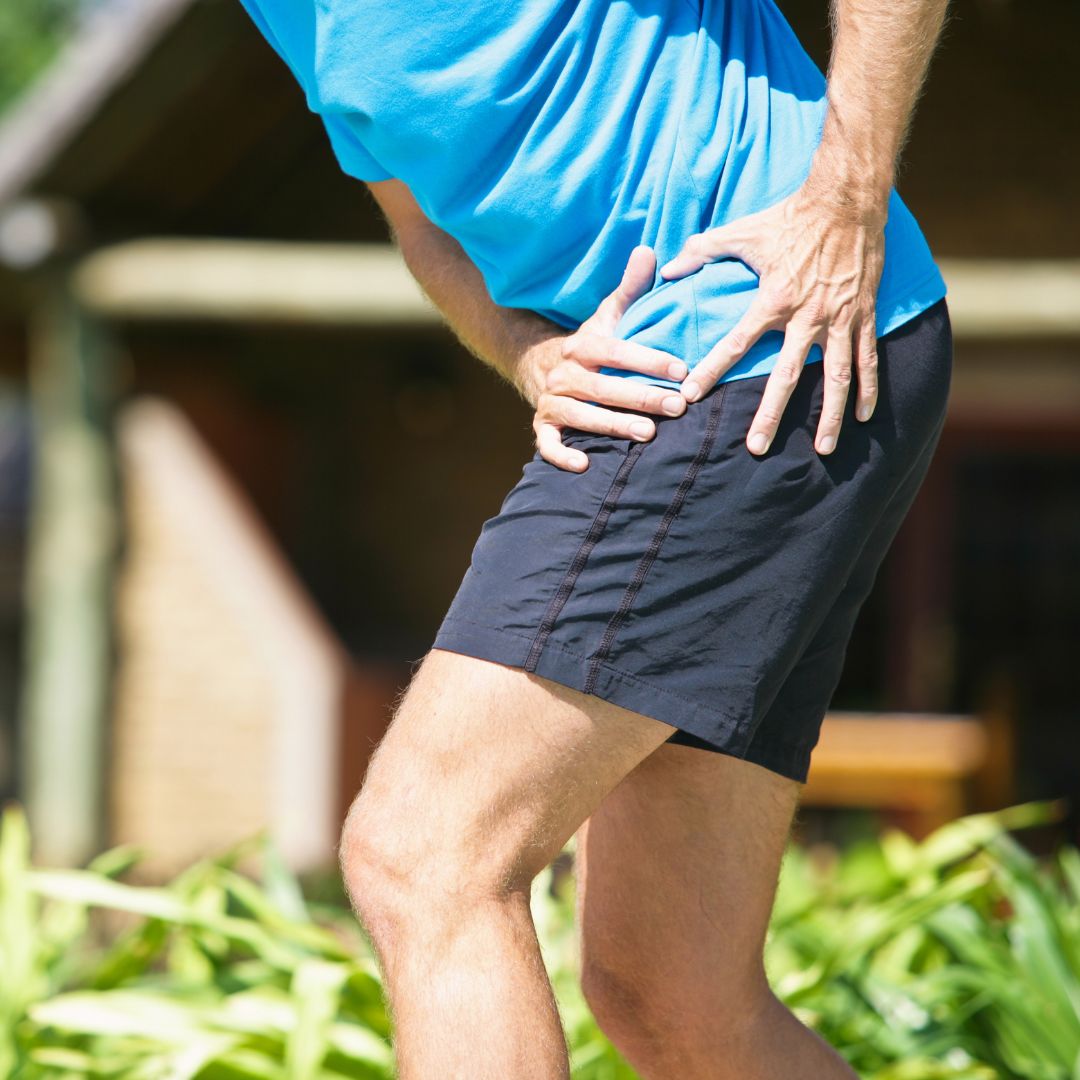
Hip flexor tendinopathy, more precisely iliopsoas tendinopathy, affects the iliopsoas tendon at the front of the hip. It causes pain in the front of the hip or the groin, particularly during anything that repeatedly demands hip flexion: running, sprinting, kicking, stairs, or lifting the knee towards the chest.
It usually builds gradually after an increase in activity or repeated loading rather than arriving with one specific injury. That slow onset is part of why it gets ignored for months.
It is easily confused with other causes of groin and front-of-hip pain, including hip impingement, labral injuries, hip osteoarthritis and a straight hip flexor strain. Getting that right matters, because the rehabilitation differs. Treatment focuses on modifying the aggravating load while progressively rebuilding hip flexor and lower limb strength. This page sits under our wider hip pain information.
Anatomy:
The iliopsoas is formed by two muscles, psoas major and iliacus, which combine into the iliopsoas tendon and attach to the lesser trochanter of the femur. It is one of the body’s major hip flexors.
It does a lot of work: walking, running, sprinting, stairs, kicking, bringing the knee to the chest and controlling the hip during sporting movement. The tendon passes across the front of the hip joint, which is why symptoms can feel as though they are coming from deep inside the groin rather than from a muscle at the surface.
Causes:
This develops when repeated loading outruns what the tendon can currently recover from and adapt to:
- A sudden increase in running: distance, frequency or speed going up too fast.
- Sprinting: high-speed running places substantial demand on the iliopsoas.
- Kicking sports: soccer, AFL and martial arts repeatedly demand powerful hip flexion.
- Hill running: uphill running increases hip flexor demand considerably.
- High training volume: repeated sessions without adequate recovery.
- Gym work: high-volume leg raises, hanging knee raises and other repeated hip flexion exercises.
- Reduced hip strength: less capacity around the hip makes higher loads harder to tolerate.
- A rapid return to sport: going back to high intensity after a period of reduced activity.
Symptoms:
Symptoms sit around the front of the hip or the groin:
- Deep pain at the front of the hip: or in the groin, often hard to point to precisely.
- Pain lifting the knee: and climbing stairs.
- Pain running, sprinting or kicking: particularly at higher speeds.
- Discomfort getting in or out of a car: or rising from a low chair.
- Pain during sit-ups or leg raises: anything loading hip flexion directly.
- Pain walking uphill: and stiffness after exercise.
- Pain after prolonged sitting: the first few steps are the worst.
Some people also get a clicking or snapping at the front of the hip. That is sometimes called internal snapping hip, where the iliopsoas tendon moves across structures at the front of the joint, usually going from flexion into extension, lowering the leg or getting up from a chair. Painless snapping is common and does not need treating. It only becomes relevant when it hurts or interferes with what you are doing.
Diagnosis:
Diagnosis comes from a detailed history and a physical examination, and usually includes screening the lumbar spine, hip joint and other groin structures, because front-of-hip pain has several possible sources.
- Location of the pain: and how deep it feels.
- Hip range of motion: and where in the range symptoms appear.
- Hip flexor strength: and pain during resisted hip flexion, which is the key test here.
- Hip and gluteal strength: because the whole hip shares the load.
- Loading tests: squatting, lunging, walking and running.
- Sporting movements: kicking and sprinting where relevant.
- Recent training changes: and previous hip or groin injuries.
Tendinopathy or a strain? A hip flexor strain usually happens suddenly, during sprinting, kicking or explosive acceleration, often with a pulling sensation followed by pain and weakness. Tendinopathy develops gradually, becomes progressively more noticeable with repeated activity, hurts on resisted hip flexion, persists over weeks or months and flares when training volume goes up.
Tendinopathy or FAI? Both cause front-of-hip and groin pain. FAI is more aggravated by deep squatting, prolonged sitting, deep hip flexion and pivoting. Iliopsoas pain is more noticeable with resisted hip flexion, running, sprinting, kicking and repeated knee lifting. They overlap, and they can coexist.
Do you need imaging? Not routinely. Ultrasound or MRI is considered where symptoms persist, the diagnosis stays uncertain, a significant tear is suspected, another hip condition needs investigating, or things are not responding as expected.
Treatment:
The core is load management and progressive strengthening. Complete rest is rarely necessary.
- Activity modification: temporarily reducing running volume, sprinting, hill running, kicking, high-volume stair climbing, leg raises, hanging knee raises and repeated deep hip flexion. The goal is a manageable level of activity while capacity rebuilds, not stopping.
- Progressive hip flexor strengthening: starting with isometric hip flexion, then resisted hip flexion, standing hip flexion work, marching variations, loaded hip flexion and running-specific strengthening. Resistance, speed and range increase as symptoms improve.
- Gluteal and lower limb strengthening: glutes, quadriceps, hamstrings, adductors, calves and trunk. Focusing only on the hip flexor misses why it was overloaded in the first place.
- Manual therapy: helps with associated muscular discomfort or joint restriction and can give temporary relief. It does not restore the tendon’s ability to tolerate running or kicking, so it sits alongside the exercise.
- Shockwave therapy: extracorporeal shockwave may be considered as an adjunct in persistent tendinopathy. It is available at every Tensegrity clinic except Willoughby, and exercise and load management remain the main treatment.
- Running rehabilitation: temporarily reducing distance, speed, hills and intervals, then rebuilding through comfortable walking, basic strengthening, short easy runs, longer runs, faster running, hills, acceleration and finally sprinting.
- Return to sport work: for kicking sports, faster running, acceleration and deceleration, sprinting, jumping, change of direction, progressive kicking and sport-specific drills.
Should you stretch your hip flexors? It gets recommended automatically for front-of-hip pain, and it is not always appropriate. Aggressive stretching can aggravate an irritable iliopsoas tendon. Stretching should depend on whether there is a genuine mobility restriction and how you respond to it. Having hip pain does not mean the hip flexors are simply too tight.
Pain-relieving or anti-inflammatory medication may occasionally be appropriate and is worth discussing with your GP or pharmacist. Image-guided injections are sometimes considered in persistent or diagnostically difficult cases, and the benefits and risks belong in a conversation with an appropriate medical practitioner.
Rehabilitation:
How long does it take? Relatively mild or recent symptoms often start improving within about six to twelve weeks. More established tendinopathy commonly needs around three to six months of progressive rehabilitation. Long-standing cases, or athletes returning to high-speed running and kicking, can need six months or longer.
It depends on how long symptoms have been there, how irritable the tendon is, your hip strength, your running or sporting demands, your training volume, previous injuries, how consistent you are, and how well the aggravating loads are managed.
Going straight from basic strengthening to full-speed sport exposes the tendon to a very large jump in load. That is the most common reason symptoms come back.
Three exercises for hip flexor tendinopathy
These three were put together by our practitioners as a starting point. They are general exercises, not a personalised program.
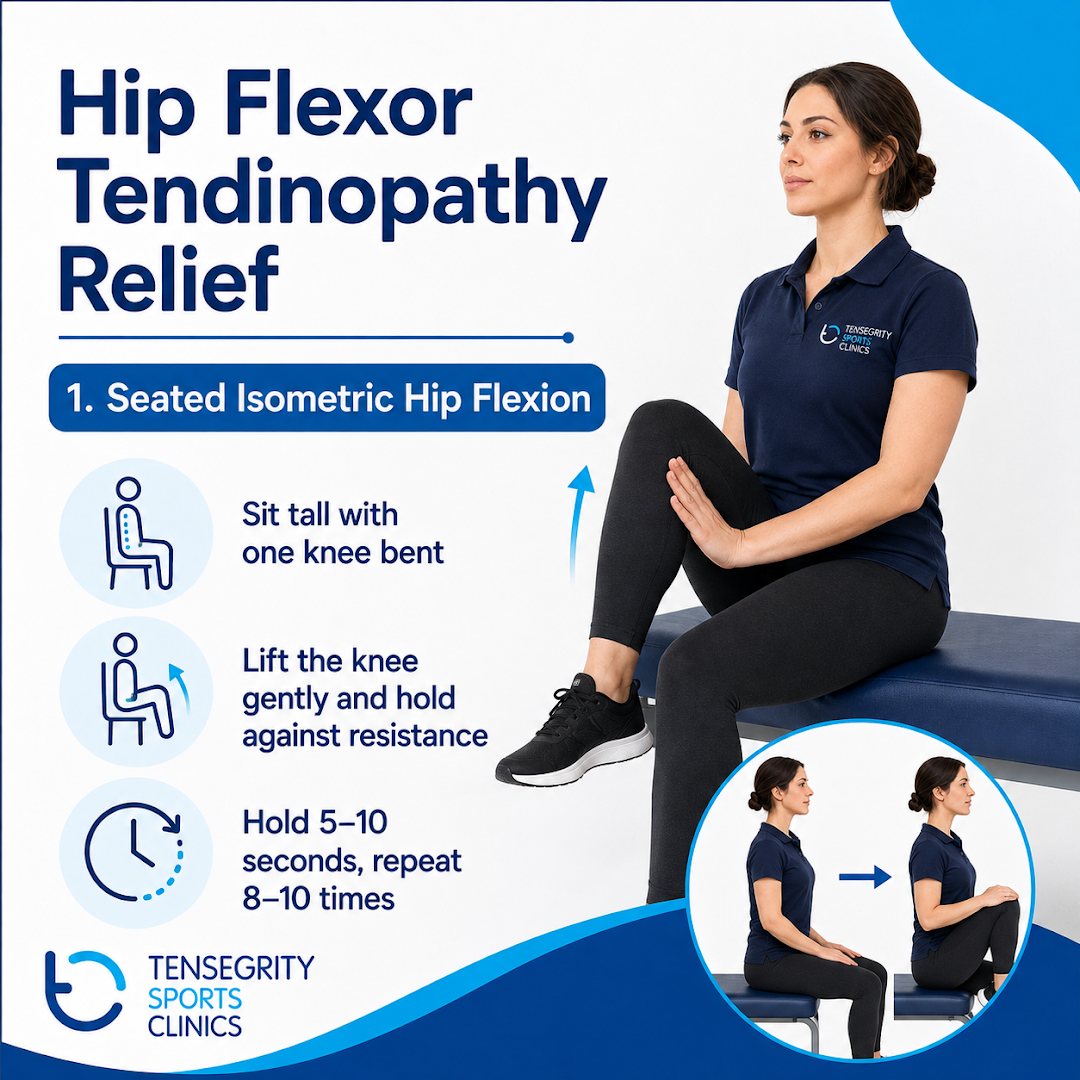

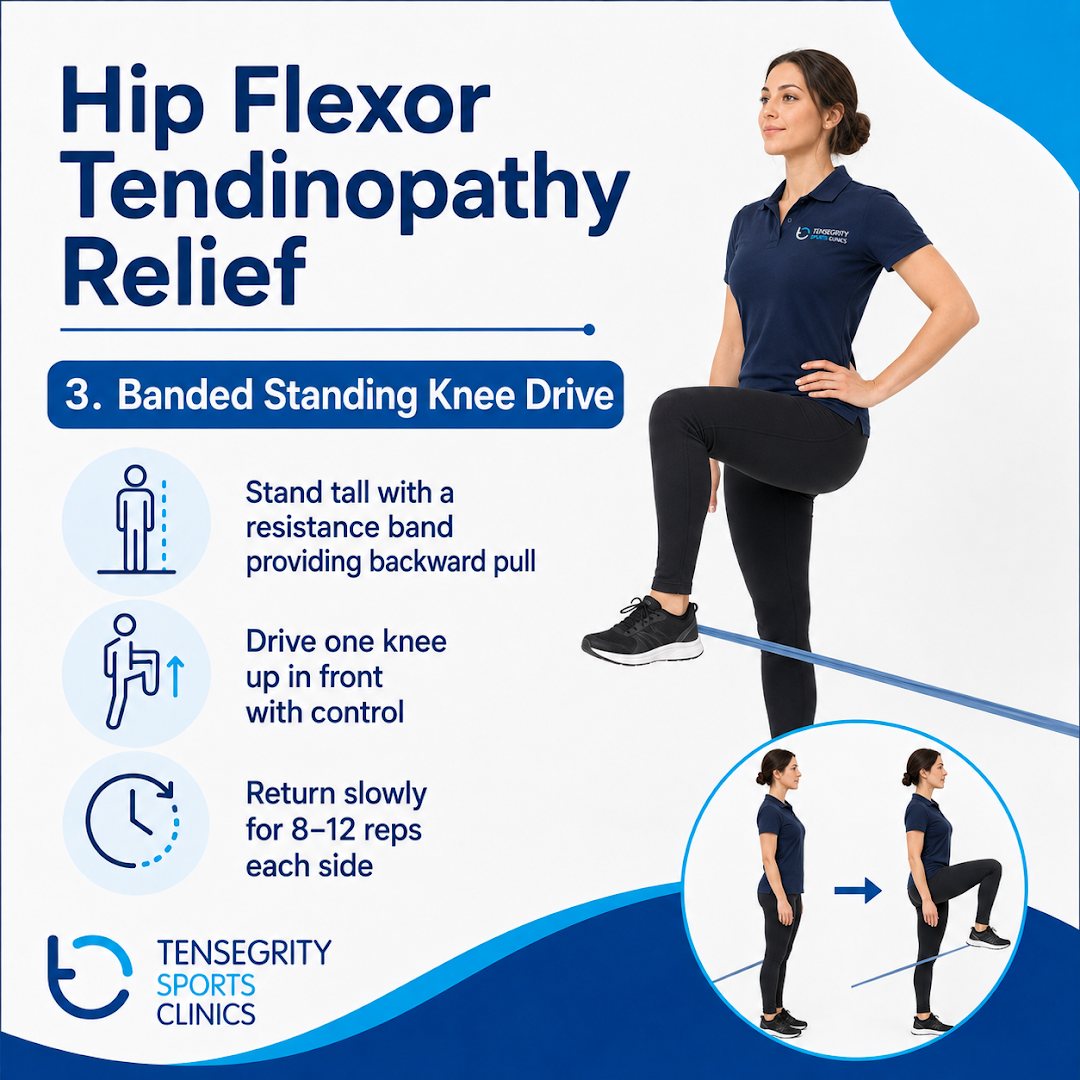
Aggressive hip flexor stretching can aggravate an irritable tendon, so it is not automatically the answer here. If it is not settling, book an assessment.
Prevention:
- Maintain hip flexor strength: most people never train it directly, which is part of the problem.
- Maintain gluteal and lower limb strength: so the load is shared.
- Increase running volume gradually: and introduce sprinting and hills progressively.
- Increase kicking volume gradually: particularly at the start of a season.
- Avoid sudden spikes in training load: the single most common trigger.
- Allow recovery between demanding sessions: and keep strength training through the season.
- Finish rehabilitation after previous hip or groin injuries: and address recurring front-of-hip pain early.
Outlook:
Most people with iliopsoas tendinopathy return to normal activity and sport with appropriate rehabilitation. Persistent symptoms do not mean the tendon needs complete rest.
In fact, repeatedly resting until the pain goes and then going straight back to full activity is what keeps this recurring, because the tendon never rebuilds enough capacity. Rehabilitation has to progressively prepare the hip for the actual demands of walking, running, sprinting, kicking or whatever you need it for.
It does not usually mean permanently avoiding running, squatting, kicking or hip flexion exercises. During an irritable period the aggravating activities are temporarily reduced. The long-term goal is a stronger, more load-tolerant hip flexor.
Get assessed if: hip or groin pain persists or is getting worse, pain significantly affects your walking, you develop substantial weakness, symptoms began after a significant traumatic injury, you have significant bruising or swelling, the hip repeatedly catches or locks, you cannot bear weight, or symptoms are not improving despite appropriate rehabilitation.
Sudden severe hip or groin pain after trauma, particularly with an inability to bear weight, needs prompt medical assessment. So does severe hip pain alongside an unexplained fever or feeling generally unwell.