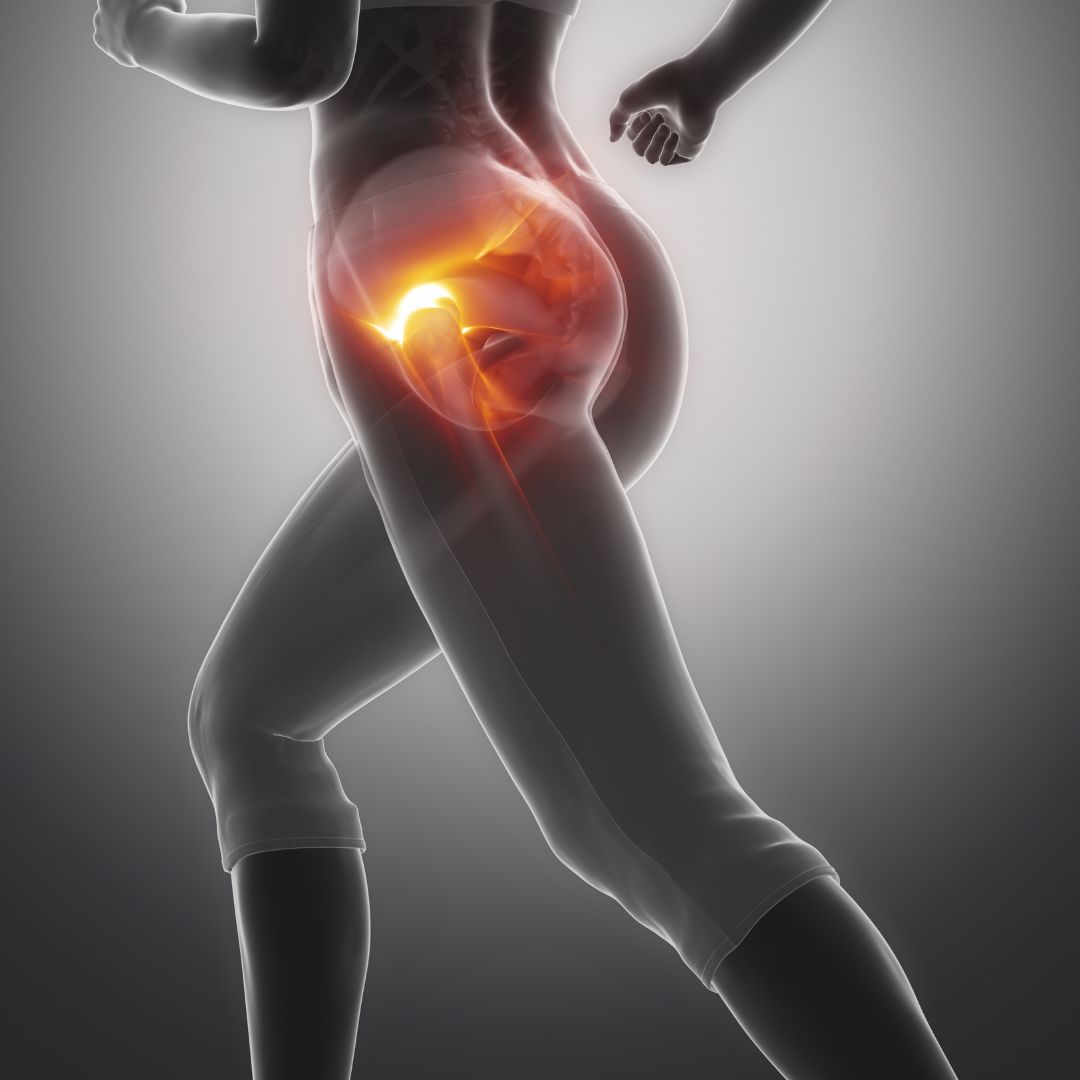

Overview:
A hip flexor strain is when one or more of the muscles at the front of the hip is overstretched or partially torn. It usually happens in a single moment during sprinting, kicking, rapid acceleration or an explosive change of direction.
Soccer, AFL, rugby, martial arts, dance and running-based sports see most of them. Symptoms start suddenly: pain at the front of the hip or groin, weakness lifting the knee, and discomfort walking, running or kicking.
Most mild to moderate strains recover well with appropriate rehabilitation. More significant injuries need a longer recovery and an assessment to rule out other causes of acute hip and groin pain. This page sits under our wider hip pain information.
Anatomy:
The hip flexor group brings the thigh towards the body. The main players are the iliopsoas, made up of iliacus and psoas major; rectus femoris, one of the quadriceps that crosses both the hip and the knee; sartorius, a long muscle running across the front of the thigh; and tensor fasciae latae.
They matter in walking, running, sprinting, kicking, stairs, jumping, changing direction and lifting the knee. Rectus femoris is the one most vulnerable during explosive activity, because it crosses two joints and can be loaded at both ends at once.
Causes:
A strain happens when the muscle is rapidly stretched or contracts forcefully:
- Sprinting: the single most common mechanism.
- Rapid acceleration: or an explosive start from standing.
- Powerful kicking: particularly a long kick or a missed contact.
- A sudden change of direction: or jumping and landing awkwardly.
- Slipping or overstretching the leg: the leg goes further than the muscle was ready for.
- A sudden increase in training intensity: often the first fast session of a pre-season.
- Forceful or repeated hip flexion in the gym: heavy or high-volume leg raises.
Risk goes up with a previous hip flexor injury, a jump in sprinting volume, inadequate preparation for high-speed work, reduced hip flexor or lower limb strength, fatigue, returning to sport before finishing rehabilitation, and limited exposure to sprinting or kicking before competition starts. Previous injury matters most, because incomplete rehabilitation is what drives recurrence.
Symptoms:
- Sudden pain at the front of the hip: usually with a clear moment you can name.
- Groin pain: and tenderness at the front of the hip.
- Pain lifting the knee: and climbing stairs.
- Pain running, sprinting or kicking: particularly at speed.
- Reduced hip strength: the leg feels weak rather than just sore.
- Pain stretching the front of the hip: and difficulty walking normally.
- A tearing or pulling sensation: in more significant strains, sometimes with swelling, bruising and a limp.
Grading. A Grade 1 strain involves a relatively small amount of fibre damage: mild pain, tenderness, minimal strength loss, walking normally or with minor discomfort. A Grade 2 is a moderate partial tear with more pain, reduced strength, pain walking or running, possible swelling or bruising and difficulty getting back to sport. A Grade 3 is a severe or complete tear with sudden severe pain, significant weakness, swelling or bruising, difficulty walking and major loss of function. Severe injuries need appropriate medical assessment.
Diagnosis:
Assessment starts with how the injury happened, then a physical examination.
- The mechanism: what you were doing at the moment it went.
- Location of the pain: and muscle tenderness on palpation.
- Walking ability: and whether there is a limp.
- Hip range of motion: and what the stretch position does.
- Hip flexor strength: and pain during resisted hip flexion.
- Bruising or swelling: which helps with grading.
- Running and sporting movements: when the stage of injury allows.
Strain or tendinopathy? A strain happens suddenly, with a clear mechanism, immediate pain, and sometimes bruising or swelling. Iliopsoas tendinopathy develops gradually, gets progressively worse with repeated activity, relates to ongoing load rather than one event, and persists or flares over a longer period. The distinction changes both the rehabilitation and what to expect.
Hip flexor strain or groin strain? A groin strain usually involves the adductor muscles on the inside of the thigh. A hip flexor strain is felt more towards the front of the hip and upper thigh. They overlap enough that assessment is worth it.
Do you need imaging? Most mild strains do not. Ultrasound or MRI is considered where a significant tear is suspected, there is substantial weakness, significant bruising or swelling develops, the diagnosis is uncertain, recovery is not progressing, or a tendon or avulsion injury is suspected. In younger athletes, sudden severe pain during sprinting or kicking can involve an avulsion injury, where the tendon pulls on its bony attachment. That needs proper assessment.
Treatment:
Early on the aim is to protect the injured muscle while keeping appropriate movement, then progressively rebuild strength and finally speed.
- Early management: temporarily stopping sprinting and kicking, reducing what clearly increases pain, keeping comfortable walking where possible, gradually restoring hip movement, and avoiding aggressive stretching of the injured muscle. Ice may give short-term relief if you prefer it, though it is not essential for healing. Prolonged complete rest is generally unnecessary for uncomplicated strains.
- Early rehabilitation: gentle hip flexor activation, isometric hip flexion, controlled range of motion work and comfortable lower limb strengthening.
- Progressive strengthening: resisted hip flexion, standing marches, loaded hip flexion, squats, split squats, lunges, step-ups and running-specific strengthening.
- Loading rectus femoris across both joints: where it is the muscle involved, rehabilitation needs to load it at the hip and the knee together, not just one.
- Progressive return to running: comfortable walking, strengthening, easy jogging, continuous running, faster running, acceleration, higher-speed running, then sprinting.
- Return to kicking: short-range controlled kicking, low intensity, then increasing distance, then increasing force, then sport-specific drills and full-intensity kicking.
- Manual therapy: useful for surrounding muscle discomfort or stiffness. It cannot replace the strengthening that restores muscle capacity.
Should you stretch it? Not aggressively, and not straight away. Hard stretching immediately after a strain can aggravate it. Early on the priority is comfortable movement rather than forcing the muscle into a strong stretch. Mobility comes back gradually as healing progresses, guided by symptoms and what you actually need to do.
Rehabilitation:
How long does it take? As a guide, mild Grade 1 strains take about one to three weeks. Moderate Grade 2 strains take about three to eight weeks. More significant strains may need two to three months or longer. Severe tears or avulsion injuries can take several months and require medical management. Those are approximate. Return to sport is based on recovered function, not the calendar.
Before returning to unrestricted sport, you should have appropriate hip range of motion, hip flexor strength, lower limb strength, running tolerance, sprinting ability, acceleration, change of direction capacity, kicking ability where relevant, and confidence in sport-specific movement.
Pain disappearing during everyday activities does not mean the muscle is ready for maximal sprinting or kicking. That gap is where most re-injuries happen. For athletes, tolerating high-speed running before unrestricted competition is the part that cannot be skipped.
Three exercises for a hip flexor strain
These three were put together by our practitioners as a starting point. They are general exercises, not a personalised program.
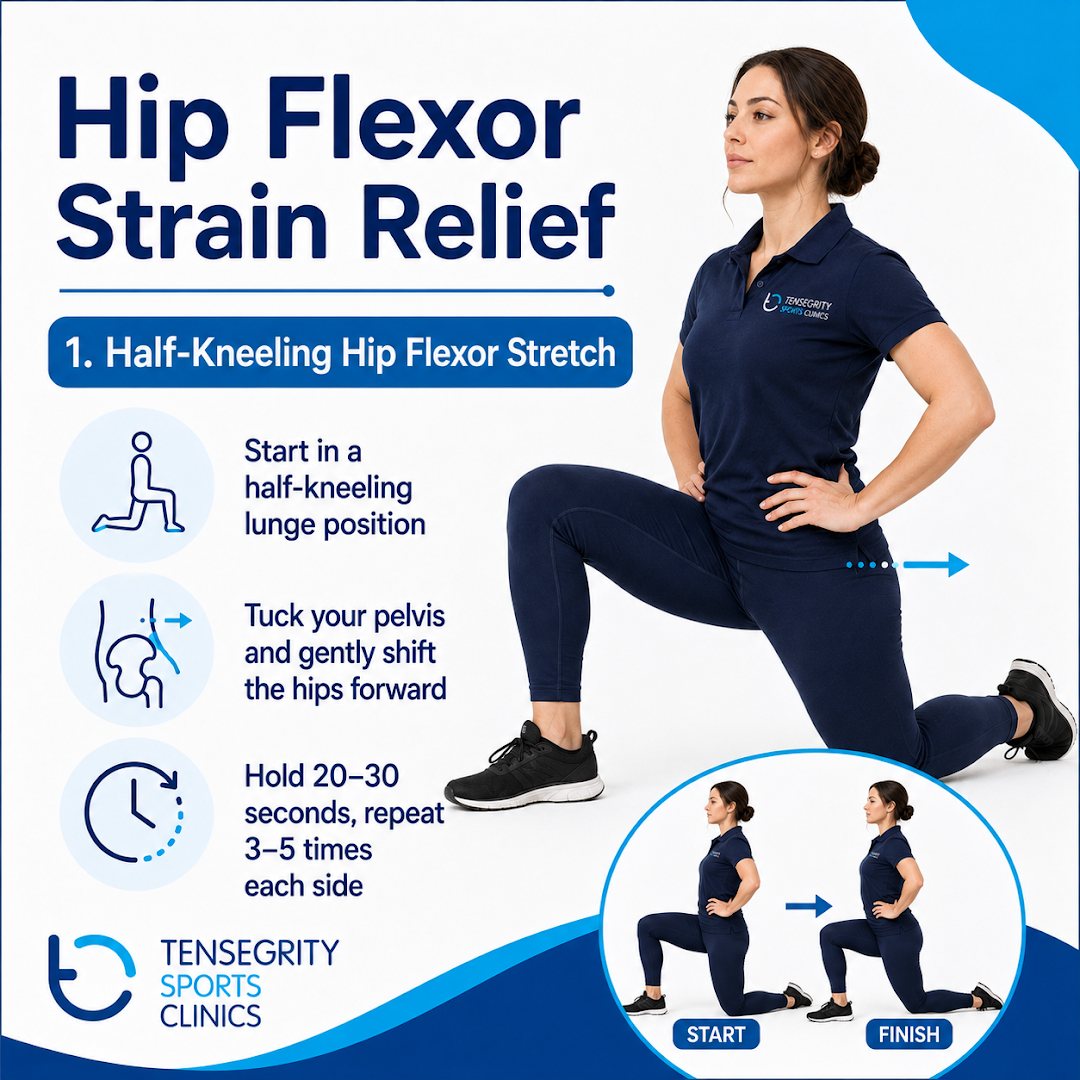
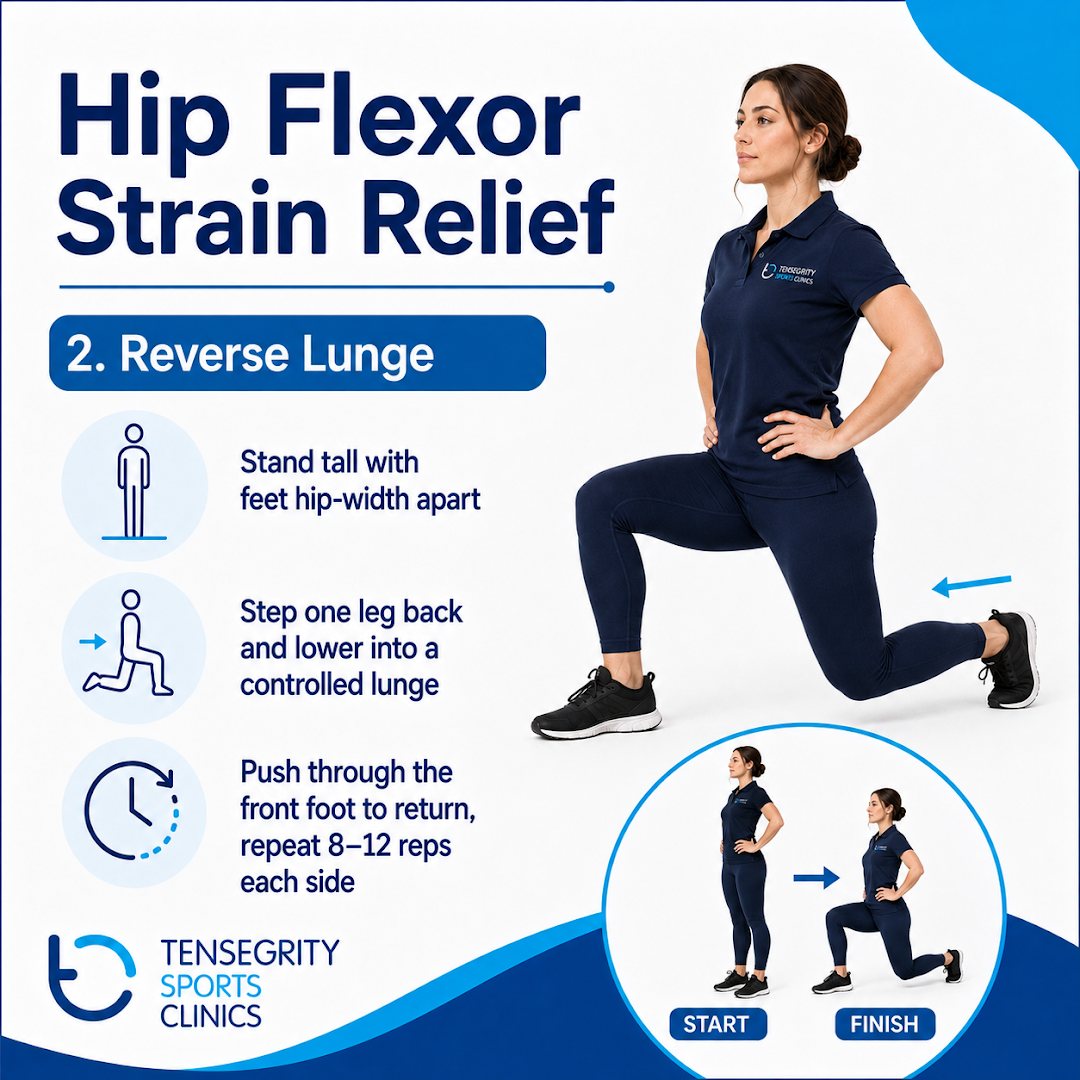
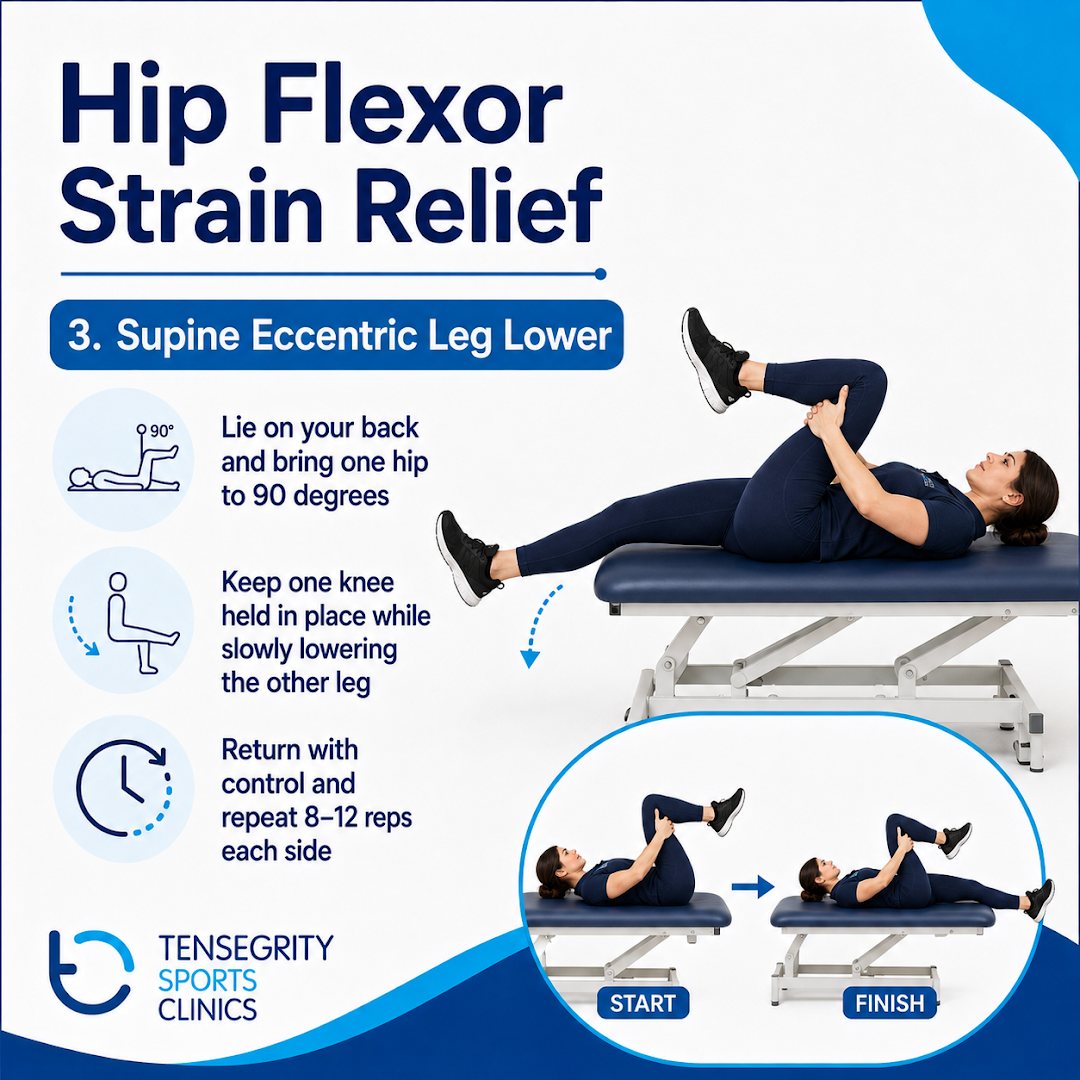
The stretch belongs later rather than in the first few days, when hard stretching can aggravate a fresh strain. If you cannot walk normally or the leg feels weak, get assessed before starting.
Prevention:
- Maintain hip flexor strength: directly, not just as a by-product of running.
- Maintain gluteal and lower limb strength: so the hip flexors are not compensating.
- Include regular sprint exposure: where the sport calls for it. Muscles that never sprint are not ready to sprint.
- Increase running speed progressively: and kicking volume gradually.
- Warm up properly before high-intensity activity: particularly in cold weather.
- Avoid sudden spikes in training load: and keep strength training through the season.
- Finish rehabilitation after a previous strain: and return to maximal-speed movement in stages.
Outlook:
Most hip flexor strains have a good outlook and recover without surgery. The risk of it happening again goes up when athletes return to high-speed activity before rebuilding enough strength and capacity, which is why rehabilitation has to continue past the point of being pain-free.
A strain usually means temporary modification rather than permanently avoiding running, kicking or sport. As symptoms settle, strength is rebuilt and then speed is reintroduced. For athletes, rehabilitation should continue until the hip flexors can handle high-speed running, explosive movement and powerful kicking, not stop as soon as everyday movement feels comfortable.
Get assessed if: you had severe pain after an acute injury, you heard or felt a significant pop or tearing sensation, you cannot walk normally, significant bruising or swelling develops, there is substantial weakness lifting the leg, symptoms are getting worse, pain is not improving as expected, or you cannot get back to normal exercise despite rehabilitation.
Young athletes with sudden severe hip or pelvic pain during sprinting or kicking should be assessed to exclude an avulsion injury.