
Overview:
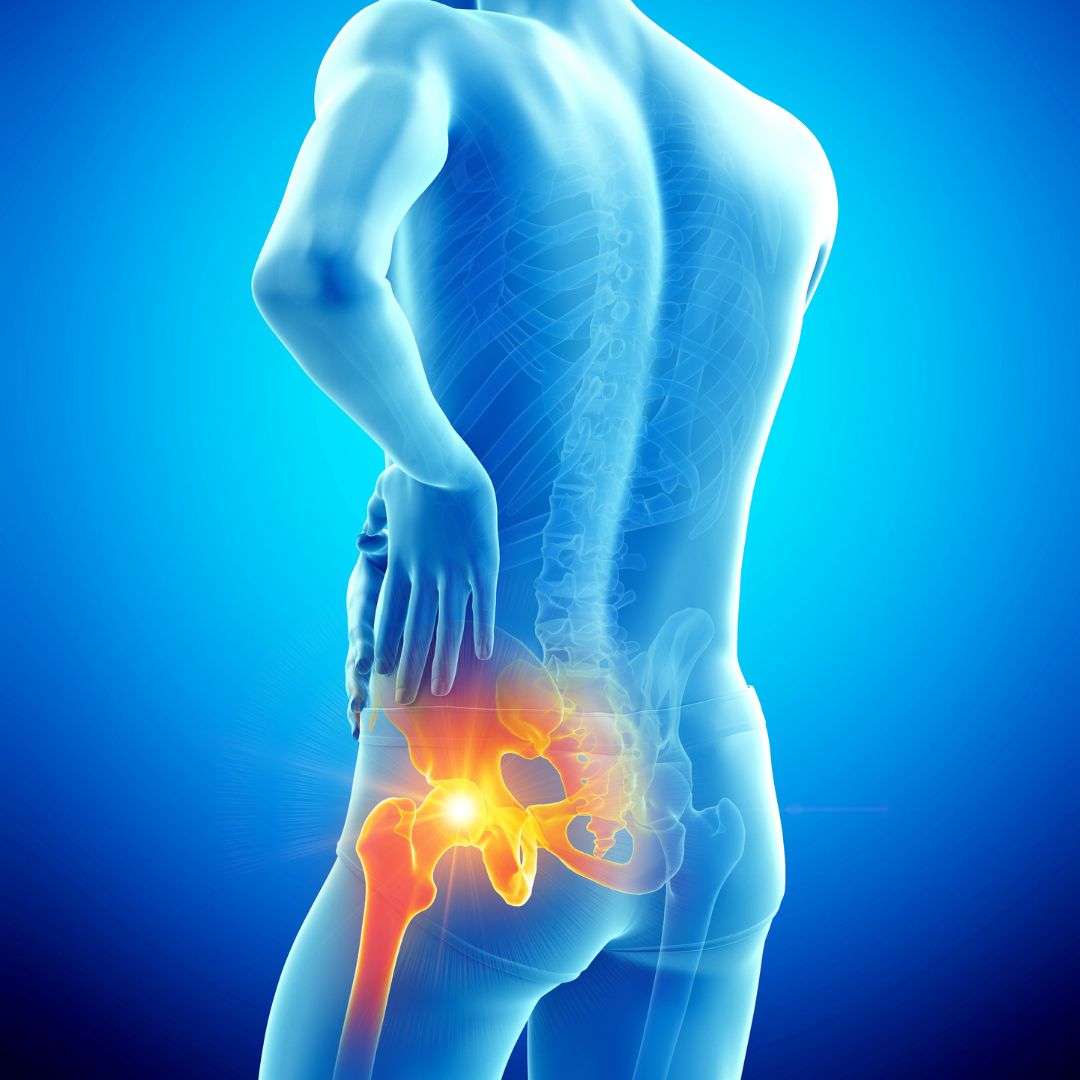
Femoroacetabular impingement, usually shortened to FAI and often called hip impingement, describes a hip where the shape of the joint leads to increased contact between the femur and the acetabulum during certain movements.
It typically causes pain at the front of the hip or in the groin, particularly with deep squatting, long periods sitting, running, pivoting or anything involving repeated hip flexion.
Here is the part that gets missed. FAI-related anatomy is common and does not automatically mean you will have pain. Plenty of people have cam or pincer shaped hips on imaging with no symptoms at all. When the shape sits alongside symptoms and clinical findings, it is called FAI syndrome. Treatment usually starts with activity modification and progressive rehabilitation, not an operation. This page sits under our wider hip pain information.
Anatomy:
The hip is a ball and socket joint. The femoral head is the rounded top of the thigh bone, the femoral neck is the narrower section below it, and the acetabulum is the socket in the pelvis. A ring of fibrocartilage called the labrum surrounds the edge of the socket, and articular cartilage covers the joint surfaces.
Cam morphology means extra bone or reduced roundness around the junction of the femoral head and neck, which can contact the edge of the socket during deep flexion and rotation. It is relatively common, particularly in athletes. Pincer morphology means the socket covers more of the femoral head than usual, so the femoral neck can contact the rim. Some people have both. On its own, none of this means there is a problem.
Morphology is not syndrome. Someone can have cam or pincer shape on an X-ray with no pain, normal function and no difficulty exercising. That does not need treating. FAI syndrome means symptoms, clinical findings on examination and imaging consistent with the morphology, together. The scan alone is not the diagnosis.
Causes:
- Hip development during adolescence: cam morphology may develop during skeletal growth, particularly in young people playing high-load sport.
- Sporting participation: football, soccer, hockey and other sports involving repeated hip loading show higher rates of cam morphology.
- Individual anatomy: some people simply develop a different hip shape.
- Repetitive hip flexion and rotation: which can provoke symptoms where the anatomy is already there.
- High training loads: repeated high-intensity sport exposes the hip to substantial force.
Exercise should not be treated as harmful just because FAI morphology is present. Many athletes with these features stay completely symptom free.
Symptoms:
FAI syndrome commonly causes pain around the front of the hip or the groin:
- Deep groin pain: often described as inside the joint rather than on the surface.
- Pain in deep squatting or lunging: the most reliable provoker.
- Pain sitting for long periods: and getting in or out of a car.
- Pain bringing the knee towards the chest: or during running and kicking.
- Pain twisting or pivoting: turning on a loaded leg.
- Hip stiffness and reduced movement: particularly into rotation.
- Clicking or catching: and difficulty with deep gym exercises.
Many people describe it with the C-sign, cupping a hand in a C shape around the front and side of the hip. That gesture usually means deep joint discomfort rather than something superficial.
Diagnosis:
Assessment is a detailed history and physical examination, with provocation tests to see whether particular hip positions reproduce your familiar symptoms.
- Location and behaviour of the pain: what brings it on, and how deep it feels.
- Hip range of motion: particularly flexion and internal rotation.
- Hip strength: tested across all directions.
- Loading tests: squatting, lunging and single-leg movements.
- Running or sporting movements: where relevant to what you do.
- Recent training changes and occupational demands: long hours seated matters here.
- Previous hip injuries: and how they were managed.
FAI or hip flexor pain? Both cause pain at the front of the hip. Hip flexor pain is typically aggravated by resisted hip flexion, sprinting and kicking. FAI syndrome is more likely to give deep groin discomfort with deep flexion, squatting, pivoting and prolonged sitting. There is real overlap, which is why assessment matters rather than assuming all front-of-hip pain is impingement.
FAI and labral tears often occur together, because repeated contact between the femur and socket can load the labrum. But both FAI morphology and labral abnormalities show up in people with no pain, so a scan showing both does not automatically mean surgery. X-ray assesses the shape of the femoral head and neck, the socket, the joint space and any signs of osteoarthritis. MRI is added where more detail is needed about the labrum, cartilage or surrounding soft tissue.
Treatment:
Initial management is commonly non-surgical, aimed at improving the hip’s ability to tolerate the movements and loads you actually need.
- Activity modification: temporarily reducing very deep squatting, deep lunging, long periods sitting in low chairs, repeated pivoting, high-volume kicking and high-volume running. Not permanent avoidance. The point is less irritation while capacity is rebuilt.
- Progressive hip strengthening: glutes, hip flexors, extensors, abductors, adductors, quadriceps, hamstrings and trunk. What you train depends on your goals. An athlete needs the hip prepared for far more than walking.
- Squat and movement modification: adjusting depth, stance width, foot position, exercise selection and resistance often lets training continue while symptoms settle. There is no single correct squat technique for FAI, because hip anatomy differs between people. The movement adapts to you.
- Mobility work where it is genuinely restricted: forcing a structurally limited hip into greater range is not always appropriate. The goal is the movement your activities require without repeatedly provoking the joint, not maximum flexibility.
- Manual therapy: can give short-term relief and address relevant muscular or joint restriction. It cannot change the shape of the bones, so it sits alongside strengthening and load management.
- Running and sport progression: strength training, then running, faster running, jumping, landing, acceleration, deceleration, pivoting, cutting, kicking and sport-specific drills.
- Review and progression: reassessed against function rather than repeated unchanged.
Surgery. Not everyone with FAI needs it, and many people with symptomatic FAI improve with rehabilitation and activity modification. Surgical assessment may be considered where symptoms remain significantly limiting despite appropriate rehabilitation, hip pain substantially affects quality of life, sport or work stays significantly restricted, associated labral or cartilage pathology is clinically important, or the symptoms and findings are consistent with surgically treatable FAI syndrome. Surgery should not be recommended simply because an X-ray shows cam or pincer morphology. Where it is appropriate, hip arthroscopy through small incisions may reshape clinically relevant cam morphology, address overcoverage, repair the labrum or treat associated cartilage damage. Rehabilitation afterwards is what restores strength and function.
Rehabilitation:
How long does it take? With non-surgical treatment, meaningful improvement often comes over about six to twelve weeks. Building enough strength and capacity for demanding sport commonly takes three to six months or longer. After hip arthroscopy, rehabilitation typically runs several months, and return to unrestricted sport commonly takes around four to six months or longer depending on the procedure and the sport. Treat those as guides, not guarantees.
Returning to sport is judged on hip pain, the range of motion your sport actually needs, hip and lower limb strength, single-leg control, running tolerance, jumping and landing, change of direction, sport-specific skills and confidence. Ideally you should be tolerating progressive training loads before unrestricted competition.
Three exercises for FAI
These three were put together by our practitioners as a starting point. They are general exercises, not a personalised program.
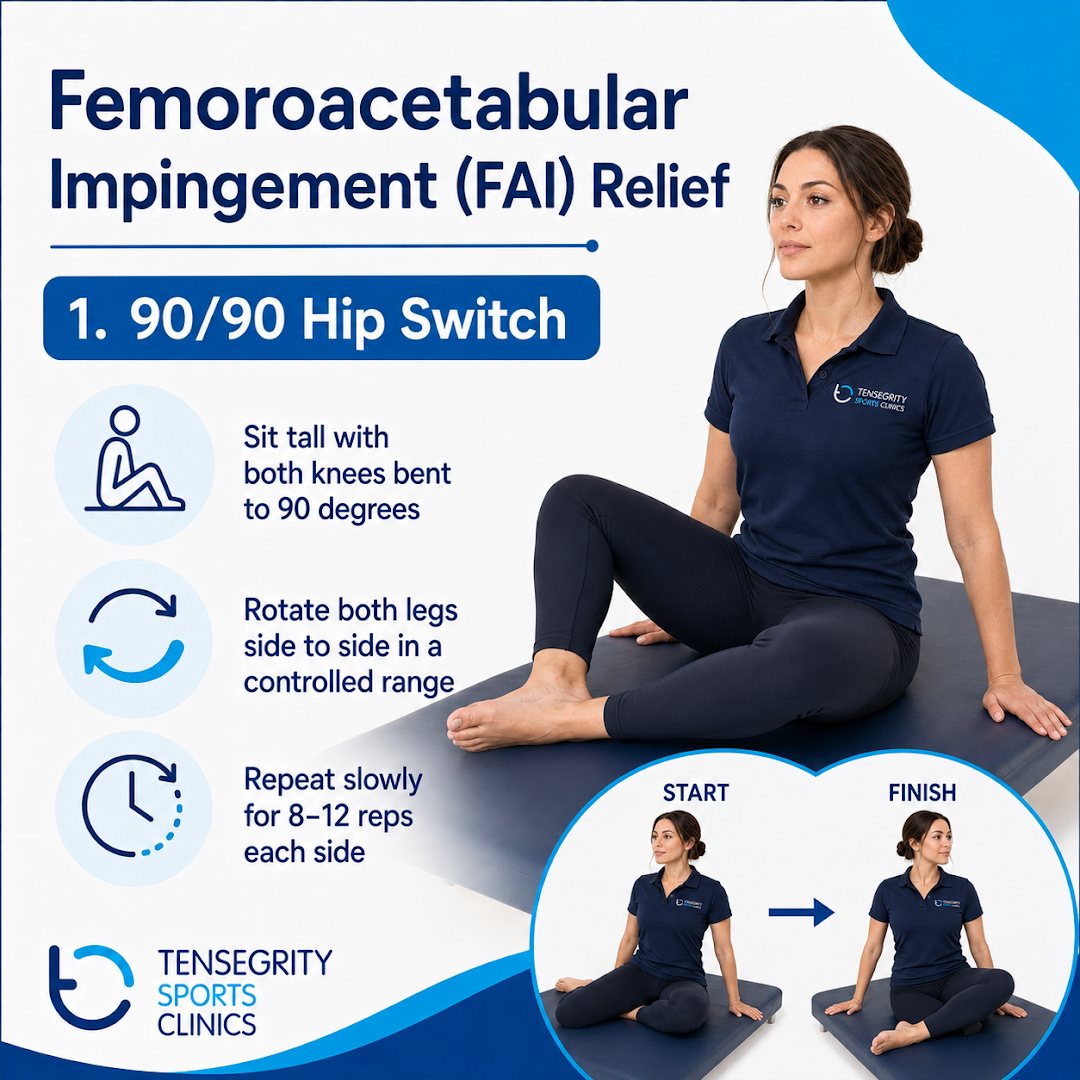
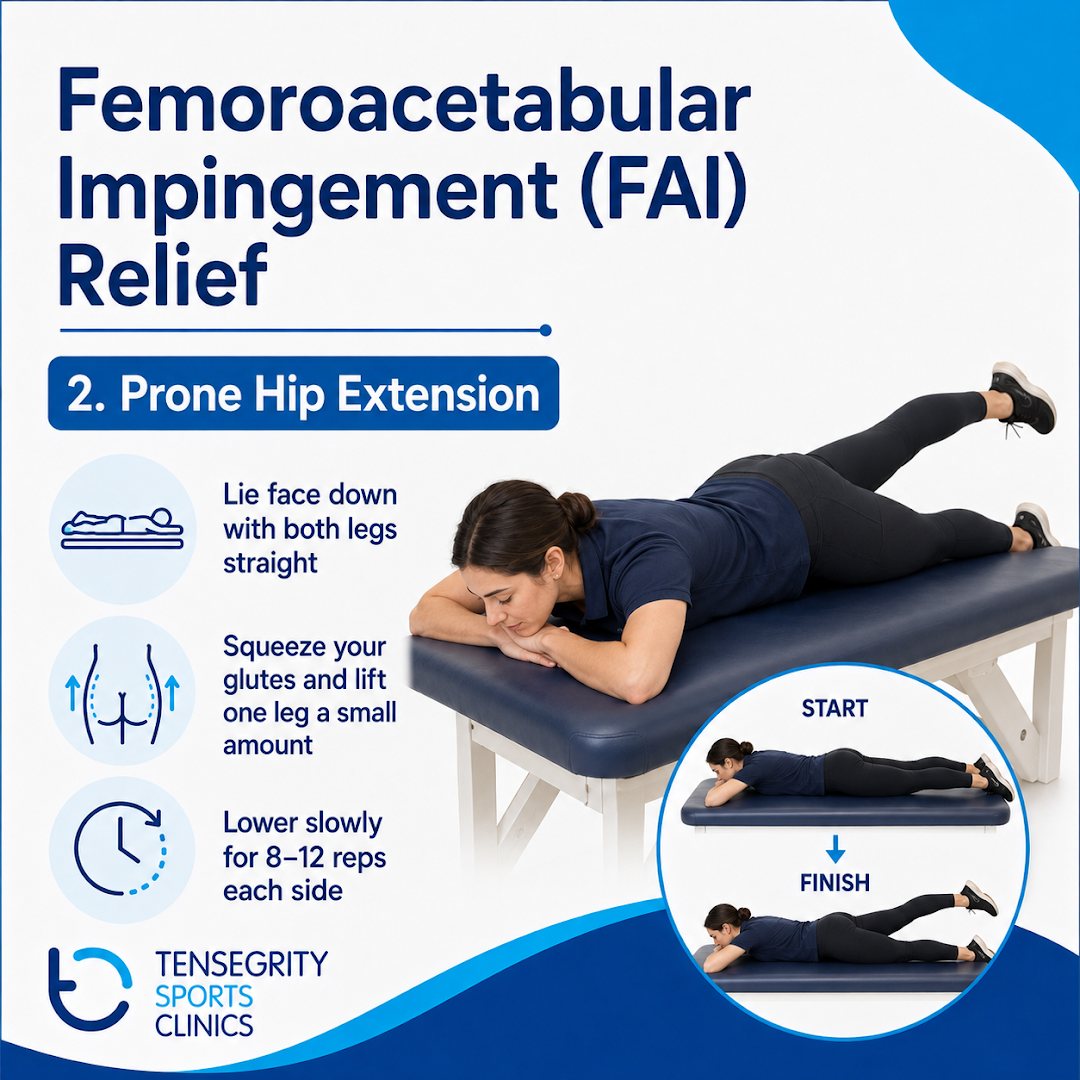
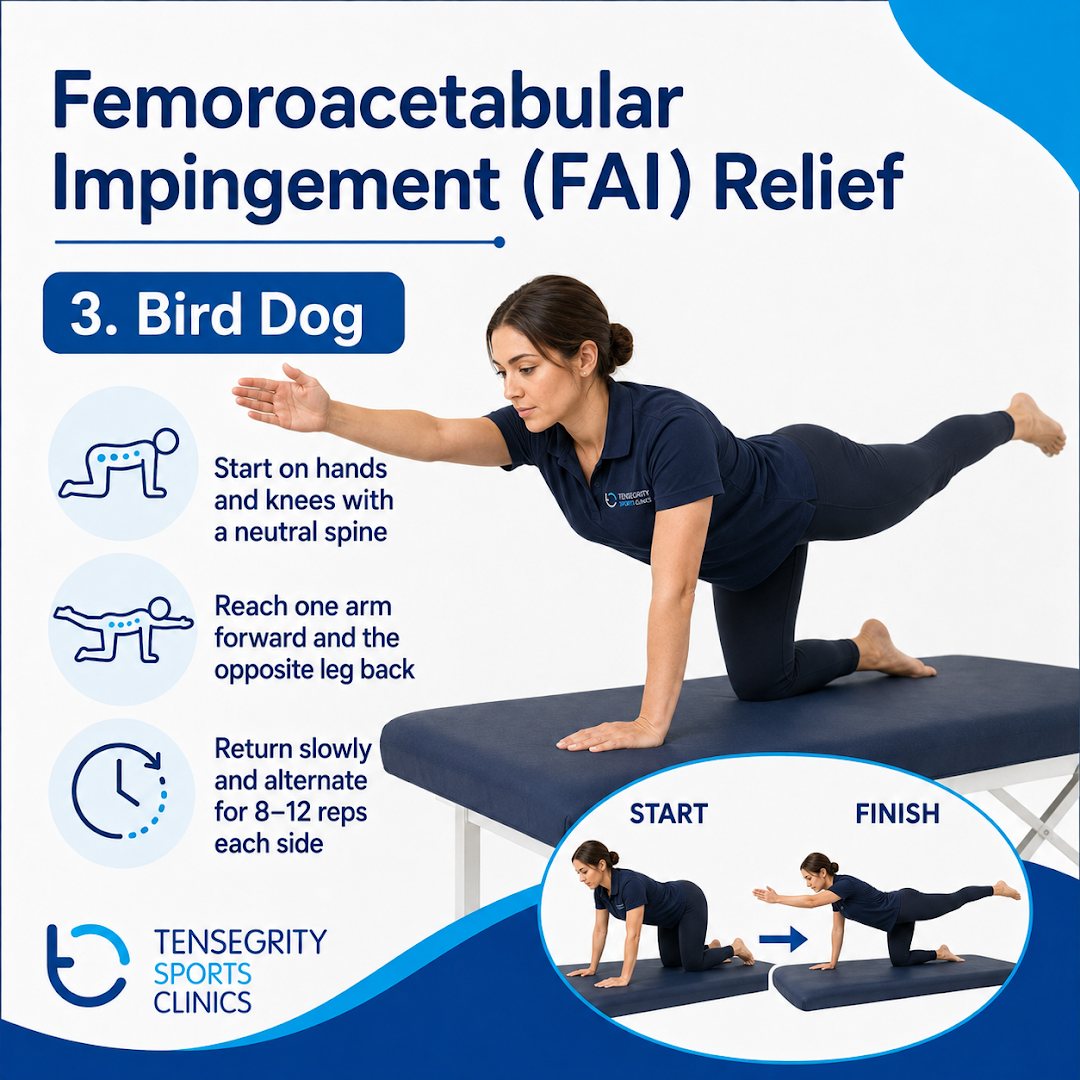
Deep squatting and long periods sitting with the knees higher than the hips both load the front of the joint. Adjust those before adding more exercise, and book an assessment if the hip is not settling.
Prevention:
FAI morphology itself cannot be prevented or changed through exercise once skeletal development is complete. These reduce symptomatic flare-ups:
- Maintain hip and lower limb strength: the main protective factor available to you.
- Progress training volume gradually: and avoid sudden increases in running or sporting load.
- Modify repeatedly provocative positions: where it is practical to do so.
- Keep regular strength training: through the season, not just pre-season.
- Allow sufficient recovery: between demanding sessions.
- Finish rehabilitation after hip injuries: and build sport-specific capacity progressively.
- Address recurring groin or hip pain early: before it starts limiting training.
Outlook:
Having cam or pincer morphology does not mean the hip is damaged or destined to become painful. Many people with these features play high-level sport with no symptoms at all. For people who do have FAI syndrome, conservative rehabilitation improves pain and function in many cases, and some with persistent symptoms benefit from surgical assessment. What matters most is how the hip feels and functions, not how the X-ray looks.
Being told you have hip impingement can sound like the bones are grinding themselves apart every time you move. That is not what is happening. The aim is to work out which activities are currently provoking the joint, build strength and capacity, and progressively get back to the movement, exercise and sport that matter to you.
Get assessed if: hip or groin pain persists or is getting worse, symptoms significantly affect walking or exercise, the hip repeatedly catches or locks, hip movement becomes substantially restricted, or you cannot get back to normal sport despite rehabilitation.
Sudden severe hip pain following trauma, particularly with an inability to bear weight, needs prompt medical assessment.