

Overview:
Shoulder bursitis, usually called subacromial bursitis, is when the bursa in the shoulder becomes irritated and sensitive. It causes pain around the front or outer shoulder, particularly lifting the arm, reaching overhead, or lying on that side at night.
A bursa is a small fluid-filled structure that reduces friction between tissues. In the shoulder, the subacromial-subdeltoid bursa helps the rotator cuff tendons and the structures around them move smoothly as the arm moves.
Bursitis rarely turns up on its own. It usually sits alongside rotator cuff related shoulder pain, which is why treating the bursa in isolation tends not to hold. Most cases are managed without surgery. This page sits under our wider shoulder pain information.
Anatomy:
The shoulder is built from several bones, muscles, tendons, ligaments and joints working together to give a very large range of movement. The humerus is the upper arm bone, the scapula is the shoulder blade, and the clavicle is the collarbone. The acromion is a bony projection of the shoulder blade forming the top of the shoulder.
The rotator cuff, four muscles and their tendons, stabilises and moves the joint. The subacromial-subdeltoid bursa sits between the rotator cuff and the structures above it, reducing friction as the arm moves. When it becomes irritated it can be painful through shoulder movement.
Causes:
Bursitis develops when the shoulder takes on repetitive or excessive load:
- A sudden increase in activity: rapidly increasing swimming, throwing, gym training or physical work.
- Repetitive overhead movement: frequent reaching or working above shoulder height.
- Overhead sport: swimming, tennis, cricket and baseball load the shoulder repeatedly.
- Gym training: a jump in pressing, overhead lifting or shoulder volume.
- Rotator cuff problems: bursal irritation frequently occurs alongside rotator cuff tendinopathy rather than by itself.
- Direct trauma: falling onto the shoulder or taking a direct impact.
- Reduced shoulder capacity: weakness through the cuff and surrounding muscles makes repetitive or heavy activity harder to tolerate.
- Age-related change: changes in the tendons and surrounding structures become more common with age.
Less commonly a bursa can become infected. That is septic bursitis, and it needs medical treatment rather than rehabilitation.
Symptoms:
- Pain at the outer or front of the shoulder: often the first thing people notice.
- Pain raising the arm: particularly through overhead activity.
- Pain reaching behind your back: or putting on a shirt, jacket or seatbelt.
- Night pain: lying on the affected shoulder wakes you.
- Pain pushing or pulling: and during swimming, throwing or racquet sports.
- Tenderness and reduced movement: the shoulder is sore to touch and does not want to go as far.
- Pain travelling into the upper arm: without going much past the elbow.
Some people notice a particularly painful section of movement when raising or lowering the arm, sometimes called a painful arc.
Diagnosis:
Assessment starts with a detailed history and physical examination, using a combination of findings rather than one specific test.
- Location and behaviour of the pain: what provokes it and what settles it.
- Shoulder range of motion: and where in the range the pain sits.
- Rotator cuff strength: tested individually, because weakness changes the plan.
- Pain on resisted movement: which directions reproduce your symptoms.
- Shoulder blade function: how the scapula moves on the ribcage.
- Neck screen: where appropriate, because the neck refers into the shoulder.
- Work and sport demands: including recent changes in exercise or workload.
Bursitis or rotator cuff tendinopathy? The two often occur together and produce very similar symptoms: pain raising the arm, pain overhead, night pain, difficulty lifting. That is why it is rarely useful to treat the bursa as the sole source of pain. Assessment looks at the cuff, the bursa, shoulder strength, movement and your activity demands together. Our rotator cuff tendinopathy page covers the other half of that picture.
Do you need imaging? Not always. Ultrasound can identify fluid or thickening in the bursa and assess the cuff tendons. X-ray is useful when arthritis, calcific tendinopathy or another bony condition is suspected. MRI is occasionally recommended where symptoms persist or the diagnosis is unclear. Findings on imaging do not always match the pain, so scans are read alongside the examination.
Treatment:
Treatment settles the irritation while keeping the shoulder moving and rebuilding capacity.
- Activity modification: temporarily reducing repetitive overhead work, heavy overhead pressing, high-volume swimming, throwing, heavy lateral raises and repeated reaching above shoulder height. That does not mean resting the shoulder completely. Prolonged avoidance costs strength.
- Exercise rehabilitation: progressive strengthening through the rotator cuff, deltoid, shoulder blade muscles and upper back, becoming more demanding as capacity improves.
- Restoring movement: pain makes people quietly stop using the shoulder. Mobility work keeps comfortable range without unnecessary aggravation.
- Manual therapy: helpful for associated joint stiffness or muscular discomfort and can give short-term relief. Most useful combined with active rehabilitation rather than on its own.
- Ice or heat: cold can help after an acute flare, heat is often more comfortable when the surrounding muscles feel tight. Either is fine, applied safely.
- Review and progression: reassessed as symptoms change rather than repeated unchanged.
Pain-relieving or anti-inflammatory medication may be appropriate for some people and is worth discussing with your GP or pharmacist. A corticosteroid injection into the bursa can give short-term relief for significant symptoms and can make rehabilitation easier, but it does not address shoulder strength or load capacity, so it is used as part of a plan rather than on its own. Most shoulder bursitis does not require surgery.
Rehabilitation:
Rehabilitation runs in stages. Early on the aim is comfortable movement and settling the irritable phase, usually with light work that does not push into the painful arc. From there resistance increases through the cuff and shoulder blade, then the range and speed of overhead work, then the specific demands of your sport or job.
How long does it take? A mild recent episode often starts improving in about two to six weeks. More established bursitis, or bursitis alongside rotator cuff tendinopathy, commonly needs around six to twelve weeks. Persistent cases can take several months, particularly where symptoms have been there a long time or the shoulder has to return to demanding overhead work or sport. Duration of symptoms, shoulder strength, occupational and sporting demands, associated cuff problems, overall health and consistency with rehabilitation all shift that.
Getting back to the gym, work and sport. Progressive rather than all at once. In the gym that usually means reducing load, range or volume on the painful exercises first, then rebuilding. For overhead athletes, strengthening moves to controlled overhead movement, then faster movement, then throwing or serving drills, then gradual increases in volume. For physical work, rehabilitation should eventually reproduce the lifting, carrying and overhead demands of the job.
Three exercises for shoulder bursitis
These three were put together by our practitioners as a starting point. They are general exercises, not a personalised program.
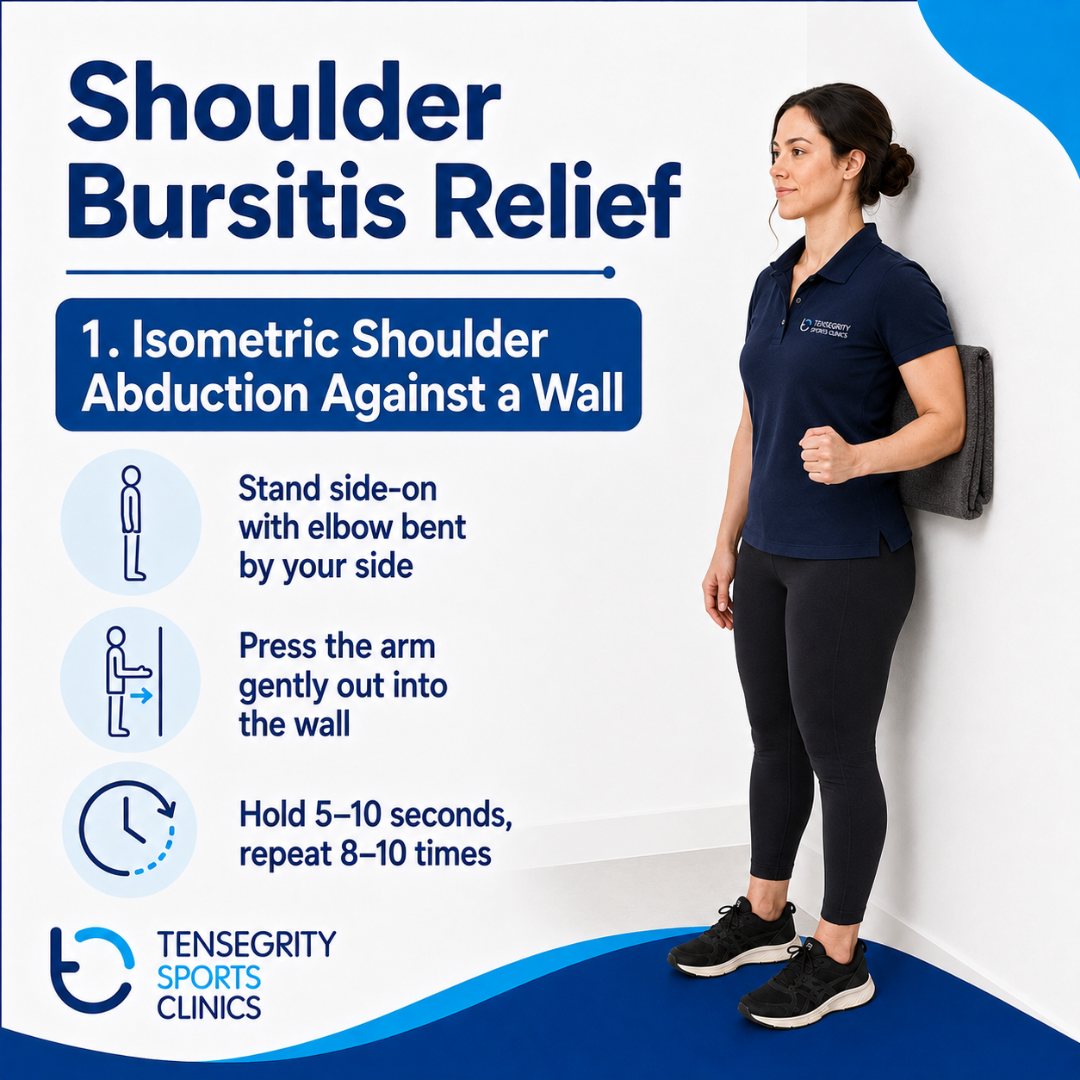
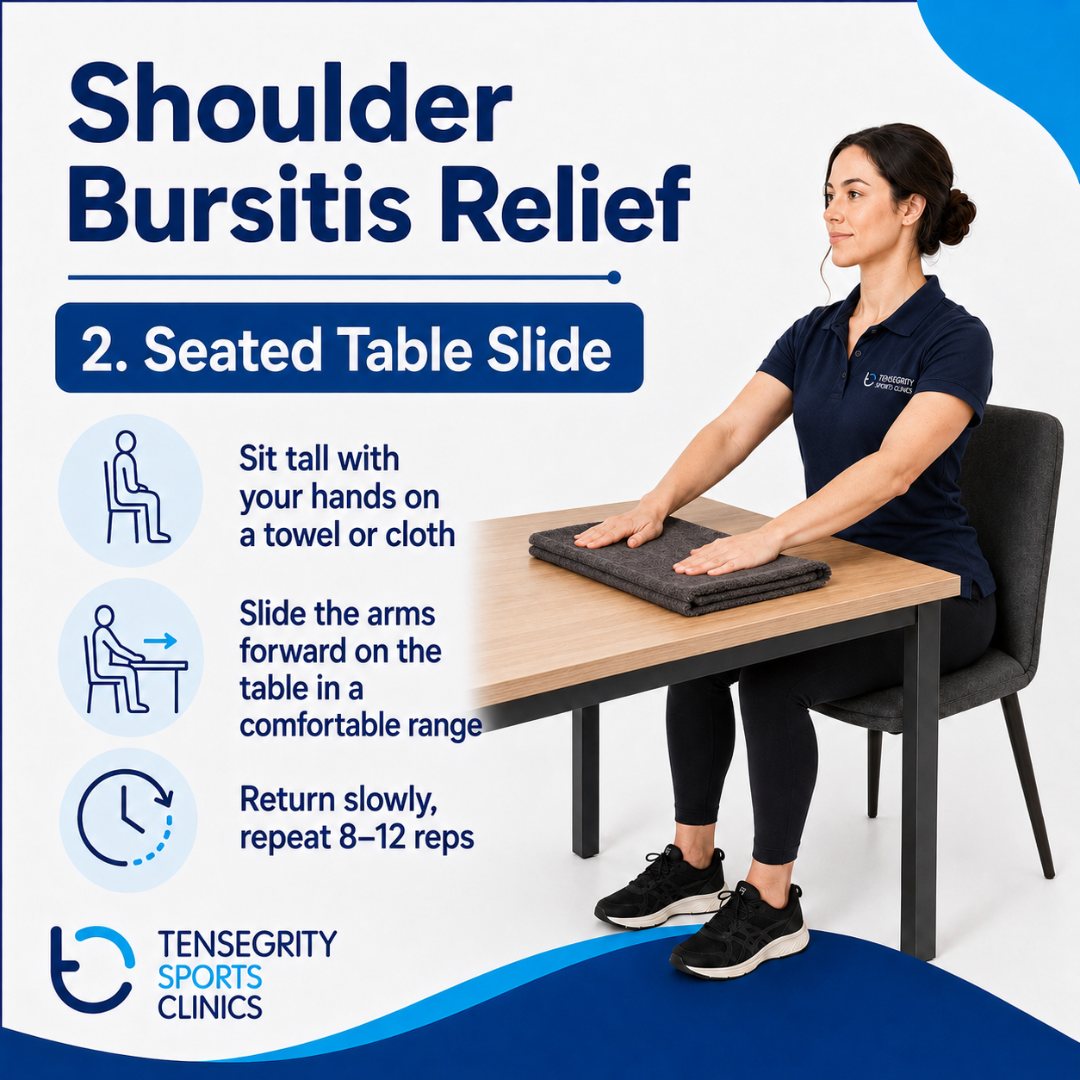
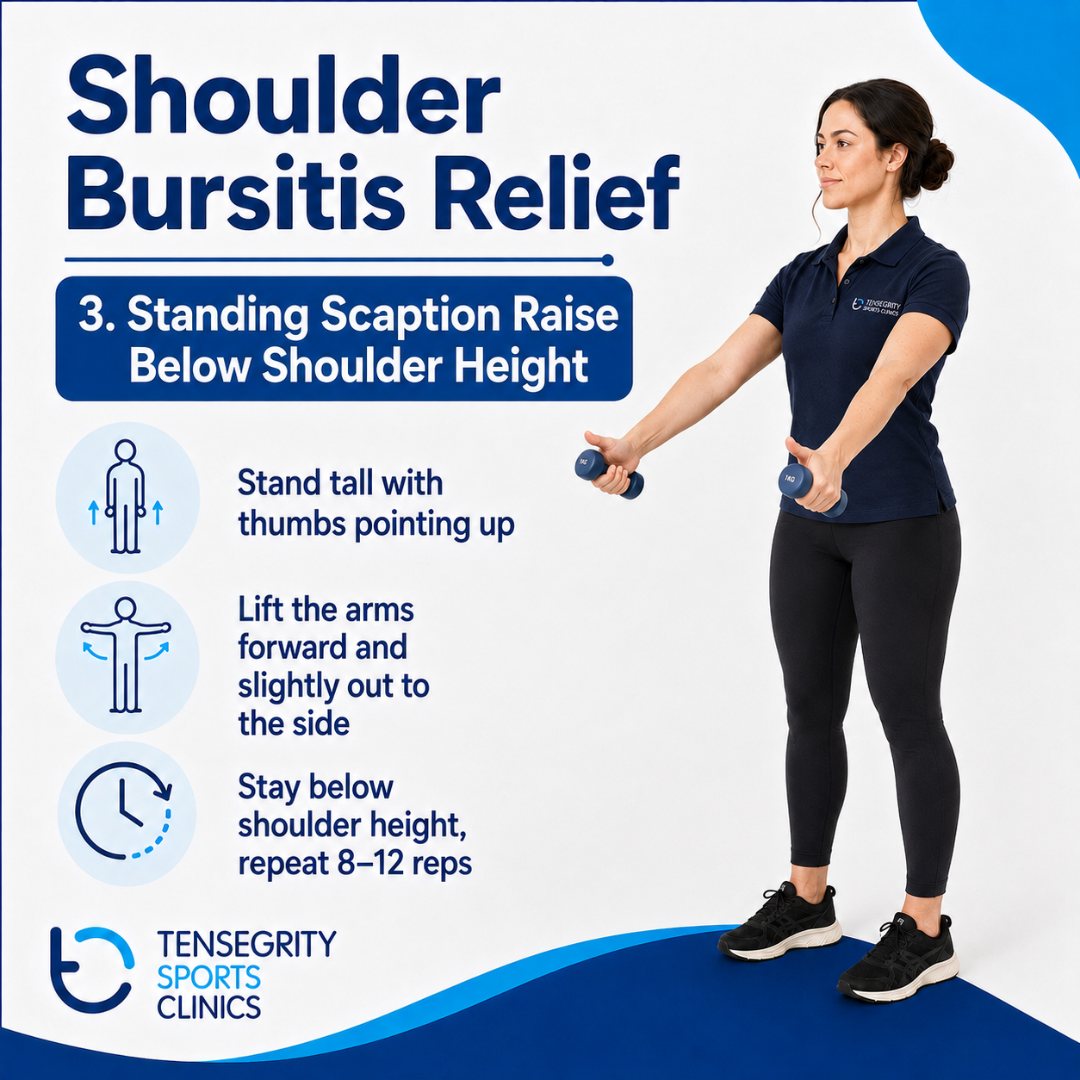
If the shoulder is not settling, or night pain is affecting your sleep, book an assessment so the loading can be matched to what the shoulder can currently handle.
Prevention:
- Keep the rotator cuff strong: the single most useful thing you can do for the shoulder.
- Keep the shoulder and upper back strong: so load is shared rather than concentrated.
- Progress overhead activity gradually: in steps rather than jumps.
- Watch swimming and throwing volume: sudden increases are a common trigger.
- Increase gym loads progressively: and allow recovery between demanding shoulder sessions.
- Keep shoulder mobility: and prepare progressively before returning to overhead sport.
- Keep strengthening after it settles: and address recurring shoulder pain early.
Outlook:
Most people with shoulder bursitis do well and return to normal work, exercise and sport without surgery. Changes seen on a scan do not mean the shoulder is permanently damaged.
For persistent cases, focusing only on trying to eliminate inflammation tends to miss the more important factors: strength, tendon capacity and overall shoulder function. Rehabilitation aims at both the symptoms and the shoulder’s ability to tolerate load. Temporarily reducing the most aggravating activities while keeping comfortable movement and rebuilding strength is what restores normal function.
Get assessed if you have: severe shoulder pain after trauma, a sudden inability to raise the arm, significant loss of strength, pain that persists or worsens, substantial swelling, numbness or other neurological symptoms, or symptoms not improving despite appropriate management.
A shoulder that is hot, red and swollen, particularly with a fever or feeling generally unwell, needs prompt medical assessment to rule out infection.