

Overview:
Rotator cuff tendinopathy is pain and reduced function in one or more of the rotator cuff tendons. It is usually felt at the front or outer side of the shoulder, and it shows up when you lift the arm, reach overhead, train, or lie on that side at night.
It can start after a sudden jump in shoulder activity, or build slowly over months of repeated loading. Swimmers, tennis players, throwers, people who lift, tradespeople and anyone working overhead all see it.
Tendinopathy does not mean the tendon has torn. It means the tendon and the structures around it have become sensitive to loads they cannot currently tolerate. That distinction matters, because it changes the treatment.
Plenty of people arrive having already tried treatment elsewhere and been told to rest it. If that is you, you are not starting from scratch. This page sits under our wider shoulder pain information.
Anatomy:
The rotator cuff is four muscles and their tendons: supraspinatus, infraspinatus, teres minor and subscapularis. They start around the shoulder blade and attach to the head of the humerus, the top of your upper arm bone.
Together they stabilise the joint, lift and rotate the arm, and control where the head of the humerus sits while you move. The supraspinatus tendon is the one most often involved, though several tendons and the structures around them can contribute.
Causes:
Rotator cuff tendinopathy is rarely down to one thing. It is usually several factors stacking up:
- A sudden increase in shoulder load: a jump in gym training, swimming, throwing or overhead work that outruns what the tendon can currently handle.
- Repetitive overhead activity: frequent reaching, lifting or sporting movement above shoulder height.
- Reduced shoulder strength: when the cuff or the shoulder blade muscles are short on capacity, higher loads are harder to tolerate.
- Training errors: weights, reps or frequency going up too fast.
- Age-related tendon change: tendon structure changes with age, though those changes do not automatically cause pain.
- Previous shoulder injury: a history of cuff problems makes recurrence more likely.
- Occupational demand: trades and jobs involving repeated lifting or overhead work load the shoulder day after day.
- Not enough recovery: repeated high-load shoulder sessions stacked without a break.
This used to be explained as the tendon being pinched or impinged. Current understanding is broader. Rotator cuff related shoulder pain involves tendon capacity, strength, load, individual anatomy and other biological factors together.
Symptoms:
- Pain at the front or outer shoulder: often felt lower than expected, around where a sleeve badge sits.
- Pain lifting the arm overhead: reaching a high shelf, hanging washing, pressing at the gym.
- Pain reaching away from the body: or reaching behind your back to do up a strap or grab a seatbelt.
- Pain pushing or pulling: particularly shoulder press and lateral raises.
- Night pain: waking when you roll onto that side.
- Weakness: the arm tires quickly or feels unreliable when lifting.
- Difficulty repeating overhead tasks: fine for one or two, sore by the tenth.
Pain may travel down the upper arm but usually does not go much past the elbow. Clicking and popping without pain is common and does not by itself mean tendon damage.
Diagnosis:
Diagnosis comes from a detailed history and a physical examination, using a combination of findings rather than one test.
- Where the pain sits and how it behaves: what brings it on, what settles it.
- Shoulder range of motion: active and passive, compared side to side.
- Rotator cuff strength: each muscle tested individually rather than as a group.
- Shoulder blade function: how the scapula moves on the ribcage.
- Pain on resisted movement: which directions reproduce your symptoms.
- Neck screen: because the neck refers into the shoulder often enough that skipping it misses cases.
- Training and work history: recent changes in exercise, load or job demands, and previous shoulder injuries.
Tendinopathy or a tear? These are different findings. Tendinopathy means pain and change associated with the tendon without necessarily a significant tear. A rotator cuff tear means partial or complete disruption of the tendon fibres. Tears also show up on scans in people with no shoulder pain at all, particularly with age, so imaging is read alongside symptoms, strength and function.
Do you need a scan? Not routinely. Ultrasound, X-ray or MRI is considered where there has been significant trauma, where there is substantial weakness, where a large tear is suspected, where symptoms persist despite appropriate treatment, or where surgery or a surgical opinion is on the table.
Treatment:
Treatment settles the irritation while progressively rebuilding what the shoulder can handle. Complete rest is rarely the long-term answer.
- Activity modification: temporarily reducing heavy overhead lifting, high-volume swimming, throwing, repetitive overhead work and heavy pressing, or the specific range that hurts. The aim is a manageable level of activity, not stopping.
- Rotator cuff strengthening: progressive resistance through external rotation, internal rotation, elevation and cuff endurance, moving from light to heavier as symptoms allow.
- Scapular strengthening: trapezius, serratus anterior, rhomboids and the rest of the shoulder blade muscles. The goal is overall capacity, not forcing the blade into one supposedly perfect position.
- Manual therapy: useful for associated joint or muscular stiffness and can give short-term relief. It does not restore tendon capacity on its own, so it sits alongside the exercise.
- Shockwave therapy: extracorporeal shockwave is used as an adjunct in persistent tendinopathy, alongside the loading program rather than instead of it. It is available at every Tensegrity clinic except Willoughby. Your practitioner will tell you whether it suits your presentation.
- Functional rehabilitation: progressively returning to what you actually need the shoulder to do, whether that is bench press and rows, throwing and serving, or overhead work on site.
- Review and progression: reassessed as capacity changes rather than repeated unchanged.
Pain-relieving or anti-inflammatory medication is sometimes appropriate during a flare and is worth discussing with your GP or pharmacist. Corticosteroid injection can give short-term relief for significant pain, but it does not replace rehabilitation and is not usually a long-term answer on its own. Most uncomplicated rotator cuff tendinopathy does not require surgery, and a structured rehabilitation program is generally recommended first.
Rehabilitation:
Rehabilitation is a staged build. Early on the work is about loading the tendon at a level it tolerates while the irritable phase settles. From there resistance goes up progressively, then speed and overhead demand, then the specific movements of your sport or job.
How long does it take? Mild or recent symptoms often show meaningful improvement in about six to eight weeks. More established rotator cuff tendinopathy commonly needs eight to twelve weeks or several months of progressive work. Long-standing cases can take three to six months or longer, particularly returning to demanding overhead sport, heavy gym training or physical work. How long depends on symptom duration, shoulder strength, your training or occupational demands, previous injuries, sleep and recovery, and how consistent you are.
Getting back to the gym and sport. Return is progressive rather than a jump from rest to unrestricted training: comfortable movement first, then basic cuff strengthening, heavier resistance, overhead strengthening, faster movements, sport-specific work, then normal volume. Some discomfort during rehabilitation can be acceptable depending on the presentation, but symptoms are monitored and the load adjusted.
Three exercises for rotator cuff tendinopathy
These three were put together by our practitioners as a starting point. They are general exercises, not a personalised program.
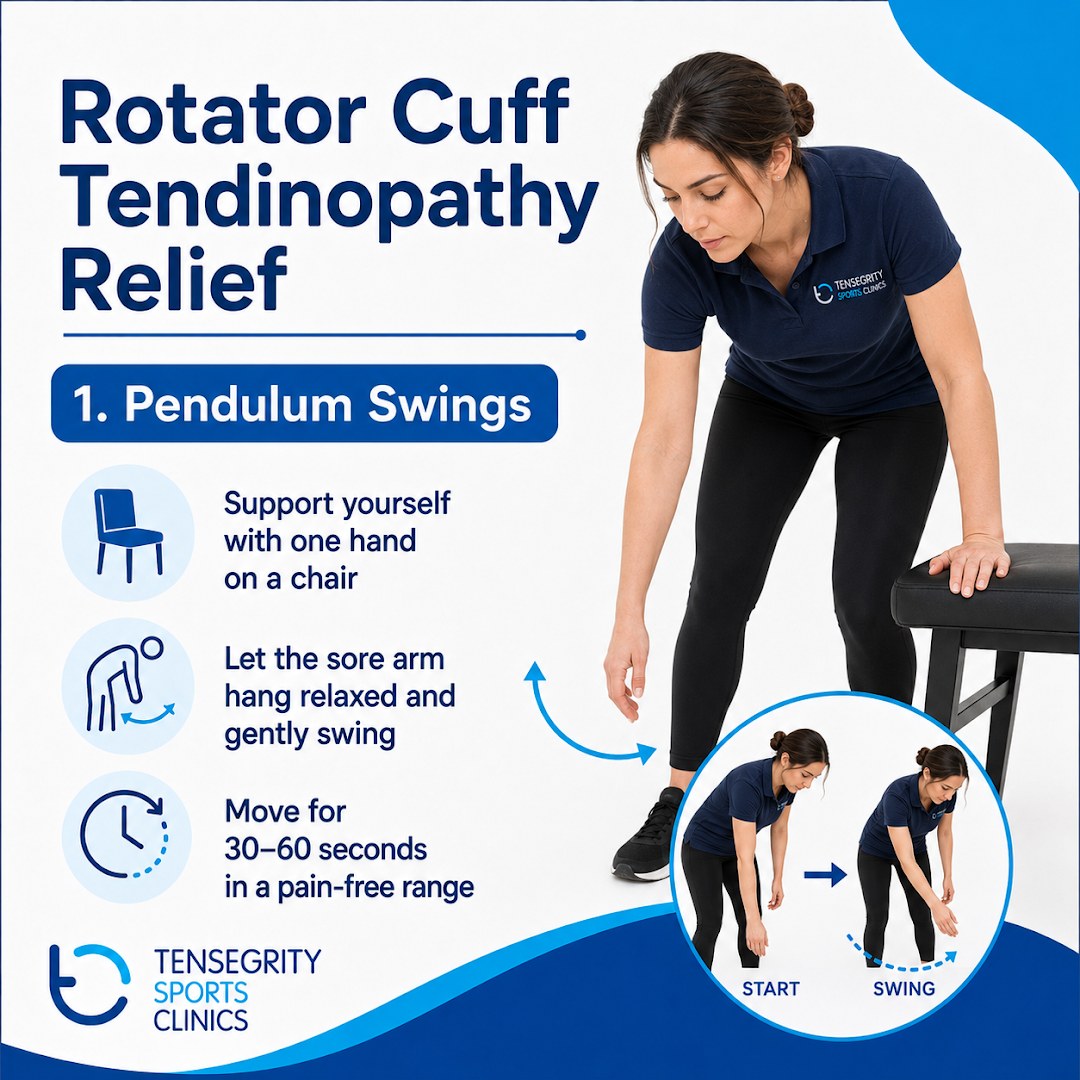
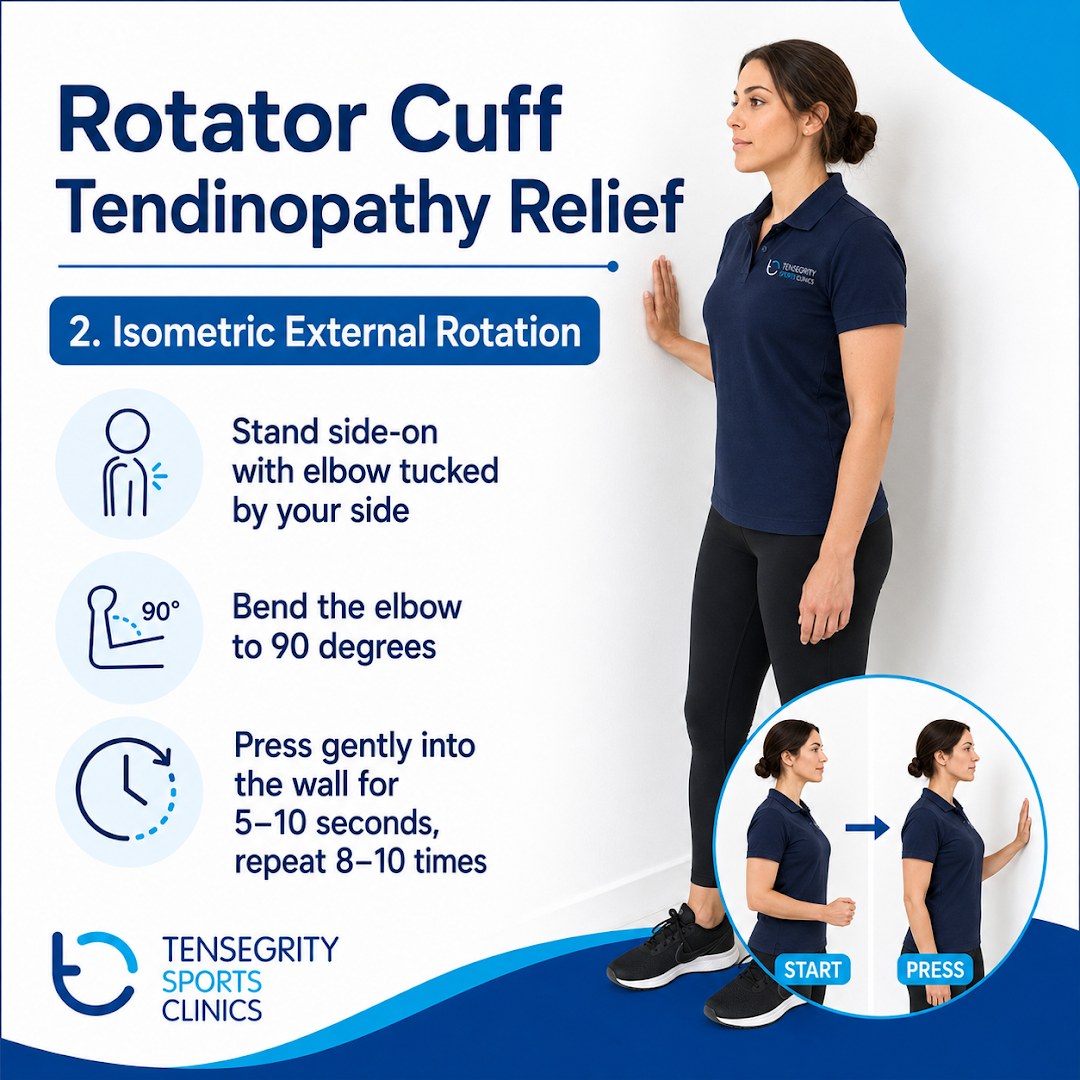
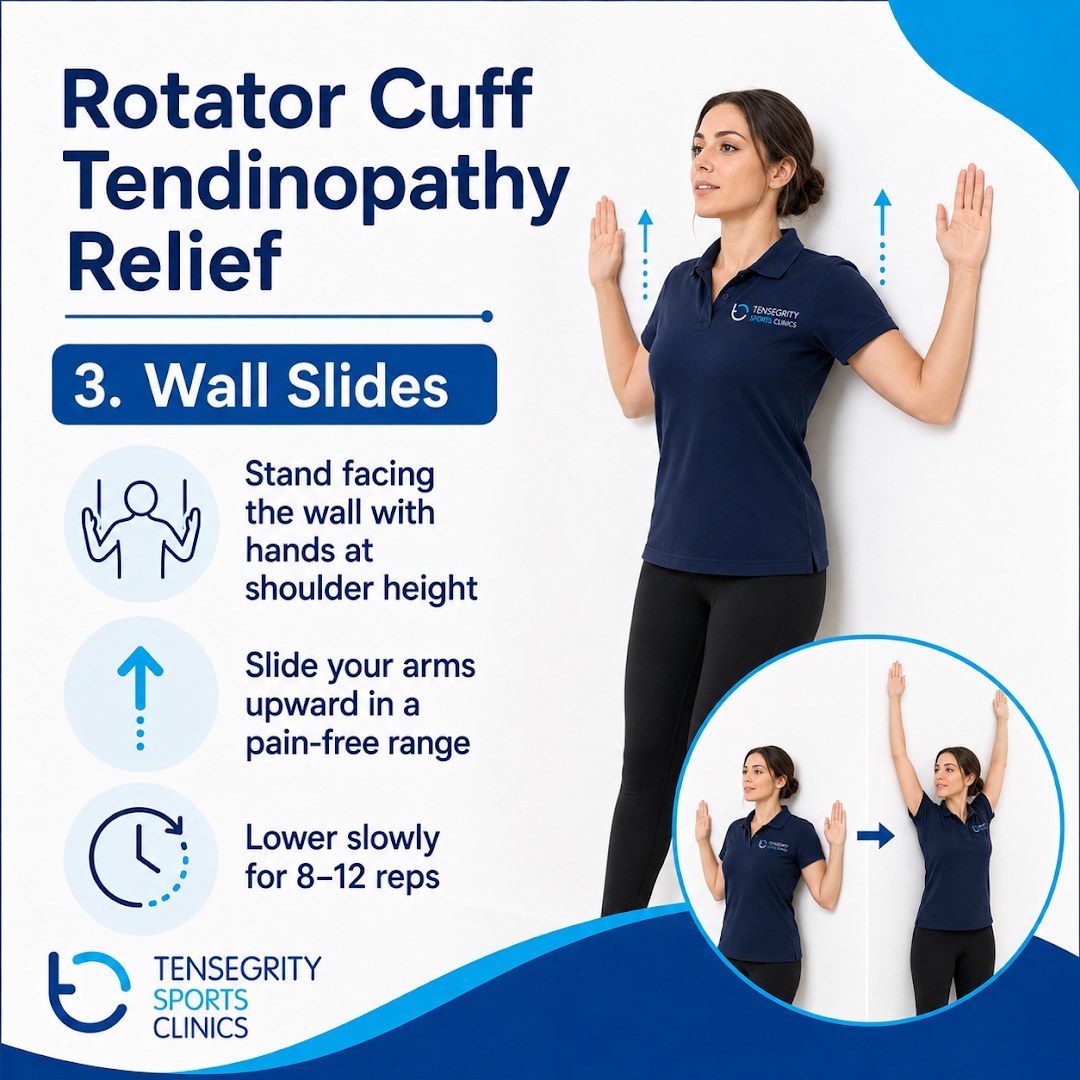
If the shoulder is not settling, or the pain is limiting your training or your work, book an assessment so the loading can be matched to what your tendon can actually handle.
Prevention:
- Keep the cuff strong: rotation work twice a week is enough to hold capacity.
- Keep the shoulder blade muscles strong: so the joint is not carrying the load alone.
- Progress overhead training gradually: in steps, not jumps.
- Watch throwing and swimming volume: sudden increases are a common trigger.
- Increase gym weights progressively: and allow recovery between demanding shoulder sessions.
- Keep shoulder and upper back mobility: a stiff thoracic spine makes the shoulder work harder.
- Keep strengthening after it settles: and address recurring shoulder pain before it starts limiting you.
Outlook:
The outlook is generally good. Most people improve their pain and function through conservative management and progressive exercise without needing surgery. Tendon changes on a scan do not mean the shoulder is damaged beyond repair or that you should avoid activity. The shoulder adapts to load, and rehabilitation is about rebuilding that capacity so you can get back to work, exercise and sport with confidence.
You do not usually need to permanently avoid lifting, gym training or overhead activity. Temporarily modifying painful movements while progressively strengthening lets the cuff adapt to more load over time. The long-term goal is a strong, capable shoulder, not a protected one.
Get assessed if you have: significant shoulder pain after trauma, sudden loss of strength, an inability to raise the arm after an injury, pain that persists or is getting worse, a significant loss of movement, unexplained swelling, redness or fever, numbness or other neurological symptoms, or pain that is not improving despite appropriate rehabilitation.
Sudden weakness or an inability to lift the arm after significant trauma should be assessed promptly to rule out a substantial rotator cuff tear or another serious shoulder injury.