
Overview:
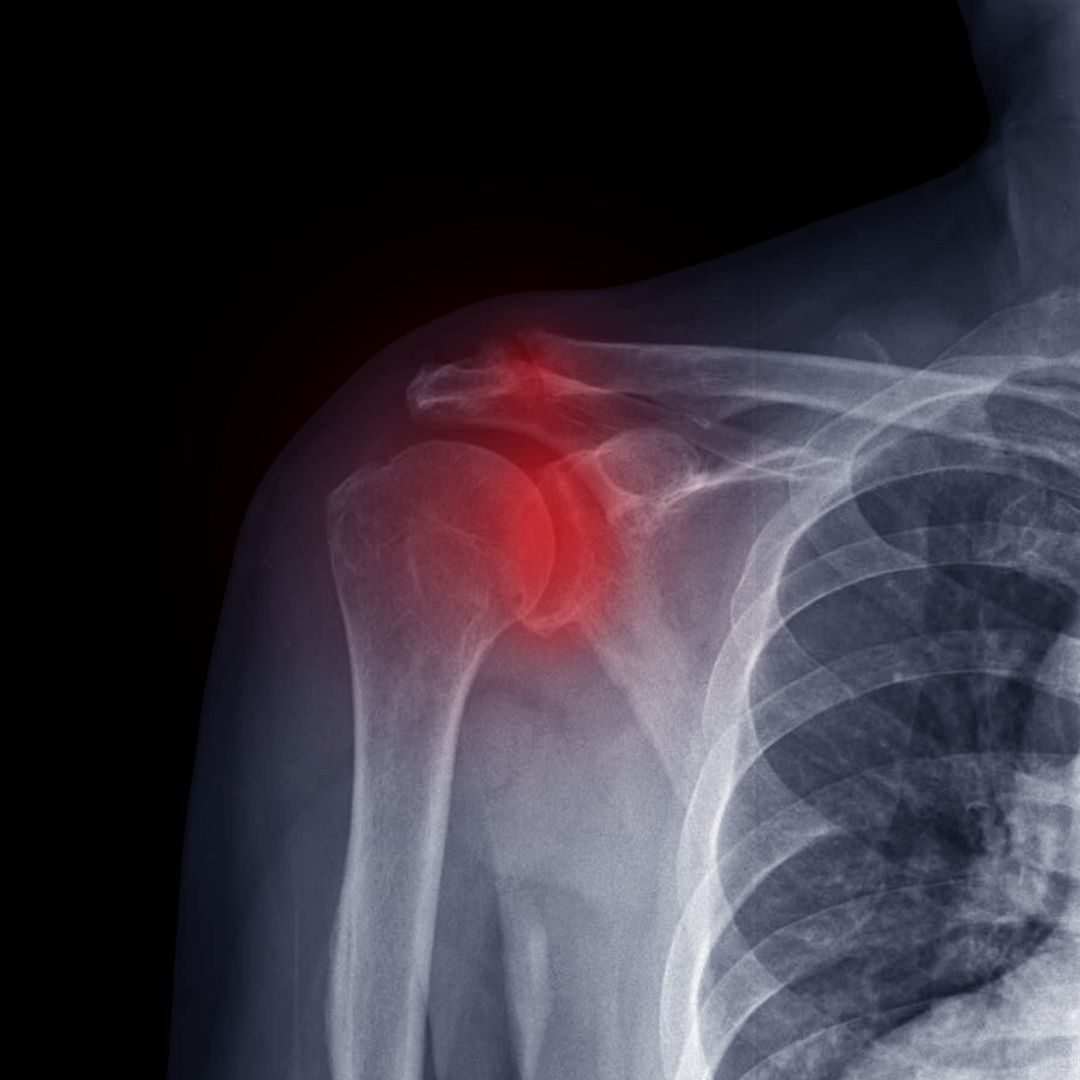
An AC joint injury affects the acromioclavicular joint at the top of the shoulder, where the collarbone meets the acromion of the shoulder blade. It is one of the more common injuries in contact sport and cycling, and in anything where you can land directly on the shoulder. Rugby, AFL, martial arts, skiing and mountain biking see it regularly.
These injuries range from a mild ligament sprain through to complete disruption of the supporting ligaments, sometimes leaving a visible bump at the top of the shoulder. A more significant one is often called a shoulder separation.
Most mild to moderate AC joint injuries are managed without surgery. Treatment controls pain, restores movement and progressively rebuilds strength before you go back to work or sport. This page sits under our wider shoulder pain information.
Anatomy:
The acromioclavicular joint sits at the top of the shoulder and is formed by the clavicle, your collarbone, and the acromion, a bony projection from the shoulder blade. The AC ligaments support the joint directly, and the stronger coracoclavicular ligaments connect the clavicle to the coracoid process of the shoulder blade.
Together those structures stabilise the shoulder girdle and let the shoulder blade move properly while the arm moves. Unlike the deeper ball and socket joint, AC joint pain is felt very specifically at the top of the shoulder, and most people can point to it with one finger.
Causes:
The usual cause is direct trauma to the shoulder:
- Falling directly onto the shoulder: the single most common mechanism.
- A tackle or contact with another player: rugby and AFL in particular.
- Coming off a bike: landing on the point of the shoulder.
- Skiing or snowboarding falls: and martial arts throws.
- Motor vehicle accidents: or any heavy impact through the shoulder.
- Repetitive loading: less commonly, the joint becomes irritated through heavy weight training, repeated pressing or repetitive overhead work rather than one event.
Grading. AC joint injuries are classified by how much ligament damage and displacement there is. Grade I is a mild sprain of the AC ligament without significant displacement, with localised pain and tenderness but a relatively stable joint. Grade II means the AC ligament is torn and the coracoclavicular ligaments are sprained or partly injured, with more pain, swelling and a small visible prominence. Grade III means both sets of ligaments are disrupted, with more obvious separation and often a visible bump. Grades IV, V and VI involve more substantial displacement and generally need orthopaedic assessment.
Symptoms:
- Pain directly over the top of the shoulder: localised, and you can usually point to it.
- Tenderness over the AC joint: sore to touch, with swelling and bruising after trauma.
- Pain raising the arm: particularly through the last part of the range.
- Pain reaching across the body: one of the more reliable signs the AC joint is involved.
- Night pain lying on that side: and difficulty getting comfortable.
- Difficulty pushing, pressing or lifting: and pain carrying heavy objects.
- Reduced movement: from discomfort rather than stiffness.
More significant injuries can produce a visible bump at the top of the shoulder, an altered shoulder contour, a sense of instability and real difficulty using the arm.
Diagnosis:
Diagnosis starts with how the injury happened and a physical examination.
- Location of the pain: AC joint pain is specific and local.
- AC joint tenderness: direct palpation over the joint.
- Swelling, bruising or visible deformity: which helps with grading.
- Shoulder range of motion: and where in the range symptoms appear.
- Pain reaching across the body: a movement that loads the AC joint specifically.
- Shoulder strength: cuff and surrounding muscles.
- Neurological and circulation check: after significant trauma.
Is an AC joint injury the same as a dislocation? No. In an AC joint injury the damage is where the collarbone meets the shoulder blade at the top of the shoulder. In a shoulder dislocation the head of the humerus comes out of the socket. Both can follow significant trauma, but the assessment, treatment and rehabilitation are different.
Do you need an X-ray? Often, after a significant AC joint injury, to assess alignment, determine the degree of separation and exclude a clavicle or other fracture. MRI or ultrasound is not routinely needed for a straightforward AC joint injury but is occasionally used where other soft-tissue injury is suspected.
Treatment:
Treatment depends on the grade, the symptoms and what you need the shoulder to do. Most Grade I and II injuries are managed conservatively, and many Grade III injuries can be too, though that decision takes your sport and occupation into account.
- Early management: temporarily reducing painful shoulder activity, ice for short-term pain relief, supporting the arm where appropriate, and gradually restoring comfortable movement. A sling is occasionally used for comfort after a more painful injury, but prolonged immobilisation is generally avoided unless medically indicated.
- Restoring movement: as pain settles, comfortable elevation, gentle assisted movement and shoulder blade movement come back first, progressed according to the grade and symptoms.
- Rotator cuff and deltoid strengthening: rebuilding the muscular support around the joint.
- Scapular stabilisation: giving the shoulder girdle a stable base.
- Rows and pulling progressions: usually better tolerated early than pressing.
- Pressing progressions: bench press, push-ups, dips, overhead press and heavy chest work all load the top of the shoulder and often aggravate the AC joint early. They can be reintroduced progressively as symptoms settle, with exercise selection, range and resistance modified at first.
- Weight-bearing shoulder exercises: as tolerance builds, restoring the ability to take load through the arm.
Most lower-grade AC joint injuries do not require surgery. Surgical assessment may be considered for certain high-grade injuries, significant persistent instability, severe deformity with functional impairment, persistent symptoms despite appropriate rehabilitation, or specific occupational and high-performance sporting requirements. A visible bump on its own does not mean surgery is needed. Plenty of people keep a permanent prominence after a significant separation and still regain excellent shoulder function.
Rehabilitation:
How long does it take? Recovery depends heavily on the grade. A Grade I sprain often improves substantially within about one to three weeks, though return to contact sport takes longer. A Grade II injury commonly needs around three to six weeks or more. A Grade III injury commonly needs around six to twelve weeks, with return to demanding contact sport sometimes taking several months. Higher-grade injuries, or those requiring surgery, take longer again.
Return to activity is judged on pain, movement, strength, functional capacity, tolerance of contact where relevant, and confidence using the shoulder. Not on the calendar.
Getting back to contact sport. For rugby, AFL and other contact athletes, rehabilitation should eventually prepare the shoulder for tackling, falling, direct contact, pushing, pulling, overhead movement and unexpected force. Protective padding or taping is sometimes used through the return-to-sport period, though it cannot completely prevent reinjury. Movement, strength and confidence should all be there before unrestricted contact.
Long-term AC joint pain. Some people develop persistent pain after the original injury has healed, from residual joint sensitivity, post-traumatic arthritis, repeated heavy loading, reduced shoulder strength or ongoing irritation during pressing and overhead work. Persistent symptoms are worth reassessing to work out whether the AC joint or another structure is driving it.
Three exercises for an AC joint injury
These three were put together by our practitioners as a starting point. They are general exercises, not a personalised program.
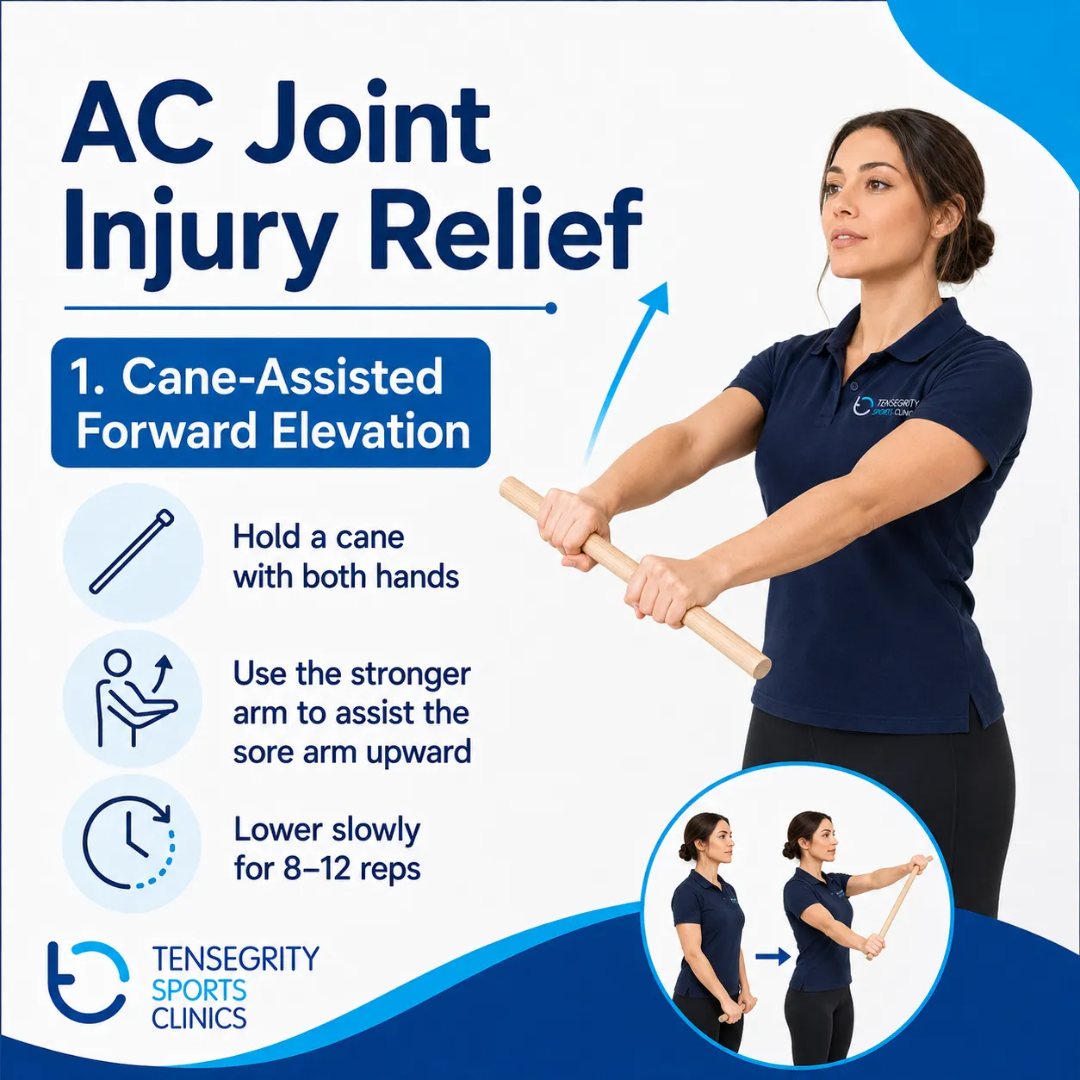
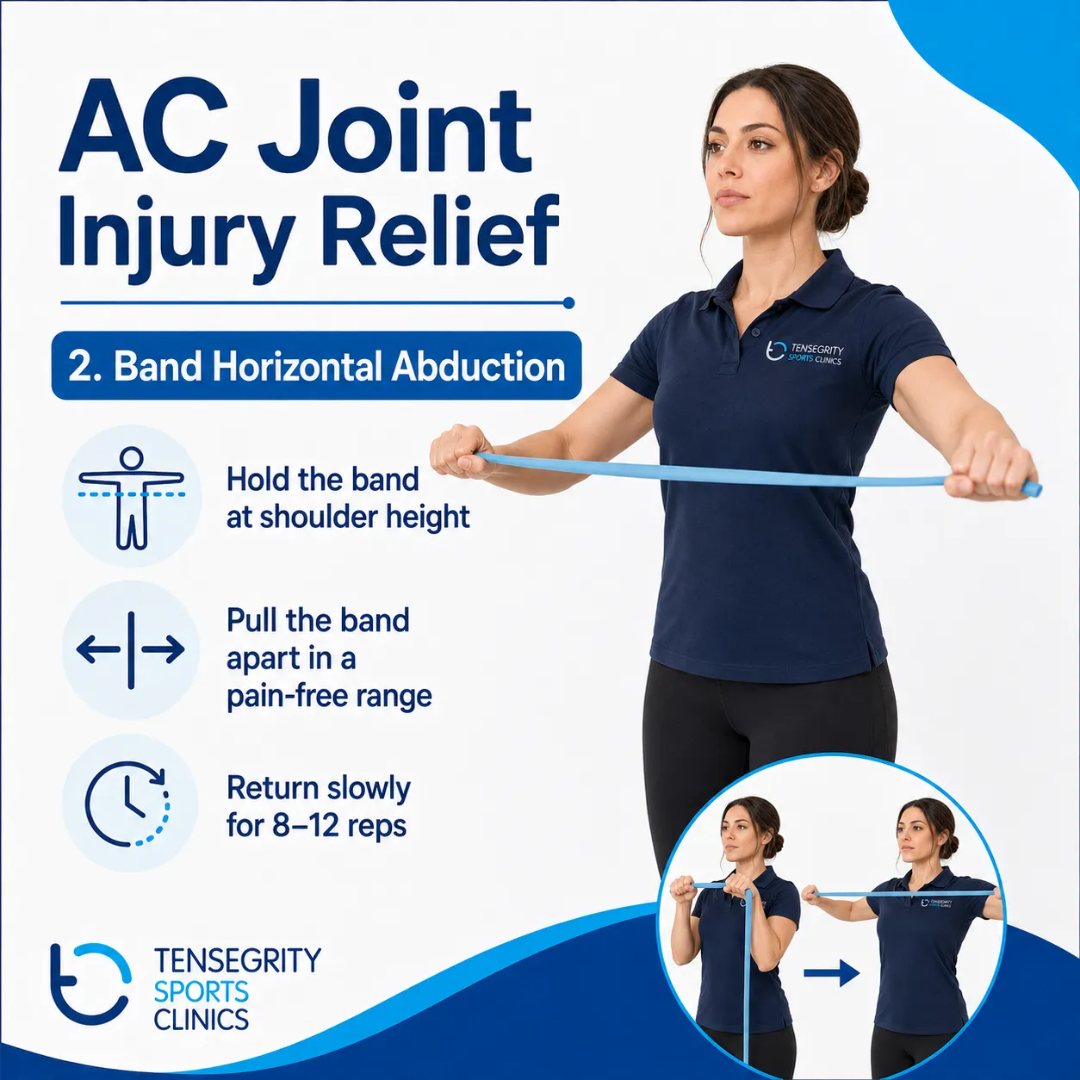
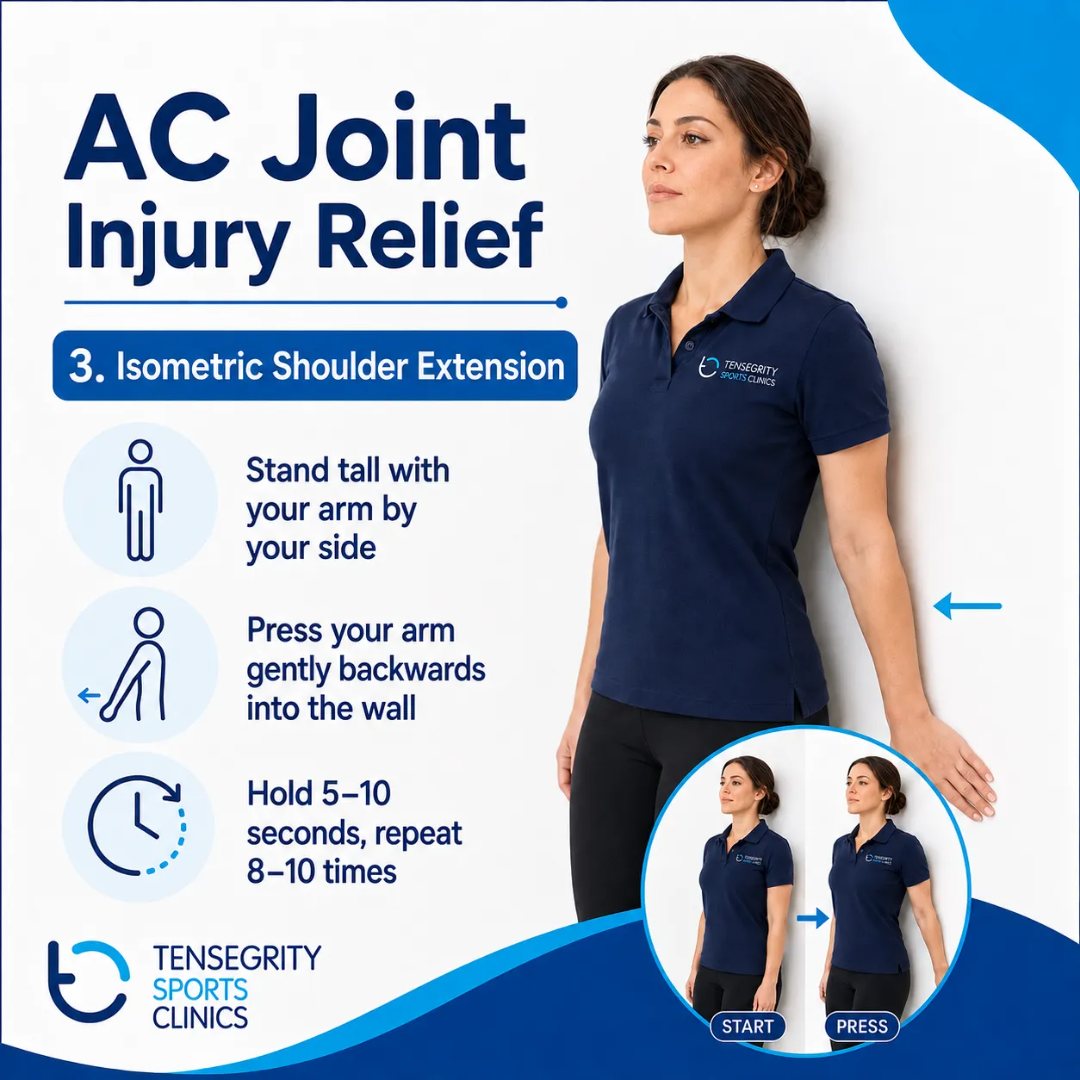
Reaching across the body loads the AC joint, so that movement usually comes later. If the shoulder is not settling, book an assessment so the progression matches the grade of injury.
Prevention:
Not every AC joint injury is preventable, because most happen through unpredictable falls and collisions. Risk can still be reduced:
- Maintain shoulder and upper body strength: a stronger shoulder girdle tolerates impact better.
- Prepare progressively for contact sport: rather than going straight into full contact.
- Practise tackling and falling technique: particularly in junior and returning players.
- Progress gym loads gradually: especially heavy pressing.
- Finish rehabilitation after a previous shoulder injury: before returning to contact.
- Maintain rotator cuff and scapular strength: ongoing, not just during rehabilitation.
- Use appropriate protective equipment: where the sport allows for it.
Outlook:
Most people with AC joint injuries recover well and get back to normal work, gym training and sport. A small bump may remain after a moderate or severe separation. That does not mean the shoulder will stay painful or work poorly. The point of rehabilitation is comfortable movement, strength, and the ability to tolerate the specific loads your life, work and sport require.
An AC joint injury does not mean permanently avoiding weight training, contact sport or overhead activity. Painful activities are temporarily modified while movement and strength are rebuilt, and for athletes the rehabilitation should go well beyond pain relief to prepare the shoulder for heavy lifting, pressing, falling and tackling.
Get assessed after a significant shoulder injury if you have: severe pain, significant swelling or bruising, an obvious deformity, an inability to raise the arm, difficulty using the arm after trauma, numbness or tingling, a pale, cold or discoloured arm or hand, persistent AC joint pain, or symptoms not improving as expected.
Significant shoulder trauma can also cause fractures and other injuries, so an obvious deformity or a substantial loss of function should be medically assessed.