
Caring for Sydney since 2012 · 17,500+ patients · ★ 5.0 from 163 Google reviews · North Shore Local Business Awards Winner · Australian Small Business Champion Finalist
Book at Wahroonga · Bella Vista · Macquarie Park · Brookvale
Overview:
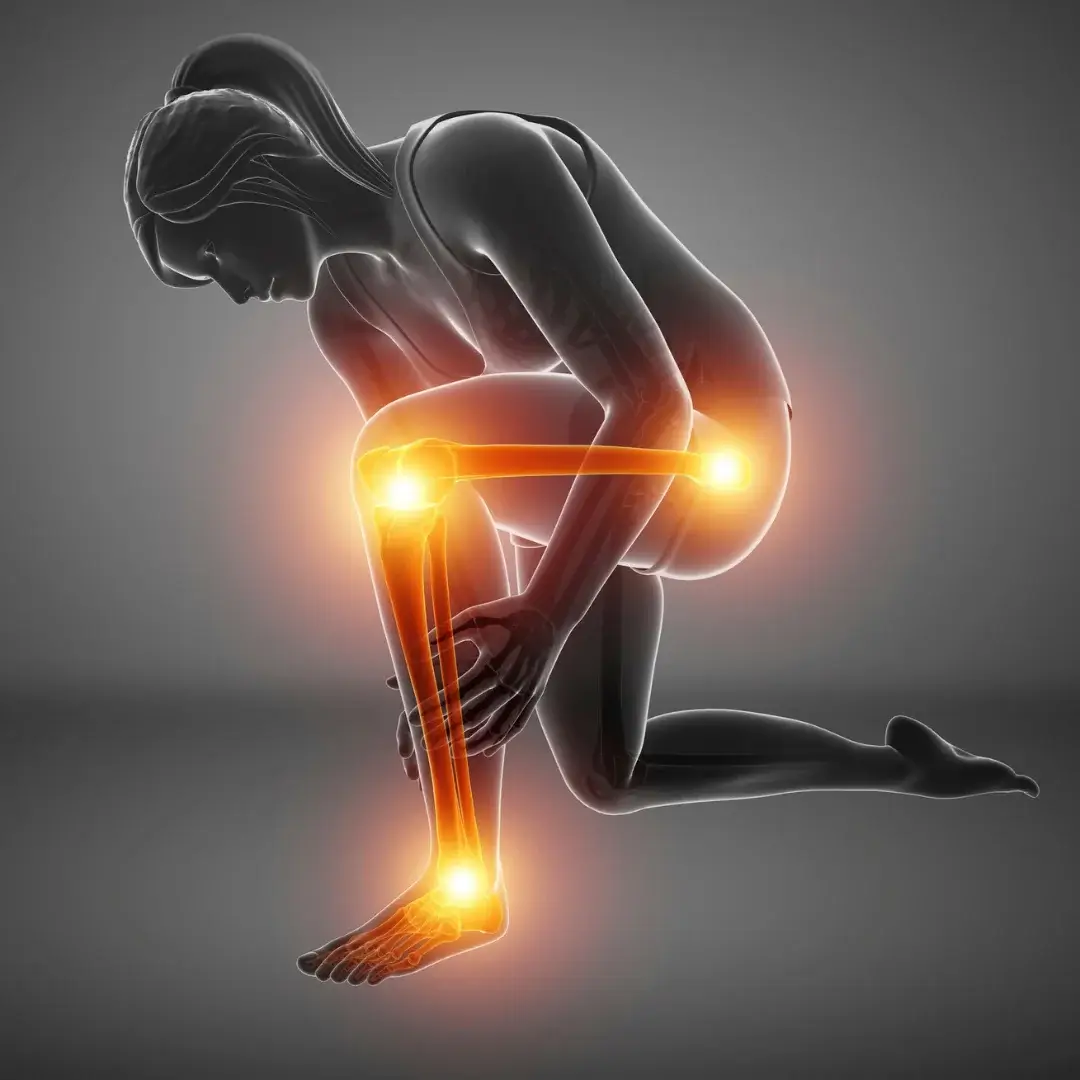
Sciatica is pain that travels along the path of the sciatic nerve, from the lower back or buttock down the back of the thigh, and often below the knee into the calf or foot. It is usually felt on one side. Some people describe it as sharp and electric, others as a deep ache with pins and needles, and some notice the leg feeling heavy or weak rather than painful.
The word sciatica describes a pattern of symptoms. It is not a diagnosis on its own. Something along the nerve’s path is being irritated or compressed, and the useful question is what. Two people with the same leg symptoms can have very different findings on assessment, and different plans as a result.
Sciatica is common. Most cases settle with conservative care, and the majority do not need surgery or imaging. What changes the timeframe is how early the driver is identified and how consistently the rehabilitation is done.
Anatomy:
The sciatic nerve is the largest nerve in the body. It forms from nerve roots that leave the spine at the lower lumbar and upper sacral levels, L4 through S3. Those roots join in the pelvis, and the nerve then passes through the buttock, beneath or occasionally through the piriformis muscle, and travels down the back of the thigh. Behind the knee it divides into the tibial and common peroneal nerves, which supply the calf, shin and foot.
Because the nerve runs such a long path, it can be irritated at several different points. Where it is irritated determines which part of the leg you feel it in, and which movements provoke it.
Causes:
Lumbar disc protrusion. The most common cause. The outer wall of a disc bulges and contacts or irritates a nerve root as it exits the spine. Symptoms are typically worse with sitting, bending forward, coughing and sneezing.
Lateral canal or foraminal narrowing. Age-related change reduces the space the nerve root passes through. More common over fifty. Symptoms often build with standing and walking, and ease with sitting or leaning forward.
Piriformis and deep gluteal irritation. The nerve is compressed or sensitised where it passes through the buttock. Often related to prolonged sitting, a change in training load, or hip and pelvic mechanics that have altered how the deep gluteal muscles work.
Load and movement pattern change. A jump in training, a new job with more sitting, a long drive, or a period of reduced activity followed by a heavy day. These do not damage the nerve, but they change how much load the surrounding tissue carries.
Pregnancy-related. Changes in load distribution, pelvic mechanics and posture through pregnancy can produce sciatic symptoms. Assessment and treatment are adapted accordingly.
Symptoms:
- Pain travelling from the lower back or buttock into the back of the thigh, and often below the knee
- Symptoms on one side, though occasionally both
- Pins and needles, burning, or a sensation of the leg going to sleep
- Weakness in the leg or foot, or a sense that the leg is not reliable
- Pain that worsens with sitting, bending forward, coughing or sneezing
- Symptoms that change with position rather than staying constant
The pattern matters more than the intensity. Where in the leg you feel it, and what makes it better or worse, is what tells us where the nerve is being irritated.
Diagnosis and Tests:
A first appointment is one full hour, and most of it is assessment.
We take a detailed history first: where the symptoms travel, what brings them on, what settles them, how they behave overnight, and whether they have changed over time. We also ask what you have stopped doing, because that is what the plan is built around.
Neurological testing follows. We check strength in the muscle groups supplied by each nerve root, reflexes at the knee and ankle, and sensation through the leg and foot. This tells us which level is involved and whether the nerve is being affected functionally or only producing pain.
Neural tension testing, including the straight leg raise and the slump test, assesses how the nerve tolerates being lengthened. We then assess the lumbar spine, pelvis and hips for the movement restrictions and load patterns behind the irritation.
Most sciatica does not need imaging. Scans are useful where there is progressive weakness, symptoms that are not responding as expected, or findings that suggest a different pathway. Your practitioner will tell you if yours is one of those cases.
Treatment:
Treatment matches what the assessment found. Depending on your presentation it may include:
- Joint mobilisation and manipulation at the lumbar spine, pelvis and hips, to restore movement at the segments contributing to the irritation
- Soft tissue therapy and remedial massage, through the deep gluteal muscles, hamstrings and lumbar musculature
- Dry needling, for trigger points in the gluteal and lumbar muscles that are contributing to symptoms
- Neural mobilisation, graded movement designed to improve how the nerve tolerates load and length
- Cold laser therapy, used to support tissue healing and pain modulation
- Exercise rehabilitation, introduced early and progressed as symptoms settle
Where a persistent tendon or attachment-point problem sits alongside the sciatica, shockwave therapy may be used as part of the plan, alongside the loading program rather than instead of it. It is available at every Tensegrity clinic except Willoughby.
Medication and injection-based options. These sit outside a chiropractor’s scope of practice. If pain is limiting your sleep or stopping you starting rehabilitation, that is worth discussing with your GP or pharmacist rather than self-prescribing long term.
The purpose of hands-on treatment is to make movement more comfortable so loading can start sooner. The loading is what holds the change.
Rehabilitation:
Rehabilitation for sciatica usually runs in three stages, though the timing varies.
Early, roughly weeks one to two. The aim is calming the nerve and keeping you moving. Gentle neural glides, positions that reduce symptoms, and walking within comfort. We identify what to modify rather than telling you to stop everything.
Middle, roughly weeks two to six. As leg symptoms centralise back toward the spine, we build hip and trunk strength and restore comfortable lumbar movement. Sitting tolerance and bending usually improve through this stage.
Later, roughly weeks six onwards. Loading for what you actually need to do. Lifting mechanics, running, gym work, long drives, whatever the return looks like for you.
How long does it take? Most people notice meaningful change over about six to twelve weeks with consistent rehabilitation. Longstanding symptoms, or symptoms with a strong neurological component, can take longer. Your practitioner will give you a realistic range at the first visit.
Three exercises for sciatica
These three were put together by our practitioners as a starting point. They are general exercises, not a personalised program. Stop if any of them increase the symptoms travelling down your leg.

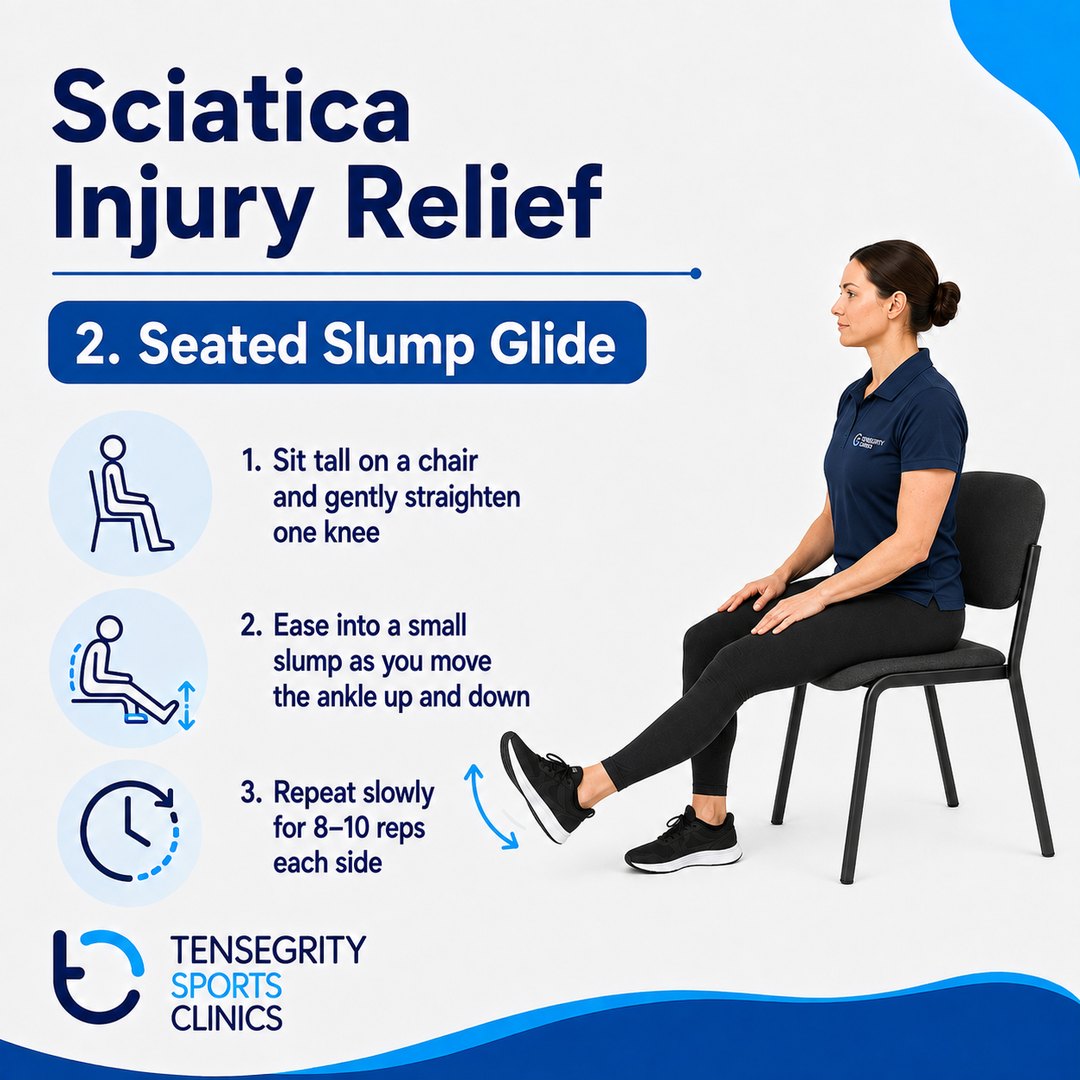
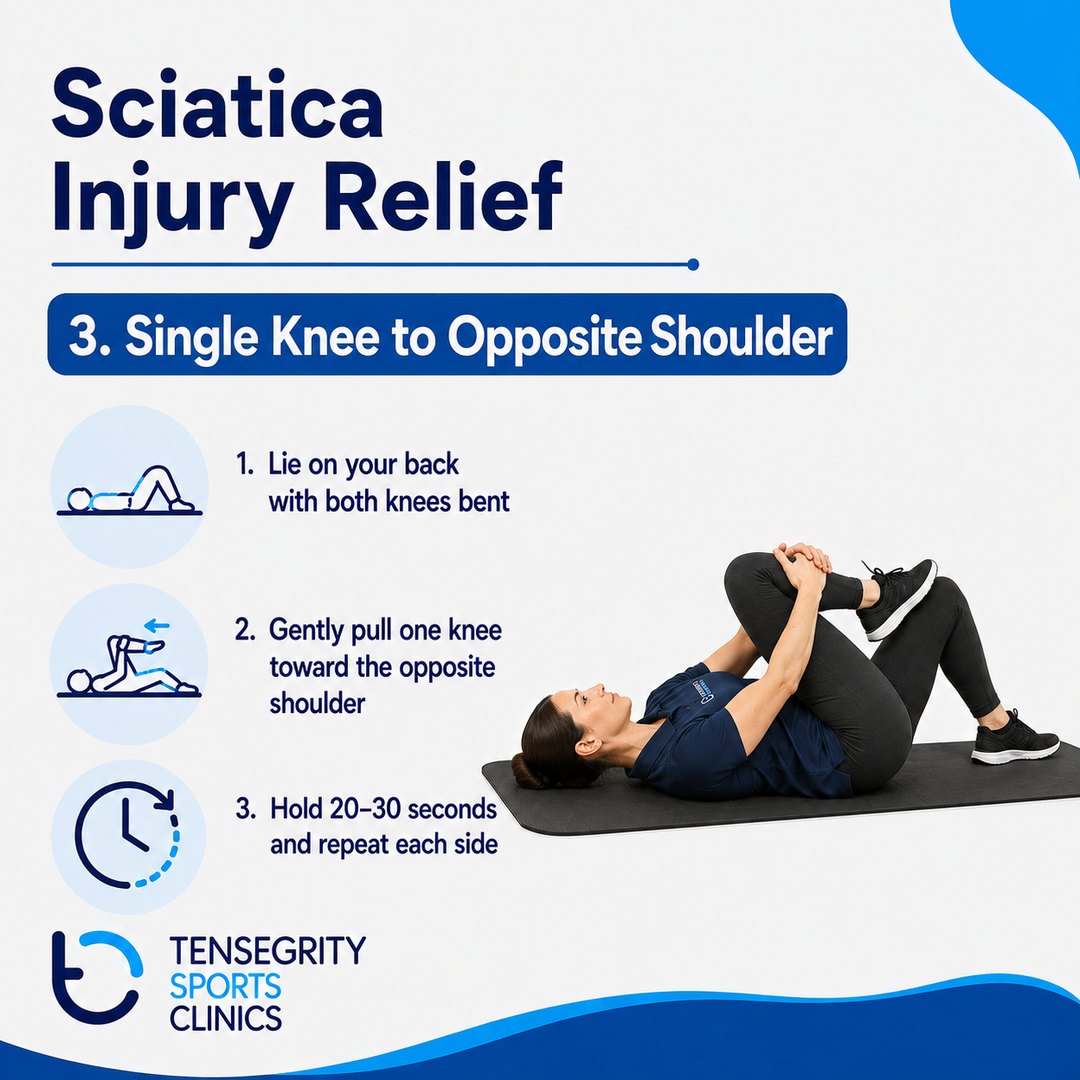
If the leg pain is not settling, or the pain is limiting your training or daily activity, book an assessment so the loading can be matched to what your leg can currently handle.
What our practitioners recommend:
These are the items our practitioners most often suggest for sciatica between appointments. They support your rehabilitation. They do not replace assessment, and what suits you depends on your presentation.
- Spikey massage ball. Used for self massage into the glute, where referred symptoms are often felt.
- Microwavable heat pack. Heat is commonly used through the lower back and glute when the area is tight rather than acutely irritable.
As an Amazon Associate I earn from qualifying purchases. We may earn a commission on these links. Our recommendations are based on clinical judgement and are not influenced by commission.
Prevention:
- Build training load gradually. Most flare-ups follow a change in volume, not a single movement.
- Break up long periods of sitting. How long you hold a position matters more than the position itself.
- Keep the hips and thoracic spine moving so the lower back carries less of the work.
- Strength train the trunk, hips and legs consistently.
- Finish the rehabilitation. Stopping when the leg pain goes, rather than when capacity returns, is the most common reason sciatica comes back.
Outlook/Prognosis:
Most sciatica improves with conservative care. A useful early sign is centralisation, where symptoms retreat from the foot or calf back toward the buttock and lower back. That usually indicates the nerve is settling, even when the back itself feels no better yet.
Recovery is rarely a straight line. Good days and flare-ups both happen, and a flare does not mean the plan has failed. What matters is the direction over weeks rather than day to day.
Where symptoms are not responding as expected, or there is progressive weakness, we will say so and refer for imaging or medical review rather than continuing unchanged.
Living With:
Practical changes that usually help while symptoms settle:
- Set up your seat so your hips sit slightly above your knees, and get up regularly
- On long drives, stop and walk every hour or so
- Sleep on your side with a pillow between the knees, or on your back with a pillow under them
- Lift by loading the hips and legs rather than bending through the lower back
- Keep walking. Short and frequent is usually better tolerated than long and occasional
When to seek help sooner:
Book in promptly, or see a medical practitioner, if you notice any of the following alongside your symptoms:
- Numbness around the groin, inner thighs or saddle area
- Loss of bladder or bowel control
- Progressive weakness in one or both legs
- Symptoms following a significant fall or accident
- Unexplained weight loss, fever, or pain that is constant and unrelated to movement
When it just isn’t getting better
Some pain settles on its own. Some keeps coming back — after rest, after stretching, after everything you’ve already tried. That’s the pain we see every week. Our first job isn’t treatment — it’s finding out why it hasn’t settled. A thorough assessment, an honest explanation, and a clear plan, so you know exactly what’s going on and what to do next.
Already seen someone about this? Bring your scans and your story — we’re happy to be your second opinion.
Common questions:
How long does sciatica take to settle? Most people see meaningful change over six to twelve weeks with consistent rehabilitation. Longstanding cases take longer. Your practitioner will give you a range based on your assessment.
Do I need a scan? Usually not. Imaging is indicated where there is progressive weakness or symptoms that are not responding as expected. Disc changes appear on scans in plenty of people with no symptoms at all, which is why the assessment matters more.
Should I rest? Extended rest is not recommended. Staying as active as symptoms reasonably allow is associated with better outcomes. We will tell you what to modify.
Is it safe to exercise with sciatica? Usually, with the right modifications. Movements that send symptoms further down the leg are the ones to leave out for now.
Do I need a referral? No. You can book directly online.
Every practitioner is university-qualified and AHPRA-registered. Between them, our team has delivered more than 195,000 treatments.