
Overview:
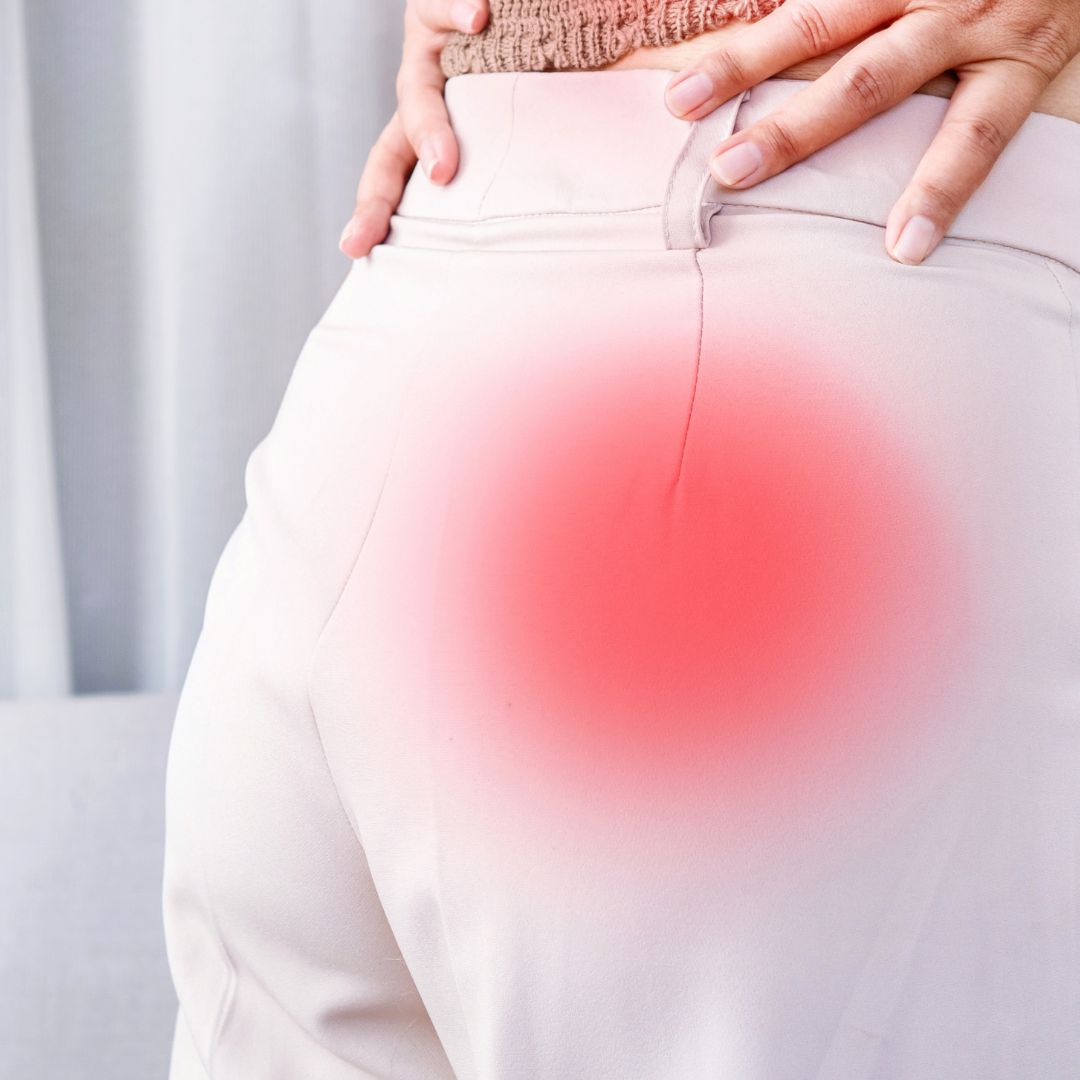
Gluteal tendinopathy is the most common cause of pain on the outside of the hip. It affects the tendons of the gluteal muscles, usually gluteus medius and gluteus minimus, where they attach to the greater trochanter at the top outer part of the thigh bone.
The classic picture is pain walking, climbing stairs, standing on one leg, and lying on that side at night. Broken sleep is often what finally brings people in.
It is frequently included under the broader heading of Greater Trochanteric Pain Syndrome, or GTPS. It is also still often called trochanteric bursitis, but the research suggests persistent lateral hip pain usually involves the gluteal tendons rather than an isolated inflamed bursa. That matters, because it changes the treatment from settling inflammation to managing compression and rebuilding load capacity. This page sits under our wider hip pain information.
Anatomy:
The gluteal muscles sit around the back and side of the hip. There are three: gluteus maximus, gluteus medius and gluteus minimus. The medius and minimus tendons attach to the greater trochanter, the bony prominence you can feel on the outside of the femur.
Those muscles stabilise the pelvis when you walk, control the hip during single-leg activities, take the leg out to the side, and keep you balanced through walking, running and stairs. A small fluid-filled trochanteric bursa also sits in this region, reducing friction between the tissues.
Gluteal tendinopathy or GTPS? Related, not identical. Gluteal tendinopathy specifically means a problem with the gluteal tendons. GTPS is the broader term for pain around the outer hip, and can include gluteus medius or minimus tendinopathy, partial gluteal tendon tears, trochanteric bursal irritation, or other structures around the greater trochanter. GTPS is a more useful term than calling all lateral hip pain bursitis.
Causes:
This usually develops from a combination of tendon loading, compression and individual factors:
- A sudden increase in walking or running: more distance, more hills or more frequency than the tendon has capacity for.
- Repetitive single-leg loading: running, stairs and long walks load these tendons over and over.
- Reduced hip strength: less capacity means everyday and sporting loads are harder to tolerate.
- Tendon compression: certain hip positions press the gluteal tendons against the greater trochanter. This is the part most treatment misses.
- Previous lateral hip pain: makes recurrence more likely.
- Starting something new: a new exercise program or a significant jump in activity.
- Age and hormonal factors: particularly common in middle-aged and older adults, and reported more often in women.
- Changes after another injury: a lower back or lower limb problem can alter how the hip is loaded.
Symptoms:
The characteristic symptom is pain over the outside of the hip, around the greater trochanter:
- Pain on the outside of the hip: and tenderness pressing over the bony point.
- Pain lying on that side: and night pain that disturbs sleep.
- Pain on stairs: and walking uphill.
- Pain during prolonged walking or running: often building over the distance rather than starting immediately.
- Pain standing on one leg: or getting out of a chair.
- Pain carrying a child or a heavy bag on one side: the classic everyday trigger.
- Pain crossing the legs: or after sitting with the knees together for a long stretch.
Pain may travel down the outer thigh but typically does not go all the way into the foot.
Why does lying on my side hurt? Side sleeping compresses the sensitive gluteal tendons against the greater trochanter. Lying on the sore side aggravates it directly. Lying on the other side can also hurt, because the top leg falls across the body and pulls the affected hip into adduction, which compresses the tendons too. During an irritable period, changing position or putting a pillow between the knees often helps.
Diagnosis:
Diagnosis comes from a detailed history and physical examination.
- Location of the pain: and tenderness over the greater trochanter.
- Hip strength: tested rather than assumed, because weakness drives the whole picture.
- Single-leg balance: and whether the pelvis stays level.
- Loading tests: walking, squatting and stair climbing.
- Pain on resisted hip movements: which directions reproduce it.
- Hip range of motion: and running mechanics where relevant.
- Lower back assessment: where appropriate, because several conditions produce pain around the hip.
Do you need an ultrasound or MRI? Not routinely. Imaging is considered where symptoms persist, the diagnosis is uncertain, a significant gluteal tendon tear is suspected, symptoms are not responding as expected, or another hip condition needs investigating. Scans often show tendon changes or bursal fluid in people with no significant symptoms, so treatment follows your pain, strength and function rather than the report.
Treatment:
Two principles drive everything: reduce excessive compression and aggravating load, then progressively strengthen the gluteal tendons and the muscles around them.
- Reducing tendon compression: during the irritable stage, temporarily reducing lying directly on the painful hip, standing with your weight shifted onto one hip, sitting with the legs crossed, letting the knees fall together, and aggressive stretches that pull the leg across the body. None of these are permanently harmful. The aim is less repeated compression while the tendon settles.
- Progressive hip abductor and gluteal strengthening: starting with controlled exercises that do not substantially aggravate symptoms, then building through bridges, squats, step-ups and hip hinge work as capacity improves.
- Single-leg strength and control: single-leg balance, single-leg squats, step-downs, lunges and single-leg deadlift variations. The glutes matter most during single-leg activity, so this stage is not optional.
- Walking and running modification: complete avoidance is rarely necessary, but temporarily reducing distance, hills, stair volume or running frequency helps when symptoms are highly irritable. Then build back up.
- Manual therapy: useful for associated muscular discomfort or joint restriction and can give short-term relief. It does not restore tendon capacity, so it sits alongside the strengthening.
- Shockwave therapy: extracorporeal shockwave is worth considering for persistent gluteal tendinopathy or GTPS. It is available at every Tensegrity clinic except Willoughby, and is used alongside the strengthening program rather than instead of it.
- Review and progression: resistance and complexity increase as strength improves rather than staying the same.
Should you stretch the ITB or glutes? People with lateral hip pain are often told to stretch hard. Stretches that take the leg significantly across the body increase compression of the gluteal tendons against the greater trochanter and can aggravate an irritable tendon. Stretching needs to be individualised here, not handed out automatically.
Pain-relieving medication may be appropriate and is worth discussing with your GP or pharmacist. Corticosteroid injections can give short-term relief for significant lateral hip pain, but they do not restore tendon strength or capacity and are not usually a long-term solution on their own.
Rehabilitation:
How long does it take? Mild or relatively recent symptoms often start improving within about six to twelve weeks. More established gluteal tendinopathy commonly needs around three to six months of progressive rehabilitation. Long-standing cases can take six to twelve months or longer, particularly where symptoms have been there a while or substantial strength needs rebuilding.
How long depends on how long it has been going, how irritable the tendon is, your hip strength, your walking and running demands, your overall activity, how consistent you are, and how well the aggravating positions and loads are managed.
Getting back to running and sport. The progression runs through comfortable everyday walking, progressive hip strengthening, single-leg strengthening, short easy running, increasing duration, faster running, hills, sport-specific training, then full training and competition. For athletes, the endpoint is the actual force the sport demands, not the point where walking stops hurting.
Three exercises for gluteal tendinopathy
These three were put together by our practitioners as a starting point. They are general exercises, not a personalised program.
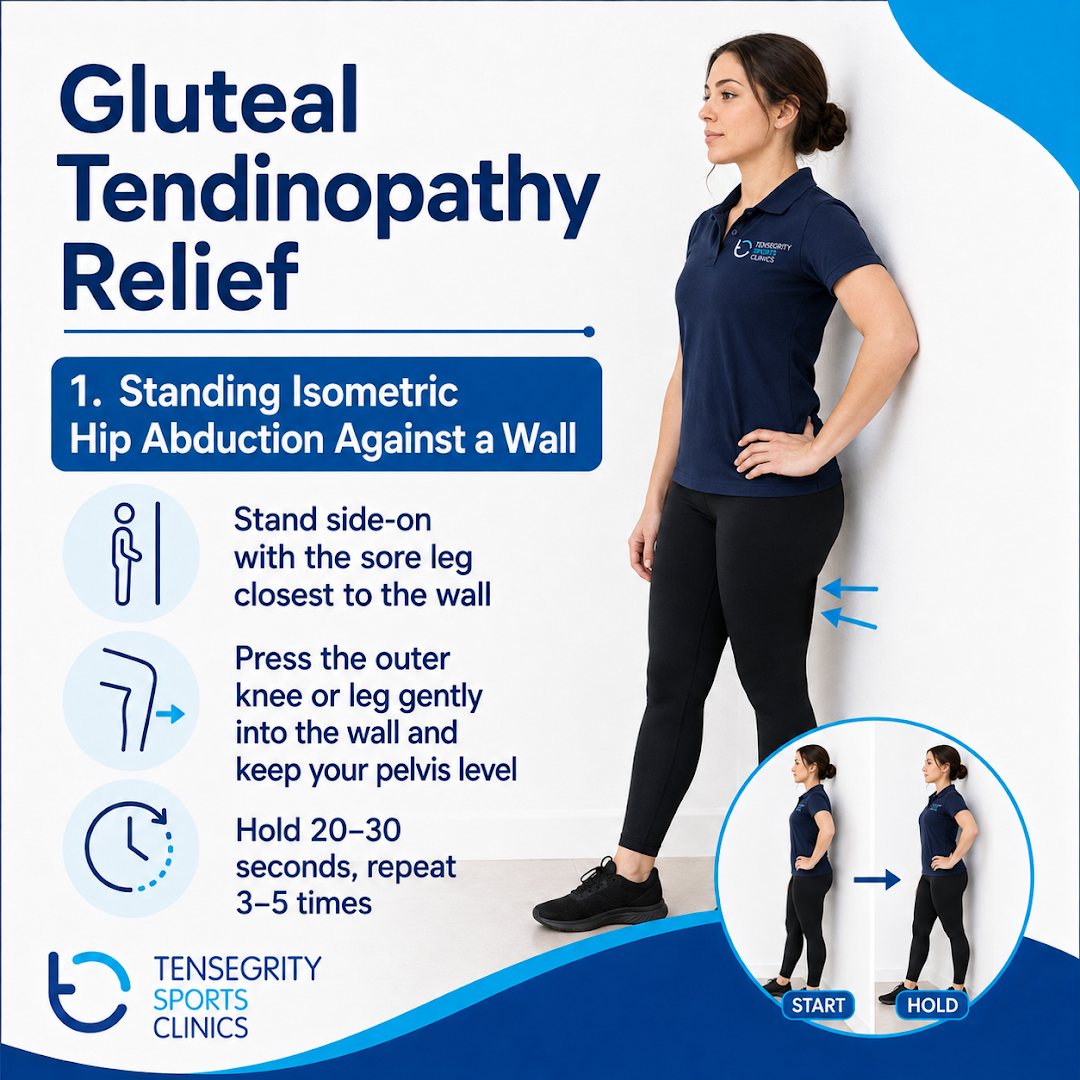
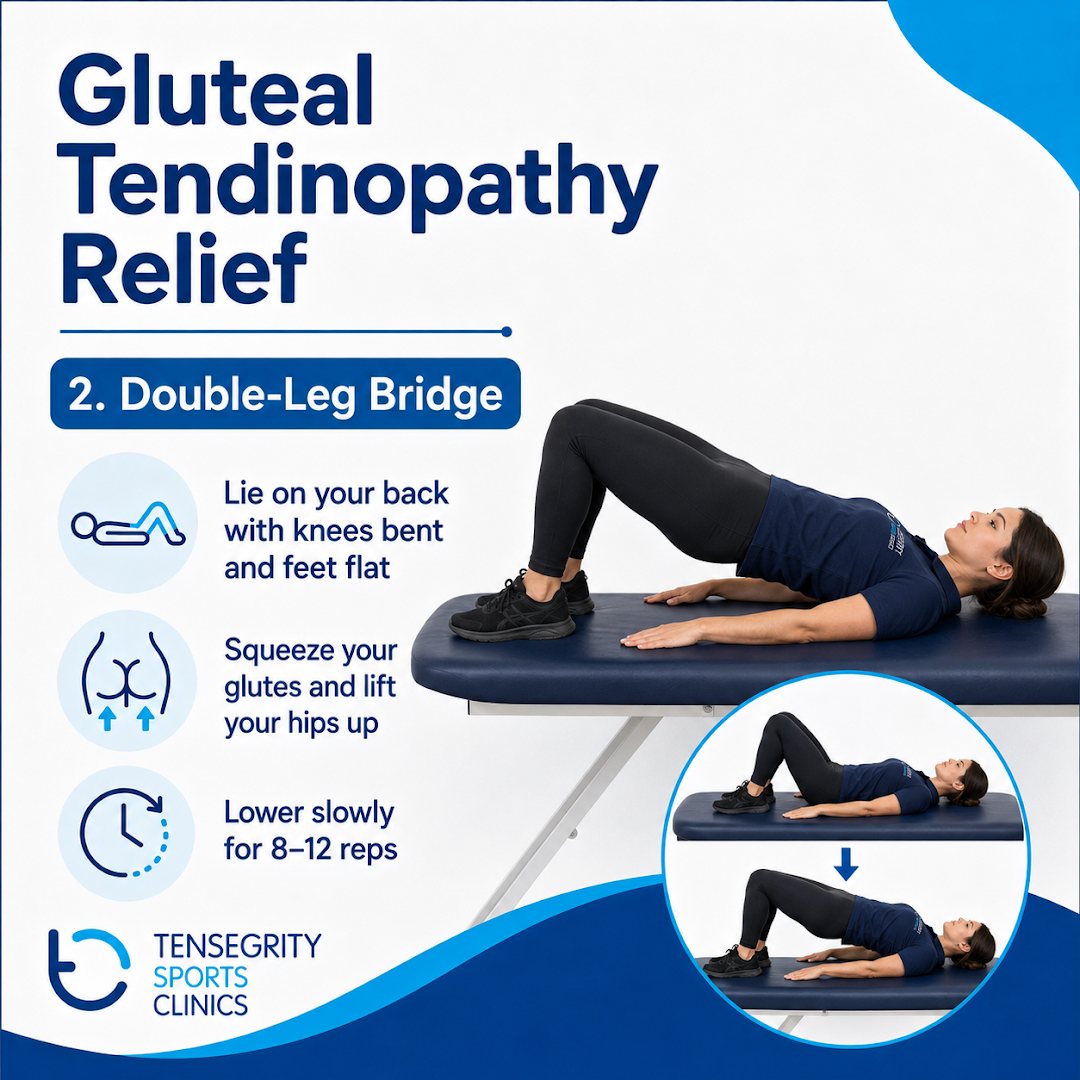
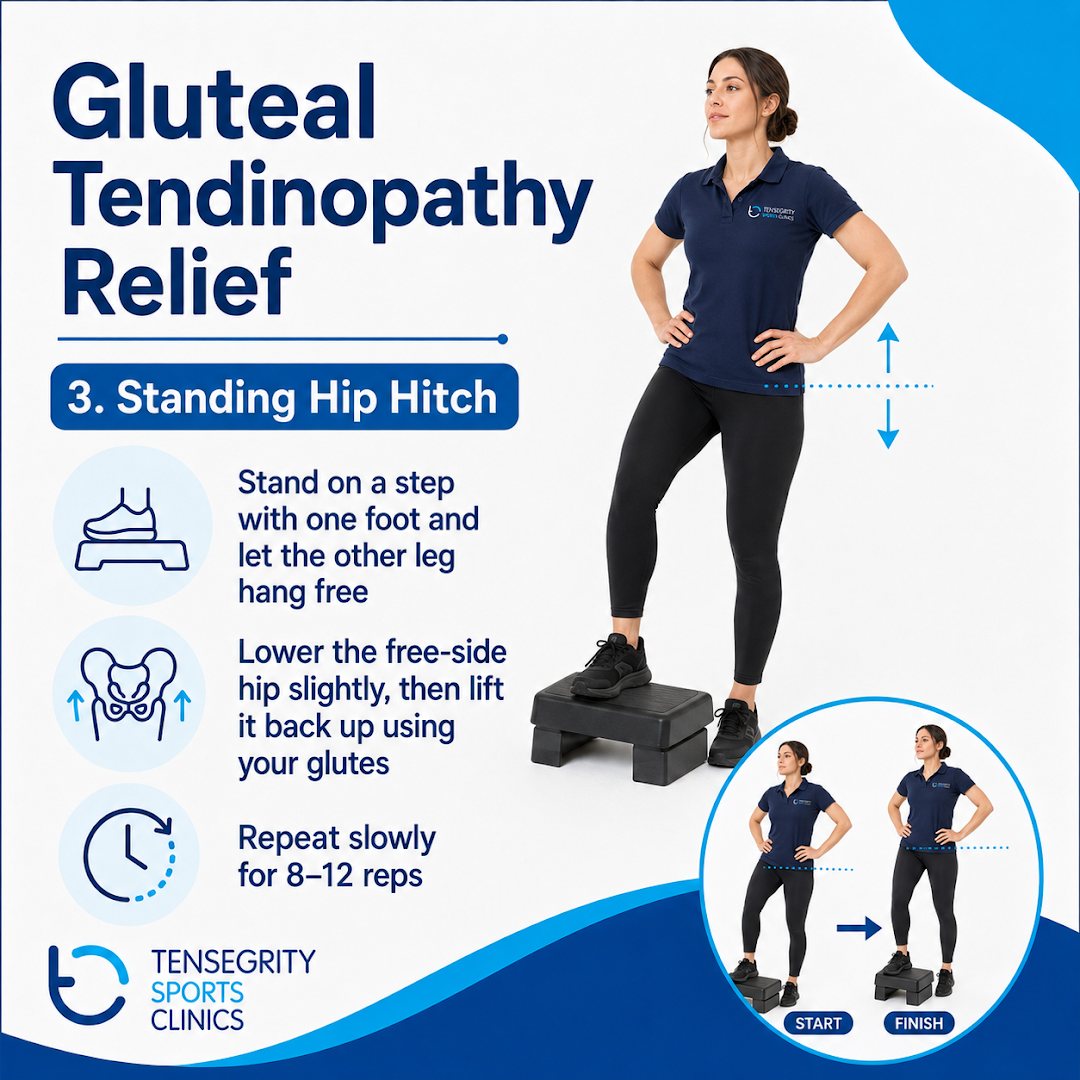
Keep the knees apart. Avoid crossing your legs and avoid stretches that pull the leg across your body, both compress the tendon. If it is not settling, book an assessment.
Prevention:
- Maintain gluteal and hip strength: ongoing, not just while it hurts.
- Maintain lower limb strength: so the hip is not carrying everything.
- Increase walking and running volume gradually: and introduce hills progressively.
- Avoid sudden increases in training: the most common trigger by a distance.
- Keep regular strength training: and allow recovery between demanding sessions.
- Watch the standing habit: repeatedly shifting all your weight onto one hip compresses the tendon.
- Finish rehabilitation before returning to full load: and address recurring lateral hip pain early.
Outlook:
Most people with gluteal tendinopathy improve significantly with appropriate conservative management. Persistent lateral hip pain does not mean the tendon is continually deteriorating. Tendons adapt and get stronger when they are loaded progressively, which is the whole basis of the treatment.
It does not usually mean stopping walking, exercising or running permanently. During the irritable period, the positions and activities that repeatedly compress or overload the tendon are temporarily modified. Progressive strengthening then rebuilds the hip’s ability to handle walking, stairs, running and everything else. The long-term goal is a stronger, more load-tolerant hip rather than a lifetime of avoiding movement because of a diagnosis.
Get assessed if: hip pain persists or is getting worse, pain is significantly affecting your walking, night pain becomes severe or persistent, you develop substantial weakness, symptoms began after significant trauma, you cannot bear weight, pain comes with fever or feeling generally unwell, you have significant numbness or neurological symptoms, or things are not improving despite appropriate rehabilitation.
Sudden severe hip pain after a fall or injury, particularly with an inability to bear weight, needs prompt medical assessment.