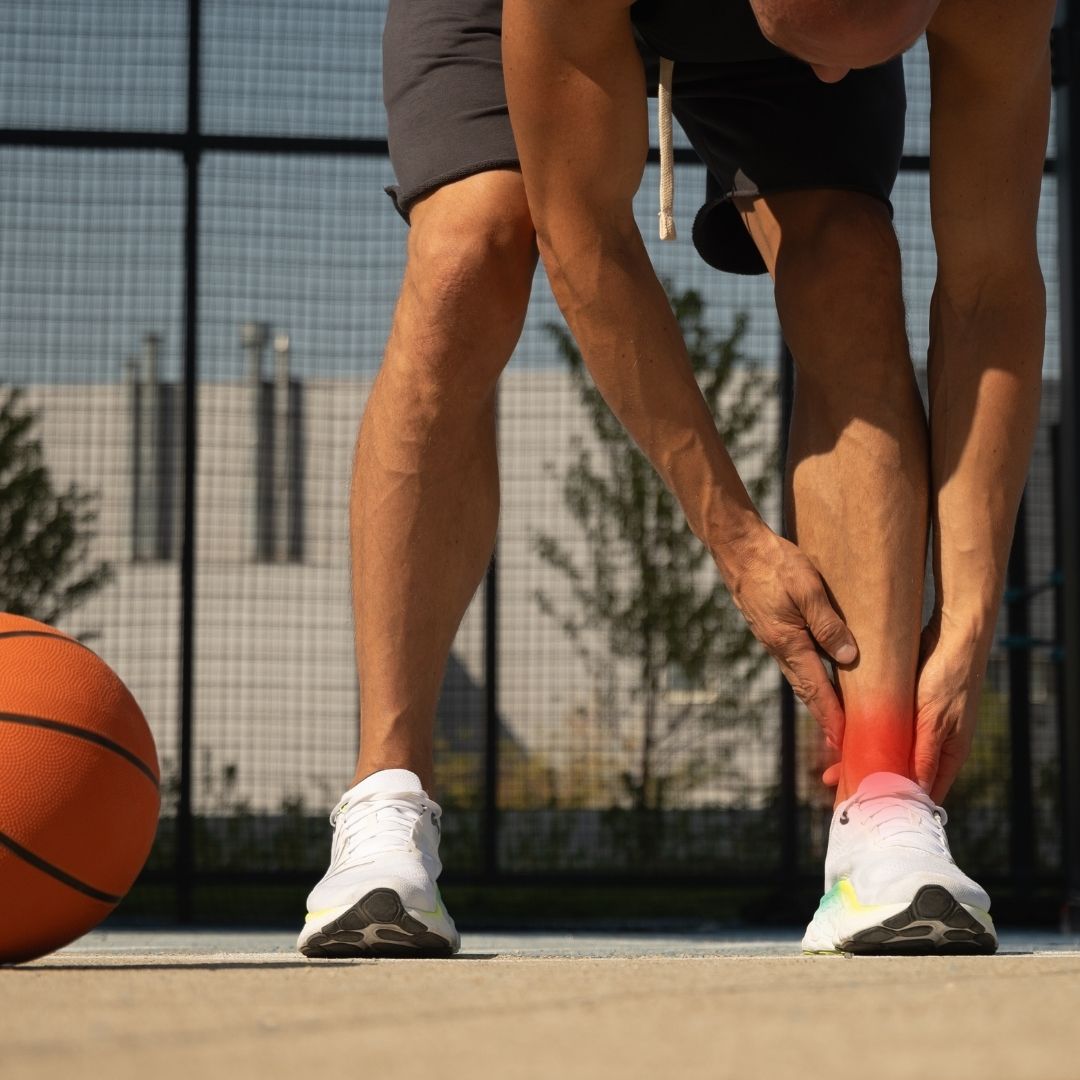

Overview:
A high ankle sprain is an injury to the syndesmosis, the ligaments that bind the two shin bones together just above the ankle joint. It is a different injury from the common ankle sprain, it sits higher up the leg, and it takes considerably longer to recover.
This distinction matters. People often assume they have rolled their ankle in the usual way, follow standard sprain advice, and then cannot understand why they are still sore at six weeks. High ankle sprains account for a small share of all ankle sprains but a large share of the time lost from sport.
Anatomy:
The tibia and fibula run side by side down the lower leg and are joined near the ankle by the syndesmosis, a set of ligaments including the anterior and posterior tibiofibular ligaments and the interosseous membrane above them.
This connection has to be stable but not rigid. Every time you take weight through the ankle the two bones spread very slightly to accommodate the talus below. When the syndesmosis is injured, that controlled spread is lost, and load through the joint becomes painful.
Causes:
The mechanism is usually rotational rather than the inward roll that causes a standard sprain.
- External rotation of the foot with the ankle bent upwards, often when the foot is planted and the body turns over it.
- Contact sports: Being tackled or landed on while the foot is fixed. Common in rugby, AFL, soccer and hockey.
- Skiing and snowboarding: A rigid boot holds the ankle while the body rotates above it.
- A forceful upward bend of the ankle: Landing awkwardly from height or driving the shin forward over a fixed foot.
- A previous ankle injury: Reduced control at the ankle increases the chance of the foot being caught in a vulnerable position.
Symptoms:
The location of the pain is the clearest difference from an ordinary ankle sprain.
- Pain above the ankle joint, between the two shin bones, rather than over the bony bump on the outside.
- Pain on taking weight, especially pushing off, and often a reluctance to walk normally.
- Swelling that may be less obvious than a standard sprain, which sometimes leads people to underestimate it.
- Pain when the foot is turned outwards, or when the two shin bones are squeezed together higher up the calf.
- A sense that the ankle is not tolerating load even though it does not feel unstable in the usual way.
Diagnosis and Tests:
Assessment focuses on separating this from a standard lateral sprain, and on ruling out fracture.
- History: The mechanism matters. A rotational injury with pain above the joint line raises suspicion immediately.
- Palpation: Tenderness over the syndesmosis, and how far up the leg that tenderness extends, which relates to severity.
- Specific tests: The squeeze test and external rotation stress test load the syndesmosis directly.
- Weight-bearing assessment: Whether and how you can take load through the leg.
- Imaging: X-ray is commonly indicated to exclude fracture and to assess the space between the shin bones. MRI is used when the extent of ligament injury will change the plan, or when symptoms are not settling as expected. Referral for imaging is arranged where it is warranted.
Management and Treatment:
Management depends on whether the joint remains stable, which is the first question to answer.
- Establishing stability: A stable injury is managed without surgery. An unstable one needs an orthopaedic opinion, and that assessment comes first.
- Protected loading: A boot or brace early on in many cases, with a staged return to full weight-bearing rather than pushing through.
- Restoring ankle bend: Regaining the ability to bring the knee forward over the foot is a priority, because walking and running both depend on it.
- Progressive strengthening: Calf, ankle and hip work, building from isometric holds to loaded and then dynamic work.
- Return to sport testing: Hopping, cutting and change of direction compared side to side under load, not at rest.
- Surgical opinion: Where the syndesmosis is unstable or a fracture is present, referral to an orthopaedic surgeon is the appropriate step.
- Medication and injection-based options: These sit outside a chiropractor’s scope of practice. If pain is limiting your sleep or stopping you starting rehabilitation, that is worth discussing with your GP rather than self-prescribing long term.
Three exercises for a high ankle sprain
These three were put together by our practitioners as a starting point. They are general exercises, not a personalised program.
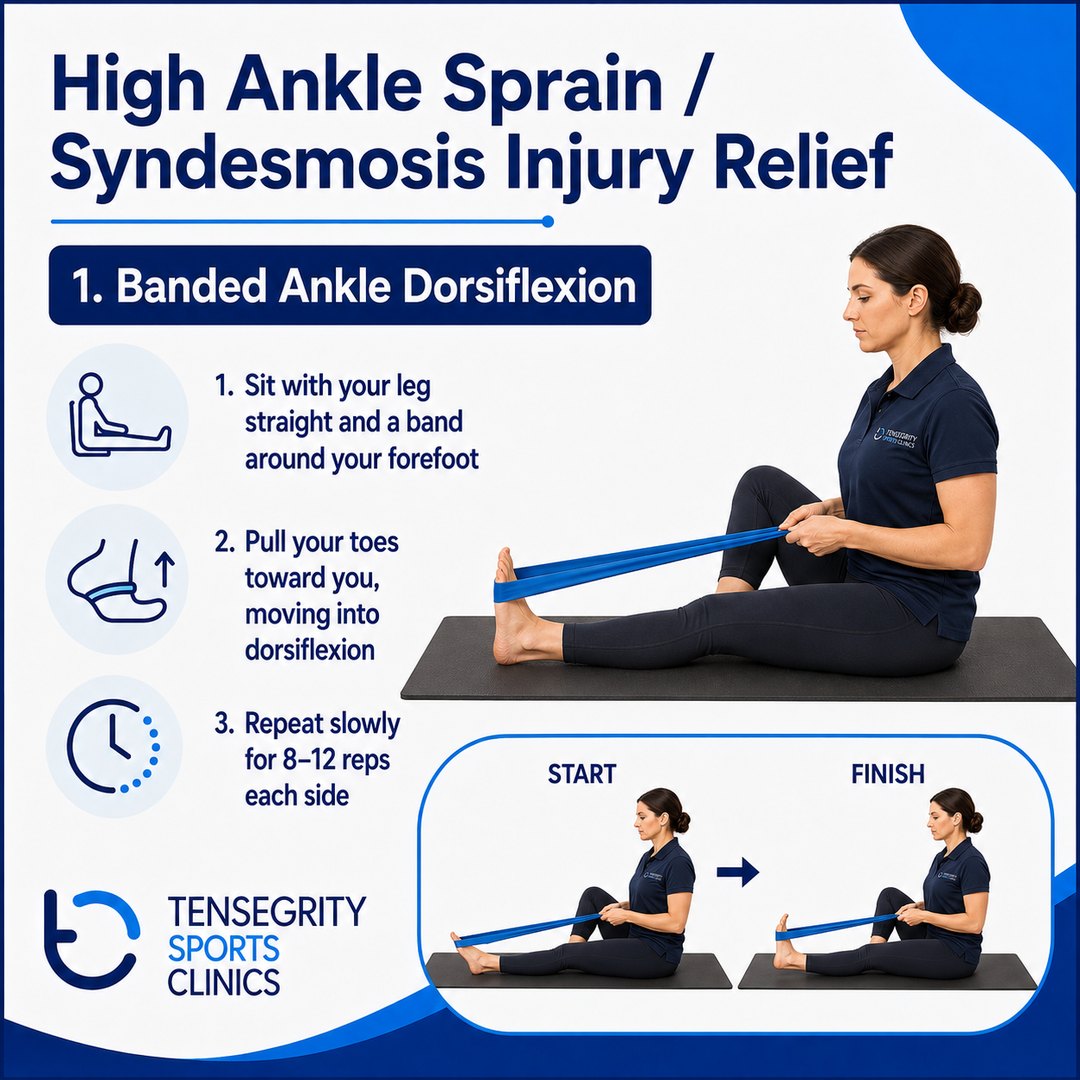
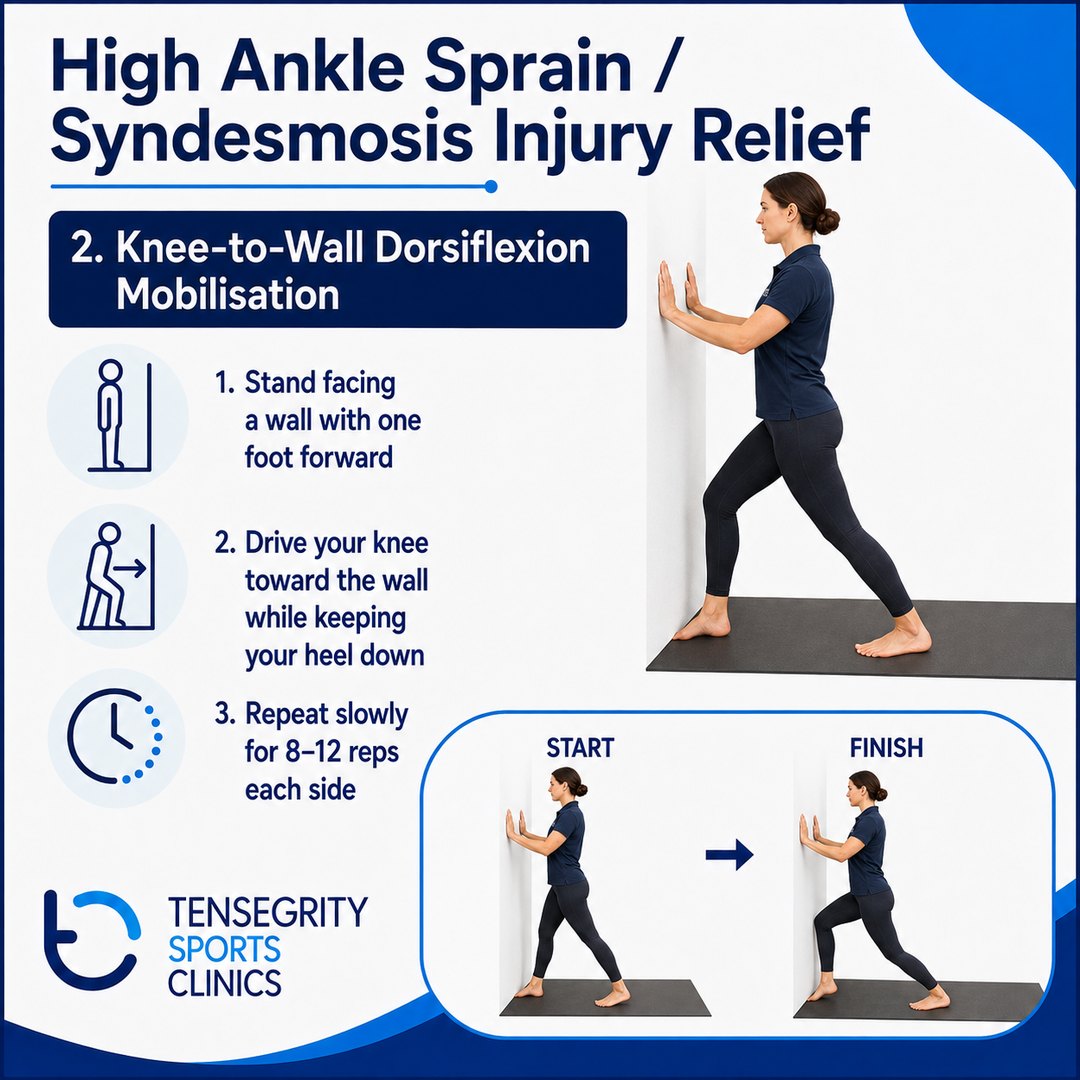
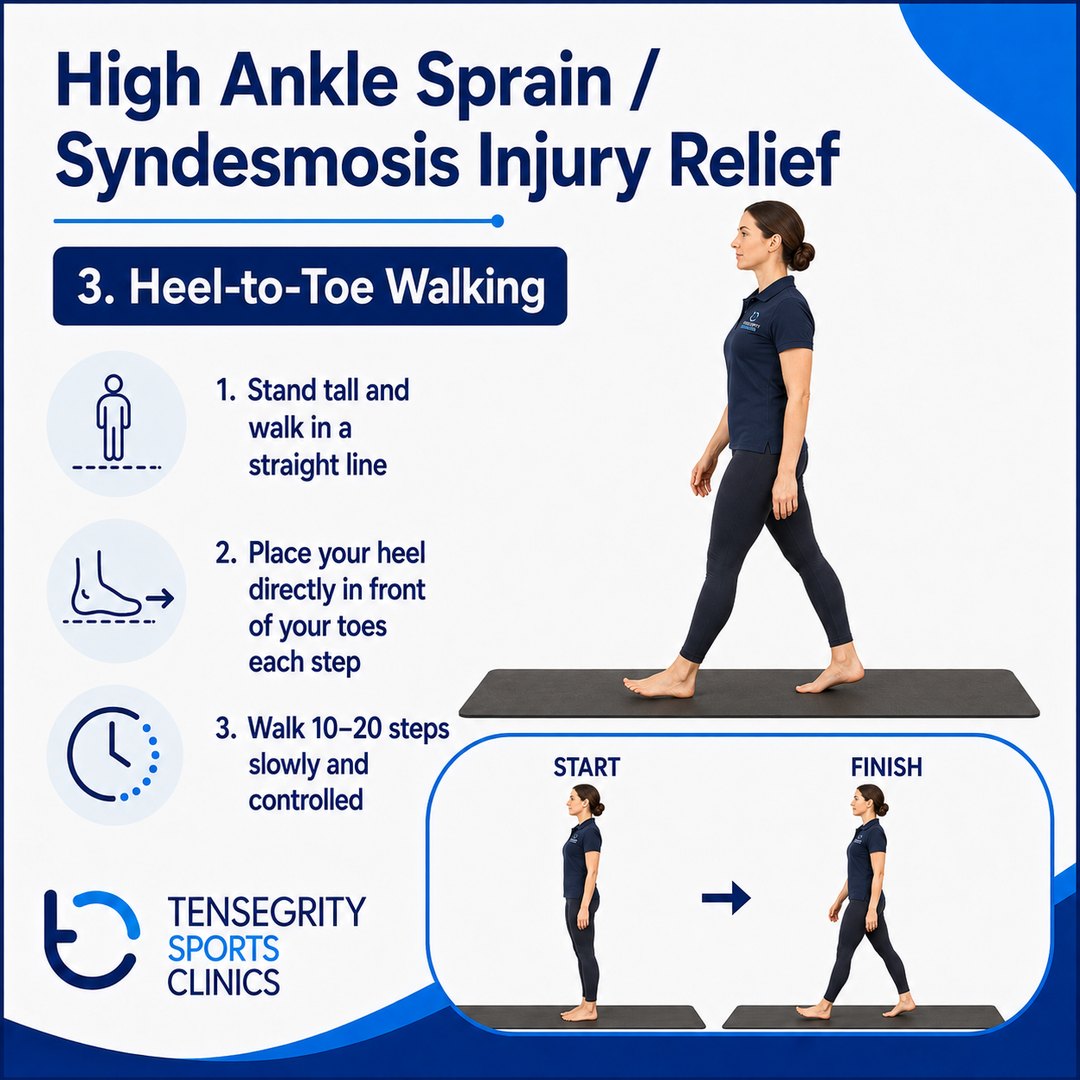
If the ankle is not tolerating weight, or the pain above the joint is not settling, book an assessment so the injury can be graded properly and the loading matched to it.
Prevention:
Prevention is mostly about ankle and hip control, since the mechanism is rotational.
- Include balance and change of direction work in your training, not just straight-line running.
- Build calf and hip strength, which control how the leg rotates over a planted foot.
- Return to contact sport in stages rather than going straight back to full match play.
- Rehabilitate a previous ankle sprain properly, since incomplete recovery raises the risk of the next one.
- Use appropriate footwear and check studs or boot fit for the surface you play on.
Outlook / Prognosis:
Recovery is slower than a standard ankle sprain, and setting that expectation early prevents a lot of frustration. A stable, lower-grade injury commonly takes six to twelve weeks to return to sport, roughly twice as long as a comparable lateral sprain.
Higher-grade or unstable injuries take longer and may involve surgical stabilisation, after which the rehabilitation program is structured around the surgeon’s protocol. Returning to sport before the ankle can tolerate cutting and pivoting under load is the most common reason symptoms drag on.