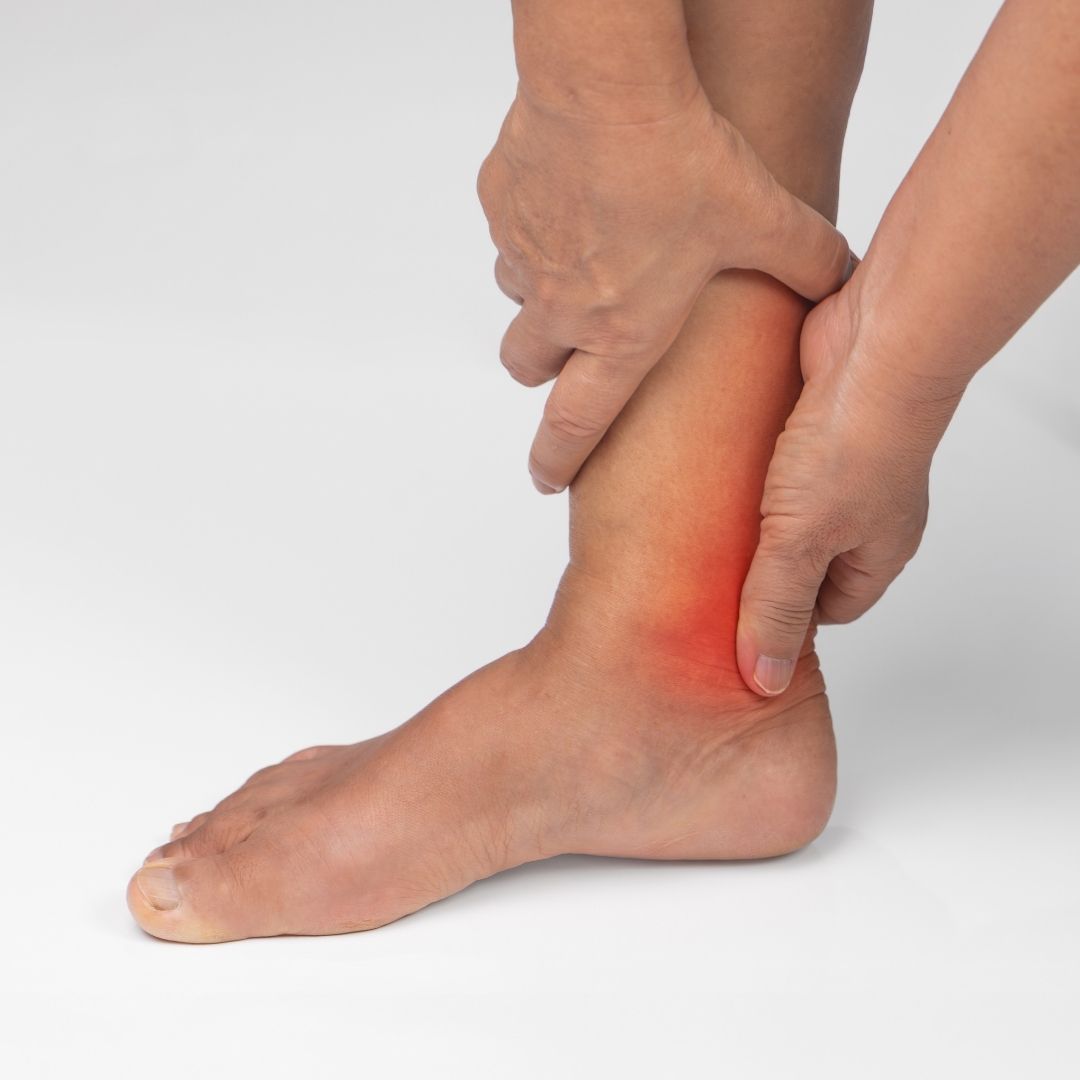

Overview:
Chronic ankle instability is the ankle that keeps giving way. It develops after an ankle sprain that never fully recovered, and it affects a large share of people who sprain an ankle, particularly those who returned to activity as soon as the swelling settled.
The giving way is not only a ligament problem. After a sprain, the nerve endings that tell your brain where your foot is in space work less well, and the muscles that should react to a stumble are slower to fire. That combination is why the ankle rolls again on flat ground, on a kerb, or in the dark.
Anatomy:
The outside of the ankle is held by three ligaments, the anterior talofibular, calcaneofibular and posterior talofibular. The first of these is the one most commonly injured in a rolled ankle.
Alongside the ligaments, the peroneal muscles running down the outside of the calf act as an active brake against the ankle rolling inwards. Both systems have to work. Ligaments provide the static restraint, and the muscles provide the reaction, guided by position sense from receptors in the joint and surrounding tissue.
Causes:
Instability is usually the consequence of an earlier injury that did not fully resolve.
- An incompletely rehabilitated ankle sprain: The single biggest factor. Returning to sport when pain settles rather than when control returns.
- Reduced position sense: The joint is less able to report where it is, so corrections happen too late.
- Weak or slow peroneal muscles: The active brake against rolling is not available quickly enough.
- Ligament laxity: Some people have naturally more mobile joints, which raises the demand on muscular control.
- Repeated sprains: Each episode makes the next more likely, which is how the cycle establishes itself.
- Reduced ankle bend: A stiff ankle changes how you land and load, shifting stress elsewhere in the foot.
Symptoms:
People usually describe the problem in functional terms rather than as pain.
- Repeated giving way, often on uneven ground, kerbs, or when tired.
- A sense of the ankle not being trustworthy, and avoiding certain surfaces or activities because of it.
- Recurrent swelling after activity rather than constant swelling.
- Aching on the outside of the ankle after being on your feet.
- Reduced confidence changing direction, which often shows up as slowing down before a turn.
Diagnosis and Tests:
The assessment looks at both the ligaments and the control system around them.
- History: How many sprains, how each was managed, and in what situations the ankle gives way.
- Ligament testing: Anterior drawer and talar tilt to assess how much laxity is present.
- Balance testing: Single-leg balance with eyes open and closed, compared side to side. This often reveals more than the ligament tests.
- Strength testing: Peroneal strength in particular, comparing the two sides.
- Movement screening: Hopping, landing and change of direction, watching how the ankle and hip behave under load.
- Imaging: Not usually needed. X-ray or MRI is reserved for suspected fracture, cartilage injury, or a bone bruise when symptoms do not fit the picture.
Management and Treatment:
The evidence here is strong, and it points firmly towards active rehabilitation rather than bracing alone.
- Balance and proprioceptive training: The most effective single component. Progressed from stable to unstable surfaces, then to eyes-closed and distracted conditions.
- Peroneal and calf strengthening: Rebuilding the active brake, including work at speed rather than only slow controlled reps.
- Restoring ankle bend: Improving how far the knee can travel forward over the foot, which changes landing mechanics.
- Hip and trunk control: The ankle is the end of a chain, and poor control higher up increases the demand on it.
- Bracing or taping: Useful during return to sport as a bridge, not as a substitute for the strength and balance work.
- Surgical opinion: Considered only where instability persists after a genuine course of rehabilitation, and where ligament laxity is significant on examination.
- Medication and injection-based options: These sit outside a chiropractor’s scope of practice. If pain is limiting your sleep or stopping you starting rehabilitation, that is worth discussing with your GP rather than self-prescribing long term.
Three exercises for chronic ankle instability
These three were put together by our practitioners as a starting point. They are general exercises, not a personalised program.



If the ankle keeps giving way, or you have stopped trusting it on uneven ground, book an assessment so the balance and strength work can be matched to what the ankle can currently handle.
Prevention:
Almost all of this is about how the first sprain is managed.
- Rehabilitate an ankle sprain to the point of restored control, not just until the pain stops.
- Include single-leg balance work as a routine part of training, particularly in court and field sports.
- Add change of direction and landing work before returning to full match play.
- Use a brace or tape for the first season back after a significant sprain, alongside continued strength work.
- Address a stiff ankle rather than working around it.
Outlook / Prognosis:
Balance and strength training works. Most people see a meaningful reduction in giving way within eight to twelve weeks of consistent work, and the effect holds as long as some of the training continues.
The main reason people do not improve is stopping too early, because the ankle feels better before the control has actually been rebuilt. Where genuine ligament laxity persists after a full rehabilitation program, an orthopaedic opinion on reconstruction is reasonable, but that is the minority.